• about
  • projects
    • Beach Loft Interior Design
    • Contact Conference
    • Emerging Leader Labs
    • Junto
    • Open Foresight
    • The Future of Money
      • future of money, cont.
    • The Future of Facebook

emergent by design

Author Archives: Venessa Miemis

An Idea Worth Spreading: The Future is Networks

16 Tuesday Mar 2010

Posted by Venessa Miemis in Uncategorized

≈ 342 Comments

Tags

social evolution

Add to FacebookAdd to DiggAdd to Del.icio.usAdd to StumbleuponAdd to RedditAdd to BlinklistAdd to TwitterAdd to TechnoratiAdd to Yahoo BuzzAdd to Newsvine

This weekend I experienced a snowcrash; a moment where the seemingly disparate pieces of information floating in my head came together. A synapse fired, a new connection was made, and I was brought to a new level of consciousness, a new way of seeing the world. In reading this over, it almost sounds obvious, but it took me a while to get here. I hope that by sharing with you, it’ll help you “get it” too. So let me take you on my thinking trail.

Insight #1: The Overview

The Future is Networks.

This idea has been buzzing in my head for a long time. The first time I wrote it down was over a year ago, not really understanding what that meant, but it was an “intuition.” As time has gone by, this has seemed more and more probable, but I wasn’t sure how it fit together.

The buzzing has been growing louder, and my mind was saying, ‘The future of Social Business is networks,’ ‘The future of education is networks,’ ‘The future of society is networks.’

What did this mean?

I know everyone is busy. Everyone is looking for some solution to how to make their situation better. If you will just bear with me, I’m going to expose you to what I found to be an incredibly powerful idea. Continue reading →

#metathink monday experiment: The Power of Twitter

15 Monday Mar 2010

Posted by Venessa Miemis in Uncategorized

≈ 23 Comments

Tags

community

Add to FacebookAdd to DiggAdd to Del.icio.usAdd to StumbleuponAdd to RedditAdd to BlinklistAdd to TwitterAdd to TechnoratiAdd to Yahoo BuzzAdd to Newsvine

Good morning, Infosphere!

Over the past few months, I’ve been wanting to set up “Metathink Mondays.” Essentially, once a week, post an insight or a question that we can all ponder and reflect upon, in the service of making us smarter. Then, I’ll collect all the feedback, assemble it into another post or ebook that would be like an ‘insight report’ for all of us. We’ve done this once before, but I know we’ve all grown since then, so I’d like to revisit the topic.

What’s Metathinking?

So, if you haven’t been following along here, I’ve been working on this concept I’ve dubbed “metathinking,” or “a way of figuring out what the hell is going on.” We’re surrounded by all these streams of information, complexity, and accelerating change, and just trying to find a way to keep up. Well, there’s no way of “keeping up” – it’s flowing and it’s only getting faster. But there is a light at the end of the tunnel that will keep us from drowning. As Clay Shirky put it, “It’s not Information Overload. It’s Filter Failure.” While the programmers and engineers improve the quality of search, we need to be doing the same – but not with code, with people. Continue reading →

Framework for a Strengths-Based Society

09 Tuesday Mar 2010

Posted by Venessa Miemis in Uncategorized

≈ 89 Comments

Tags

Design, Work

Add to FacebookAdd to DiggAdd to Del.icio.usAdd to StumbleuponAdd to RedditAdd to BlinklistAdd to TwitterAdd to TechnoratiAdd to Yahoo BuzzAdd to Newsvine

The world as we know it is in disruption. Maybe it’s always been in disruption, pushing us through cycles of apparent chaos so that evolution can continue and new paradigms emerge. Thanks to social technologies, we’re growing into a globally connected communication system, and seem to be heading towards a tipping point. But what is it that we’re transitioning to?

Maybe we’ve forgotten the bigger picture. The Web was never intended to be about marketing, banner ads, and spam; it was intended to be about learning, sharing resources, and attaining a deeper level of understanding of each other and the world around us. The latter is happening, albeit slowly. I wonder if reframing the experience might help us accelerate the process.

I’ve been thinking about what that would look like, and what it is we’re really trying to achieve. I just read a piece on Edge by David Gelertner, titled ‘Time to Start Taking the Internet Seriously.’ In it, he provides an overview of “where we’re at” with the Web – a world of information, activity streams, and NOW; flooded and drowned by immediacy:

The Internet increases the supply of information hugely, but the capacity of the human mind not at all.

I think he grazed over an incredibly important idea, but never went further to develop it. Earlier in the piece, he said something that also hints at this “big idea”:

It has always been harder to find the right person than the right fact. Human experience and expertise are the most valuable resources on the Internet — if we could find them.

So the information is only half the battle. Now we need people to filter and understand it.

Over the past few years, I’ve spent a lot of time on the web; reading, learning, watching. Only in the past six months have I decided to experiment with intentionally growing a personal learning network. I’ve written before about how I’ve been using Twitter for personal growth (How to Use Twitter to Build Intelligence), and now I’m focusing on how to build the social capital within my network through “network weaving” and what could probably be referred to as “targeted sharing.”

I’m becoming convinced that this is the purpose of the web: to use it as a tool to enhance both ourselves and the network.

I think the web, in it’s nowness, has tricked us into a constant state of reaction. The information is streaming all around us, and without a focused mindset of intentional purpose in place, we are not in control. Even as we’re posting (which we often confuse with ‘creating’), what we post is usually in reaction to something else, or worse, an echo of it. In our social networks, we’re weaving intricate representations of our identities, posting our interests, photos, and status updates – but these are not ‘creating’ either, but rather asserting. “THIS is who I am. THIS is what I’ve done.” None of these things are creating.

I think, as a society, we have lost ourselves.

The Internet didn’t cause the degradation – we’ve been slowly breaking down for decades – but the Web may be pushing us in the wrong direction because of how the experience is framed. Everything is about the information “out there,” how to search it, filter it, and tag it. But where does that leave US?

I’ve danced around this subject for months, not knowing quite how to bring it forward. But perhaps what’s needed is to be blunt. Before we can hope to advance forward as a species, I think we should turn the focus away from what exists out there, and instead turn inwards and look at ourselves.

I see the web as a tool for evolving our consciousness. Not just to be more present or mindful, or more empathetic, but to actually develop to be more fully human. We must understand the implications of our human agency, and learn to cultivate the forces inherent within us that enable us to impact the world.

I’ve been thinking a lot about tagging, and folksonomies, and shared language, and found it interesting that in our obsessive desire to label literally every thing around us, we haven’t yet thought about how we define ourselves. (And I don’t count a Twitter bio of ‘social media expert’ as self-defintion).

I’m talking about really reflecting on our Strengths, the combination of things that make each of us both unique and united. There is currently no tool or app out there of which I’m aware that would allow us to describe ourselves and each other in a way that puts a focus on self-development and social capital amplification.

If we shifted the way we talked about ourselves, would there be a shift in our ability to grow? And further, would it help us to assemble dynamic teams and find the kinds of people we need in order to launch initiatives and take action?

As we become more interconnected and accessible, we need to be able to search for each other not only by topic of interest, but by the types of people with whom we’d like to collaborate. I imagine an index that would travel with us around the web, comprised of our strengths, our skills, and our social connections. As networks take precedence in the way we orient ourselves on the web, it will be useful to have visual maps of how we’re connected. Our personal skill sets, knowledge, and expertise will become our virtual resumes, constantly updated and vetted in real time. And our strengths are our underlying ‘human factors’ that act as the foundation for our personal operating systems. This might emerge as a visualization, or possibly as a series of tag clouds. Here’s a few examples of the types of words I think would be used in a “social tagging system.”

[Update: A tag cloud is just one example of what it could look like. It’s hard to put things that may boil down to ‘tacit knowledge’ into words. Another way this could go is via images, like archetypes or badges.]

I think we’ve suffered too long in fitting ourselves into roles and job descriptions instead of choosing to operate in accordance with our strengths. If we define ourselves by a job title, we attach ourselves to prestige, influence, and power. We compete for limited positions, and discard our true selves in place of fitting a mold.

But what happens now that we live in an era where our knowledge, creativity, and ingenuity are being acknowledged as the source of our wealth? What happens when we exchange value as a result of the limitless potential of our strengths? If we shifted the focus, we could each be allowed to develop and excel in the ways we’re naturally inclined to do. If we know what those strengths are and how to harness them, we’ll be able to use the Web more effectively as a tool for learning and for collaboration.

It will take a combination of self-awareness, self-assessment, and some soul-searching, but I think this is a key element in honing ourselves so we can benefit from our collective intelligence. I think it starts with developing a shared language of how we want to define ourselves, and which strengths and values we want to cultivate as we push society to the next level.

There is no longer a scarcity of information. We’re saturated by it. What we need to know now is how to combine the people together who will know how to use it.

#

From the Twittersphere

@ehooge: recommended The Oxford Muse

The Change Journey

research: You Are Who You Know: Inferring User Profiles in Online Social Networks

What Could the Future of Money Look Like?

09 Tuesday Mar 2010

Posted by Venessa Miemis in Uncategorized

≈ 135 Comments

Tags

commerce

Add to FacebookAdd to DiggAdd to Del.icio.usAdd to StumbleuponAdd to RedditAdd to BlinklistAdd to TwitterAdd to TechnoratiAdd to Yahoo BuzzAdd to Newsvine

We’ve been having a robust discussion around the idea of social capital over the past few days, and as the thread now contains over 100 great, thorough comments, I just want to create the opportunity to keep the thoughts flowing. For anyone just jumping in, if you’d like to get the background context, grab a coffee and read through Social Capital is not the same as Whuffie. If you’re short on time, here’s a brief summary:

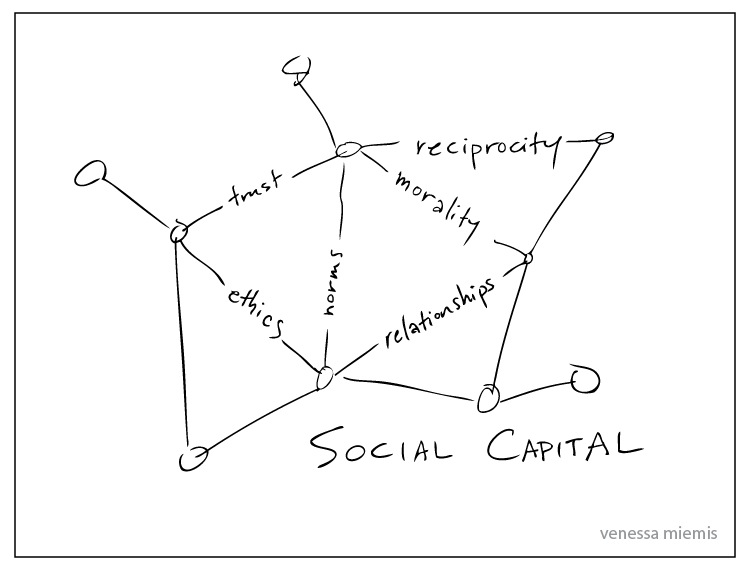
Social capital is a term to describe the embedded value within a network. Some can be misled to assume it has a direct exchange-value because of our current association with what “capital” means. In fact, it cannot be the property of a single individual, but rather the property of a network, a commons, or a community – however you’d like to think of it. So what is it? Think of it as the foundation upon which a healthy, collaborative society is built. It’s comprised of trust, connectedness, interdependence, reciprocity, and social norms. (For instance, If you think of the current lack of trust society has in our financial institutions, you’ll see the correlation with the stability of our economic system.) Individuals contribute to the strength and depth of a society’s social capital through their actions and behaviors, but cannot individually possess it.

So if we hit the reset button, wipe away our assumptions, and think about a truly new economy – what is the mechanism for us to exchange value? Continue reading →

Social Capital is not the same as Whuffie

06 Saturday Mar 2010

Posted by Venessa Miemis in Uncategorized

≈ 153 Comments

Tags

social organization

Add to FacebookAdd to DiggAdd to Del.icio.usAdd to StumbleuponAdd to RedditAdd to BlinklistAdd to TwitterAdd to TechnoratiAdd to Yahoo BuzzAdd to Newsvine

I recently read a post by Brian Solis titled Social Capital: The Currency of the Social Economy, which served as the catalyst for one of the most entertaining Twitter conversations I’ve had so far. I personally had a problem with the way the term “social capital” was used in the piece, which was inspired by the definition given to it by Tara Hunt in The Whuffie Factor. The reason I had a problem was that “social capital” already exists as a sociological concept that’s been in development for many years, and to now boil it down to an equivalent to “reputation” didn’t seem appropriate. And so I tweeted the sentiment. A lively discussion ensued with all kinds of people chiming in, including Brian Solis and Tara Hunt themselves. (Even Umair Haque from the Harvard Business Review made a cameo appearance. fun!) Continue reading →

Why do you share?

04 Thursday Mar 2010

Posted by Venessa Miemis in Uncategorized

≈ 11 Comments

Tags

culture

Add to FacebookAdd to DiggAdd to Del.icio.usAdd to StumbleuponAdd to RedditAdd to BlinklistAdd to TwitterAdd to TechnoratiAdd to Yahoo BuzzAdd to Newsvine

Over the past few weeks, we’ve been building out the idea of how to facilitate innovation within organizations. My proposal includes a revealing of the social network structure of an organization, breaking down silos between departments, sharing knowledge and information, and amplifying people’s natural strengths and talents.

I’ve been thinking about the sharing aspect the past few days, and why it shouldn’t be so hard to create an environment that encourages it.

As is usually the case, the topics I’m focused on suddenly appear all around me and bring me new perspectives and insights. In the past few days, there’s been a new meme – the Social Learning Snake Oil Salesman. The first post I noticed, Social snake oil, came from Harold Jarche, a practitioner in creating collaborative learning environments in the enterprise. He talked about how the field of Knowledge Management was “hijacked” by software vendors trying to sell it as an IT solution, and social learning is on the path to the same fate.

As soon as the software vendors and marketers get hold of a good idea, they pretty well destroy it.

Now social learning is being picked up by software vendors and marketers as the next solution-in-a-box, when it’s more of an approach and a cultural mind-set.

Since then, I’ve seen several others within the field echoing these sentiments, leading me to think about this a little more deeply.

[As a quick aside, here are a few people worth checking out if the concept of social or informal learning is new:

Harold Jarche – Learning and working on the web (@hjarche)

Jay Cross – Internet Time Wiki (@jaycross)

Jane Hart – Social Media in Learning & Center for Learning & Performance Technologies (@c4lpt)

Jon Husband – Wirearchy (@jonhusband)

Dave Snowden – Cognitive Edge (@snowded)

Charles Jennings – performance.learning.productivity (@charlesjennings)

Clark Quinn – Quinnovation (@quinnovator)

John Seely Brown John Seely Brown (@jseelybrown)

Also, check out the #km hashtag on Twitter for links to more useful content on knowledge management and learning.]

So, why the attack on social learning? I feel like I’m seeing this same pattern emerging with Design Thinking Snake Oil, and it’s frustrating to see a good thing so badly abused. Companies seem to want to implement a quick and easy solution that will solve their organizational issues, not realizing that what’s needed is not a patch for a faulty system, but rather a new system. Banking on the power of buzzwords only puts money into the pockets of consultants and marketers. At the end of the day, you’re out a couple grand, and your organization is still in trouble. These words are just the packaging – the underlying solution is a shift in culture and thinking.

Facilitating collaborative learning doesn’t have to be overcomplicated. Trying to formalize informal learning misses the point. When it comes down to it, we want to create environments that allow people to grow. There has been plenty of research linking learning with improvements in workplace performance, productivity, loyalty, and happiness.

Why?

I was reminded of the premise Daniel Pink put forward in his new book, Drive. Based on several decades of scientific research, he identifies three elements of human motivation: autonomy, mastery, and purpose. Not surprisingly, these things are all tied to learning – from learning how to make informed decisions, to honing skills and working towards expertise, to discovering and developing inherent strengths and talents. People want to grow. People want to feel remarkable. And people want to participate in behavior that both enhance themselves and their networks. We like to share.

I decided to do some ethnographic research on this topic and asked you on Twitter: “Why do you share?” The responses are below, and show how very human we are.

Pay attention, Enterprise. Social learning isn’t something you have to gnash your teeth over and figure out how to “enforce.” Learning literally makes the soul rejoice. Set up the environment, encourage the culture, and watch what will happen.

#

@jeff_dickey Why share? So people learn, and other people learn that not everybody is happy to go along with the status quo.

@SemiraSK “shared joy doubles joy” as the Germans say :))

@KathyHerrmann Sharing = Connecting, companionship, discovery, extending, excitement, richer experience.

@jankoch The short answer is love

@petertwo I share because … others may obtain value … it is a natural act (aka @WestPeter)

@Cekent I share in order to receive what others share. For me it is reciprocity, not sharing.

@cole_tucker i #share because it connects me with others and brings forth more from each of us

@AndreaMeyer it’s fun &rewarding 2 share info that’s useful 2 others; engage w/ new folks worldwide, learn new things, laugh, build future

@fadereu “We’ll transmit in order to receive.” – Nikola Tesla

@renatalemos there´s such a joy in discovering, that sharing this joy becomes part of its excitement

@ScottLeamon Sharing is almost instinctual. What I find is more curious why some do not share.

@Tomgibbonstms It is an expression of identity which I think is the purpose of all behaviour…

@jwolfworks Share? to: expand the commons, connect others to valued ideas, become acquainted, inspire, help cream rise, reveal my thinking- then receive

@MarkTamis to hone my ideas thru exchange

@sanchezjb A belief that the information shared may help or benefit someone and in turn, may help make a difference somewhere, someway.

@chris23 All psychological speculation aside, I am simply compelled to share. This, to me, is a deep & natural instinct.

@Strng_Dichotomy we share w others 2 provide level of confidence that our work will b treated w respect. sharing and relationship are coupled

@jazzmann91 I share so that I don’t become completely invisible… 🙂

@DanielStocker for feedback and to give back

@bioZhena Trying to connect with those who need what we have, and with those we need to get our tech to market

@AmandaClay I share because I can’t help it. I need to distribute good information to people who might want it. I’m a librarian.

@HowToMakeMyBlog it just feels good to share good and educating material to other people, why keep it secret?

@ehooge A first question should be: what do I share? As I like to share things that sharing increases ie: knowledge, love, happiness

Are We Becoming Our Own Puppetmasters?

28 Sunday Feb 2010

Posted by Venessa Miemis in Uncategorized

≈ 31 Comments

Tags

Social Media

Add to FacebookAdd to DiggAdd to Del.icio.usAdd to StumbleuponAdd to RedditAdd to BlinklistAdd to TwitterAdd to TechnoratiAdd to Yahoo BuzzAdd to Newsvine

What do our online personas do to our physical-world identities? As we invest more time into developing our digital selves, is something taken away from who we are? Or something added? If you’re reading this, you spend some portion of your life online, and probably maintain an online identity or two across the various social networks. How does the creation and maintenance of those identities change your physical experience of self?

I’m curious if our participation in social networks, and specifically in creating our online identities, is creating an opportunity for us to lose our agency. We seem to relish the ability to carve out of online personalities and post an unlimited amount of information about ourselves, thinking that it is in some way a declaration of our existence and importance. I wonder if it has the opposite effect. Companies are profiting off of selling the data that we so willingly produce for free, reducing us down to not much more than commodities. And we are quick to defend our personas as legitimate extensions of ourselves, engaged in meaningful interactions that take up an increasingly greater portion of our time, energy and attention. Are we drinking our own Kool-Aid? Continue reading →

What is an expert?

25 Thursday Feb 2010

Posted by Venessa Miemis in Uncategorized

≈ 73 Comments

Tags

culture

Add to FacebookAdd to DiggAdd to Del.icio.usAdd to StumbleuponAdd to RedditAdd to BlinklistAdd to TwitterAdd to TechnoratiAdd to Yahoo BuzzAdd to Newsvine

In the last post, we talked about a visualization tool that would allow us to tag ourselves and each other, and how that could be helpful for locating talent and sparking innovation. There have been great comments and ideas, and I want to continue that conversation in the next post. In the meantime, the concept of ‘expert‘ has been on my mind.

As I thought about the potential pitfalls of self-tagging, I couldn’t help but remember that article on mashable from December – There are 15,740 Social Media Experts on Twitter and wondered how we’ll get around this problem in the future.

Calling yourself an expert doesn’t make you one. Continue reading →

Tapping the Network to Facilitate Innovation

21 Sunday Feb 2010

Posted by Venessa Miemis in Uncategorized

≈ 80 Comments

Tags

Design

Add to FacebookAdd to DiggAdd to Del.icio.usAdd to StumbleuponAdd to RedditAdd to BlinklistAdd to TwitterAdd to TechnoratiAdd to Yahoo BuzzAdd to Newsvine

A few weeks ago, I noticed a contest on Stowe Boyd’s site to receive a free entry to the Social Business Edge conference coming up in April in NYC, and a chance to share the idea on stage. I just found out my entry is one of four that was selected. I’m copying it here, but I’d love to build it out with you:

How can the power and scope of social networks, combined with a human capital inventory, be used to facilitate shared creation and innovation?

It wasn’t that long ago that society was a byproduct of an industrial era, characterized by assembly lines, processes, and efficiency. Like the machines they operated, people were not expected to think, but to conform and become a cog – a replicable, interchangeable part of a machine. The problem is, humans weren’t designed for mechanization. We were designed to create.

With the rise of social tools, we’ve been publicly reclaiming ourselves – publishing blogs, joining social networks, and connecting and sharing information with each other on a global scale. As a result, a shift in values is underway, where privacy, gatekeeping, and the preference for information silos is being replaced with new expectations of publicy, openness and transparency. We’re still exploring the implications of this transition both for our personal identities and for the role of the business organization, but there’s the potential to redesign the system in a way that’s fair, participatory, and human.

But how? Continue reading →

The Importance of Managing Your Online Reputation

06 Saturday Feb 2010

Posted by Venessa Miemis in Uncategorized

≈ 63 Comments

Tags

reputation

Add to FacebookAdd to DiggAdd to Del.icio.usAdd to StumbleuponAdd to RedditAdd to BlinklistAdd to TwitterAdd to TechnoratiAdd to Yahoo BuzzAdd to Newsvine

Last week during #journchat, I saw a reference to a post titled Does Your Twitter Handle Belong on Your Resume? The author is a PR college student, and the conversation around the post is mainly tactical, but the bigger picture surrounding our online identities is one I’ve been wanting to address for some time, so this gives me the opportunity. I’ll briefly cover some basic points about the nature of online space, but then I want to dig into the opportunities that are available in a networked culture.
#1. The Web is made up of mediated publics.

I think the first time I heard the term “mediated publics” was in a paper written by danah boyd while she was still a PhD candidate. In it, she described social networks as a type of public space, but with four unique properties:

  • Persistence – What you say sticks around. This is great for asynchronous communication, but it also means that what you said at 15 is still accessible when you are 30 and have purportedly outgrown those childish days.
  • Searchability – My mother would’ve loved the ability to scream “Find!” into the ether and determine where I was hanging out with my friends. She couldn’t, and I’m thankful. Today’s teens’ parents have found their hangouts with the flick of a few keystrokes.
  • Replicability – Digital bits are copyable; this means that you can copy a conversation from one place and paste it into another place. It also means that it’s difficult to determine if the content was doctored.
  • Invisible audiences – While it is common to face strangers in public life, our eyes provide a good sense of who can overhear our expressions. In mediated publics, not only are lurkers invisible, but persistence, searchability, and replicability introduce audiences that were never present at the time when the expression was created.

A quick review of these characteristics serve as a good reminder that what you do/say/post online is effectively being done in public. When framed in this context, the results of much of the research being done around managing online information seem expected. For instance, take a look at this chart, taken from ‘Recruiters really care about your online reputation even if you don’t.’  The top five reasons mentioned here to reject a candidate for recruitment are things that would be equally inappropriate if done directly in front of that potential employer. Continue reading →

← Older posts
Newer posts →

abundance anti-rivalrous authority biohacking books cognitive enhancement collaboration commerce communication community consciousness consciousness & evolution consciousness hacking creativity creativity + design culture currency decor Design digital literacy ello entheogens ethics evolution flow futures innovation interview microdosing money money + currency neurohacker collective neurohacking neuroscience neurotech nootropics personal development philosophy projects psychedelics psychotherapy reputation Resources response-ability scarcity self smart drugs social evolution social innovation Social Media social organization society sovereignty style sustainability technology technology + society Trends Video vision willpower women Work workshop

Archives

Blog Stats

  • 1,122,085 hits

Enter your email address to subscribe to this blog and receive notifications of new posts by email.

Join 1,180 other subscribers

Top Posts

  • 5 Key Issues Impacting the Future of Facebook
  • Summary: The Postmodern Condition: A Report on Knowledge
  • A Step-by-Step Guide to Tribal Leadership: Part 1: The Five Stages of Tribal Culture
  • What is Design Thinking, Really?
  • Constructing the New Narrative

Recent Posts

  • What it Means to Be A Neurohacker
  • Using Psychedelics to Increase Performance and Reprogram the Mind/Brain Interface
  • Why the World Needs Neurohacking Now
  • The Neurohacker’s Toolbox: Nootropics
  • What is Neurohacking?
  • when the mind hijacks my flow state
  • what mental slavery looks like: repressive & reactive patterns
  • Constructing the New Narrative
  • i am a consciousness with a society of personalities
  • on the forcing of willpower & the art of relaxation

@venessamiemis

Tweets by venessamiemis

Emergent by Design

Emergent by Design

Recent Comments

Venessa Miemis's avatarVenessa Miemis on Why the World Needs Neurohacki…
Monica Anderson's avatarMonica Anderson on Why the World Needs Neurohacki…
Venessa Miemis's avatarVenessa Miemis on The Neurohacker’s Toolbo…
bonnittaroy's avatarbonnittaroy on The Neurohacker’s Toolbo…
What is Neurohacking… on What is Neurohacking?
Creative Commons License
This work is licensed under a Creative Commons Attribution 3.0 Unported License.
  • RSS - Posts

Blog at WordPress.com.

  • Subscribe Subscribed
    • emergent by design
    • Join 1,180 other subscribers
    • Already have a WordPress.com account? Log in now.
    • emergent by design
    • Subscribe Subscribed
    • Sign up
    • Log in
    • Report this content
    • View site in Reader
    • Manage subscriptions
    • Collapse this bar
 

Loading Comments...