• about
  • projects
    • Beach Loft Interior Design
    • Contact Conference
    • Emerging Leader Labs
    • Junto
    • Open Foresight
    • The Future of Money
      • future of money, cont.
    • The Future of Facebook

emergent by design

Author Archives: Venessa Miemis

How to Use Twitter to Build Intelligence

21 Monday Dec 2009

Posted by Venessa Miemis in Uncategorized

≈ 72 Comments

Tags

Social Media

Add to FacebookAdd to DiggAdd to Del.icio.usAdd to StumbleuponAdd to RedditAdd to BlinklistAdd to TwitterAdd to TechnoratiAdd to Yahoo BuzzAdd to Newsvine

intelligence: n. the capacity to acquire and apply knowledge

(this post is a group Twitter experiment – link to similar articles at bottom & share your own experience on Twitter with hashtag #MonTwit)

I’ve been thinking a lot about how we can leverage the potential of social networks in order to learn, facilitate innovation and solve problems. I’ve been experimenting with Twitter heavily for the past few months, and would like to share a few basic insights into what I’m discovering.

I started to tackle this a few weeks ago via a comment I posted on @briansolis‘s blog, so I’ll just expand on the main questions I laid out there:

  • What is Twitter?
  • How do you use it strategically?

Let me just start by saying I understand that Twitter is a communication channel that can be used in a variety of ways. Though there’s no ‘right’ way to use it, there may be ‘more effective’ ways, depending on your goal. This post is just intended to be an overview of ideas that have led me to change my own habits on Twitter, which has increased its value as a resource for me.

1. What is Twitter?

Getting started on Twitter is like walking into a crowded room blindfolded: you know there’s somebody out there, but you’re not quite sure who they are, where they are, or why you should care.

My initial Twitter experience was kind of like this: The 46 Stages of Twitter (here’s the educator’s version)

After digging deeper, I started to see patterns in the way information was traveling, and in the connections between the people I was following. Based on those observations, this is my current opinion:

Twitter is a massive Idea & Information Exchange.

Imagine if the resources you wanted in order to build your knowledge base and hone your thinking skills were available in one “place.” Imagine if there were a better way than a Google search to connect with the people, opinions and ideas you’re interested in – whether these are your customers, your colleagues, or the thought leaders you respect most within a field. Then imagine you could assemble these people into a network around yourself or your company’s brand in order to get a pulse on what’s important to you.

This is the potential of Twitter.

Granted, there is a TON of noise. I’m not suggesting that Twitter is a utopia where it’s possible to get 100% pure relevant content to what you want to know all the time. BUT, there is a tremendous wealth of information and human capital out there that is certainly worth exploring. Businesses are finding it’s useful for interacting with customers and gauging public opinion, educators are collaborating with one another and integrating it into their “personal learning networks (PLNs),” and individuals are using it to find out more about specific interest areas.

I read a piece recently by Howard Rheingold titled Twitter Literacy, in which he said:

Twitter is not a community, but its an ecology in which communities can emerge.

I think that’s a good way to look at it. Twitter consists of literally millions of pieces of info that are streaming all day every day, ranging from the profound to the absurd. At first I tried to organize a way to catch the best information, but that seems impossible. You simply can’t keep up with the content flow and catch everything. Then I started to analyze where the ‘best’ information was coming from, who the people were tweeting it, and who their connections were.

This changed everything for me.

Once you know what you’re looking for, you start to notice that certain people keep popping up in relation to certain information; you start to notice the networks of people they talk to, and you realize that there are thousands of loose, informal communities that are existing within this larger ecology of information.

2. How do you use it strategically?

Twitter’s not just about the information, but about the people creating and circulating the information. The key seems to be a combination of figuring out who to follow and how to engage with the people following you.

At first I thought that the more people I followed, the better chance I had of seeing something ‘good’ pass through my stream. Not the case. Instead, it just increased the amount of noise, while making it very difficult to see who was actually bringing me value.

So I decided to do an overhaul. I asked these two questions:

  • Who am I and what information am I trying to get?
  • What information am I bringing to the table?

Me: I am a Masters Candidate researching emerging media technology and its impact on society and culture. I’m particularly interested in how people are interacting on Twitter, and how it’s being implemented in business and education. I’d like to get the perspectives of practitioners, thought leaders in the social media sphere, systems theorists, futurists, and researchers in complexity, knowledge management, neuroscience, and human behavior. All I bring to the table is a hopeless curiosity, an analytical mind, and a desire to share my findings with whoever might be interested.

When I framed my purpose in that way, I feel like I woke up.

I think this is the first step in really benefitting from Twitter. Knowing who you are, and who your intended ‘audience’ is. I think this applies both at a personal level (like in my case) or if you’re a business.

For the better part of two weeks, I went through each and every person I followed, evaluating why we were connected and how we were bringing each other value. I scrolled through their tweets, and I asked myself “Am I compelled to click through on any of these?” If the person’s interested weren’t directly related to my research area, the answer was usually no, so I unfollowed.

For everyone else, I organized them into lists. This had absolutely nothing to do with a popularity contest, but was rather a learning experience. By forcing myself to put people into lists, it really made me focus on who each person was, and what their ‘specialty’ was. I combined some lists when they made sense. (I combined my “Social CRM” & “Community Management Strategy” lists in with the “Social Business Design” list.)

[I have a list titled “metacogs” that some people have asked about, so let me give a quick definition. I’m wordsmithing, so you won’t find it in a dictionary. I’m using it as a derivative of the word “metacognition“,  which means ‘thinking about thinking’ or ‘awareness of the process of learning,’ and combining it with the ideas of ‘design thinking,’ futures thinking,’ and lateral thinking. Generally, it means “process thinkers.”]

Once I got down to following around 850 people, a few amazing things started to happen.

1. I began to see how the people I follow are connected, and also noticed the basic makeup of the various communities that I had been following all along.
2. Because I realized that many people I was connected to were in fact connected to each other, I was able to start making some tweets specifically geared towards them and their community.
3. I actually began engaging MORE with the people I unfollowed!

This last one really surprised me and has changed my entire opinion about following. I remember having read a post by Guy Kawasaki called How I Tweet, where he said he followed everyone back out of common courtesy. That made me feel like maybe I was being mean for not following everyone back, so I originally followed his advice. But now I see things differently and have come up with my own method that works for me.

Now I’m following people who tweet within a specific topic area most of the time, but I’m engaging with EVERYONE who talks to me. I’m finding a lot of people who I don’t follow (but follow me) will send me an @reply in response to something I tweet, whether as a response to a comment or even to share a related link with me. I’ve been loving this. Because I’m researching under a big umbrella of areas, my tweets cover a broad range that isn’t going to be interesting to everyone all the time. But, when something DOES resonate with a particular person, they have the opportunity to respond to me about it, and a conversation begins.

Then someone else might respond to THAT tweet, and the conversation continues. And it literally feels like a temporary community forms around an idea. Input starts coming in from many different people, with various opinions and perspectives. This goes on for a few tweets, and then without any formal ending, we all just kinda move on.

This is starting to become the way I’m experiencing Twitter.

So what?

Well, now that I see Twitter differently, it’s shaping my user habits. I’m trying to fill each tweet with context and value. If I’m replying to a specific person, and don’t have more to say than “thanks” or “lol” or something short like that, I send it via DM. I try to think about how each public tweet appears to others, and how to structure it as an opportunity for a conversation to start.

In this way, I feel like I’m making my personal tweets more valuable to others, and in return, more people are engaging with me. It’s a positive feedback look, and it’s incredible.

Whether you’re using Twitter for personal use or to serve as the gateway to your brand, I think that approaching it with the above ideas in mind might be useful in deciding what to tweet and how to engage your audience.

I have more thoughts on all of this, but I’d like this to be a start, and to see what everyone else thinks! Thank you to everyone out there for helping shape my experience. Now that I’m seeing what is possible, I’ll be curious to see how we can put more intentionality behind our tweets and interactions. Looking forward to the continued journey with you!

– @venessamiemis

Here’s a little blurb of me discussing these concepts for IdeasProject:

And here are the links to everyone else posting on this topic today. I’ll keep this list updated:

@ekolsky – What I’ve Discovered about Twitter

@mauricioswg – What I’ve discovered about Twitter

@prem_k – What I’ve discovered about Twitter

@MarkTamis – What I’ve discovered about Twitter

@mjayliebs – What I have discovered because of Twitter

@timkastelle – What I’ve discovered about Twitter

@wimrampen – Sharing personal discoveries about Twitter

A futurist’s view of the “next big thing” in social media

17 Thursday Dec 2009

Posted by Venessa Miemis in Uncategorized

≈ 8 Comments

Tags

Social Media

Add to FacebookAdd to DiggAdd to Del.icio.usAdd to StumbleuponAdd to RedditAdd to BlinklistAdd to TwitterAdd to TechnoratiAdd to Yahoo BuzzAdd to Newsvine

this interview originally appeared on {grow}

Venessa Miemis’ Twitter bio describes her as a “Metacog, futurist and thought architect tracking emerging media and technology trends & impacts.”  Now THAT got my attention.

Currently pursuing a masters degree in New Media Studies at the New School in NYC, she  has been passionately thinking and writing about the future for seven years. Venessa kindly agreed to an interview and I found her views on the connections between social media and education, politics, global community and our future to be one of the most thought-provoking posts I’ve featured here on {grow}. I think you’ll agree:

What is a futurist and how do I get a job like that?

A futurist’s role is to help people anticipate, plan for, and adapt to change. This means tracking emerging trends and seeing how they fit into the big picture and envisioning different scenarios for what might come next. You could call this “developing foresight.”   It’s a skill set that’s in pretty high demand these days.  Things are changing rapidly and everyone is looking for ways to stay ahead of the curve.

At the professional level, futurists are hired by organizations to help them understand the forces and trends shaping their industries, and anticipate the changing needs and desires of their customers in order to stay competitive.  At the individual level, each of us constantly thinks about our own goals and dreams and develops strategies that will help us accomplish them … so in some sense, we’re all futurists.  I do think we’re in a very transformative period in history, and we all need to hone our “futures thinking” skills in order to actively participate in the process of shaping our collective future, instead of just being a passive bystander. Continue reading →

The Next Evolution of the Web – On Immediacy & Authority

07 Monday Dec 2009

Posted by Venessa Miemis in Uncategorized

≈ 18 Comments

Tags

Social Media

Add to FacebookAdd to DiggAdd to Del.icio.usAdd to StumbleuponAdd to RedditAdd to BlinklistAdd to TwitterAdd to TechnoratiAdd to Yahoo BuzzAdd to Newsvine

I just finished reading a recent post by Jeff Jarvis titled, Media after the site, which explores two ideas – what the next phase of media will be, and how we’ll determine which information to trust. I think he put together some good thoughts, but I’d like to expand on them.

Jarvis starts with a vision of the next evolution of media:

The next phase of media, I’ve been thinking, will be after the page and after the site. Media can’t expect us to go to it all the time. Media has to come to us. Media must insinuate itself into our streams.

He proposes that this idea is personified in @stephenfry, a guy with a huge Twitter following that has built a brand out of himself – via the content he creates, which then spreads and finds its niches by getting retweeted and distributed by his followers. The idea is supplemented with a quote from a NYT story:

If the news is that important, it will find me.

He identifies this as a shift in the role and function of information on the web – that ‘the website’ will become more of an archive for information, but it will constantly have new life breathed into it when it enters the ‘stream’ of the real-time web:

Content will insinuate itself into streams and streams will insinuate themselves back into content. The great Mandala.

I think Jarvis made some good observations, but I think there’s a bigger picture to be considered. I’m going to rephrase his observations in a larger context:

The real-time web has changed the way we access and distribute information.

I’ve been fleshing out these ideas over the past few months, and I think looking at Jarvis’s points through the lens of the 3 key drivers of the web’s evolution brings a bit of clarity. Historically, as complexity increases, we develop new methods of sifting through all the information – to separate quality content from noise. It’s no different on the web. There are millions of blogs and sources of news and information, but how do we get to the gooey caramel center of stuff that matters to us? Continue reading →

Thoughts on the Future of Work

03 Thursday Dec 2009

Posted by Venessa Miemis in Uncategorized

≈ 3 Comments

Tags

Work

Add to FacebookAdd to DiggAdd to Del.icio.usAdd to StumbleuponAdd to RedditAdd to BlinklistAdd to TwitterAdd to TechnoratiAdd to Yahoo BuzzAdd to Newsvine

This article is cross-posted on unstructure, in response to Julian Birkinshaw’s post, Will the role and influence of the employee be different in the new world of work?

Berkinshaw’s article focuses heavily on analyzing motivation and its drivers as an approach to discussing new management models. Defining motivation and breaking it down into categories is fine, but as Marc Buyens (@mbuyens) said in the comments section, it may be a way of overcomplicating a relatively simple concept.

We know that humans are driven by some motivation for every action that is taken. In terms of how to motivate workers, it seems like it can be simplified into a sentence:

People want to perform work that matters to them. Continue reading →

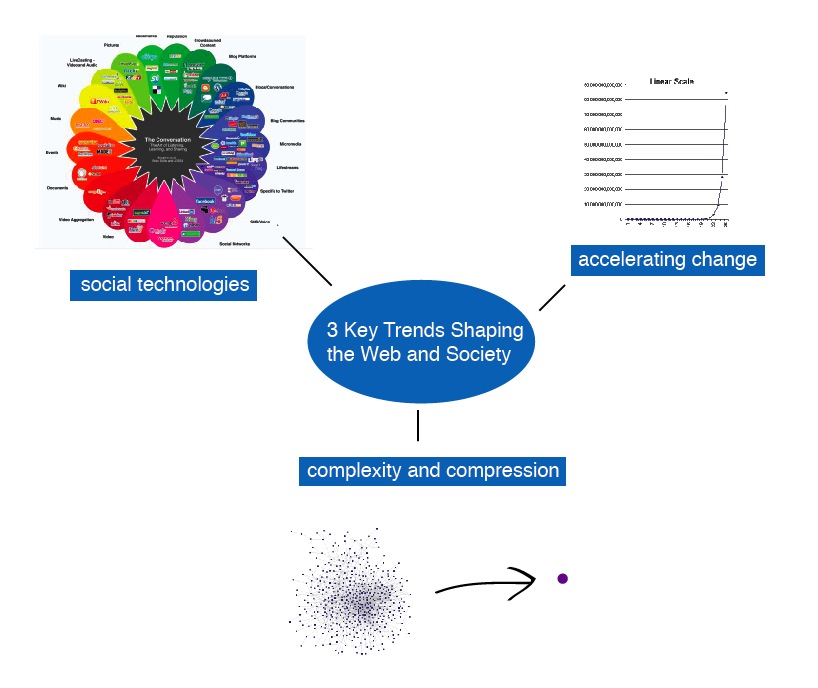
3 Key Trends Shaping the Web and Society

02 Wednesday Dec 2009

Posted by Venessa Miemis in Uncategorized

≈ 33 Comments

Tags

social evolution

Add to FacebookAdd to DiggAdd to Del.icio.usAdd to StumbleuponAdd to RedditAdd to BlinklistAdd to TwitterAdd to TechnoratiAdd to Yahoo BuzzAdd to Newsvine

Can we better equip ourselves to deal with constant change by seeing things through a new lens?

I started exploring this question with the Metathinking Manifesto, and I’m going to try and flesh out those ideas a bit further. Continue reading →

Twitter’s Intelligent, Welcome to Web 3.0

26 Thursday Nov 2009

Posted by Venessa Miemis in Uncategorized

≈ 36 Comments

Tags

Social Media

Add to FacebookAdd to DiggAdd to Del.icio.usAdd to StumbleuponAdd to RedditAdd to BlinklistAdd to TwitterAdd to TechnoratiAdd to Yahoo BuzzAdd to Newsvine

“Collective Intelligence (CI) is the capacity of human collectives to engage in intellectual cooperation in order to create, innovate, and invent.”
– Pierre Levy + James Surowiecki + Mark Tovey

I wrote a post a few days ago, Is Twitter a Complex Adaptive System?, that proposed the idea that Twitter may be evolving into an entity of sorts, a collective intelligence. I’ve come across some new posts that are amplifying that meme, and I just want to keep the thoughtstream going.

Insight #1

I was reading an article by Nova Spivack from 2006 over on Ray Kurzweil’s site, titled The Third-Generation Web is Coming. In it, he lays out the evolution from Web 1.0 –> Web 2.0 –> Web 3.0, a more intelligent web “which emphasizes machine-facilitated understanding of  information in order to provide a more productive and intuitive user experience.”

He also lays out the key technology trends driving the evolution. Among them are Ubiquitous Connectivity (broadband, mobile internet), Network Computing (SaaS, P2P, cloud computing), and Open Information (open APIs, open-source software, OpenID).

Sound familiar? Continue reading →

85+ Resources: Educator Guide for Integrating Social Media

24 Tuesday Nov 2009

Posted by Venessa Miemis in Uncategorized

≈ 38 Comments

Tags

Resources

Add to FacebookAdd to DiggAdd to Del.icio.usAdd to StumbleuponAdd to RedditAdd to BlinklistAdd to TwitterAdd to TechnoratiAdd to Yahoo BuzzAdd to Newsvine

I hope this post will be a handy reference guide, especially for those teachers new to social media technologies and how to integrate them into the classroom. This resource is by no means exhaustive, but it’s a good starting point for finding the information and people that will help you make the transition into a ’21st century learning environment’. I intend for this to be a wikipost (I will update resources as they are shared with me by others), so feel free to bookmark the page and check in periodically for new material. Enjoy. Continue reading →

Is Twitter a Complex Adaptive System?

17 Tuesday Nov 2009

Posted by Venessa Miemis in Uncategorized

≈ 64 Comments

Tags

Social Media

Add to FacebookAdd to DiggAdd to Del.icio.usAdd to StumbleuponAdd to RedditAdd to BlinklistAdd to TwitterAdd to TechnoratiAdd to Yahoo BuzzAdd to Newsvine

I’ve seen a bunch of posts bubble up over the past few days that are really sparking my curiousity about what is really going on with Twitter, so I need to do a little brain dump. Bear with me.

Insight #1

An article by Rosabeth Moss Kanter was just published today on the Harvard Business Review website, titled On Twitter and in the Workplace, It’s Power to the Connectors. In it, she highlights the fact that there is an organizational trend moving away from the hierarchical networks of the 20th century, and towards complex, distributed, non-hierarchical structures of business organization and leadership.

She also points out that success today is based on a person’s ability to leverage power and influence within their social networks, to act as “connectors” between people and information, and in turn build social capital.

She leaves the evaluation of the significance of Twitter open-ended, but she lays out a few characteristics of Twitter that I found most interesting:

In the World According to Twitter, giving away access to information rewards the giver by building followers. The more followers, the more information comes to the giver to distribute, which in turn builds more followers. The process cannot be commanded or controlled; followers opt in and out as they choose. The results are transparent and purely quantitative; network size is all that matters. Networks of this sort are self-organizing and democratic but without any collective interaction.

(just keep those points in mind, I’m going to come back to it) Continue reading →

Filtered Twitter Accounts

16 Monday Nov 2009

Posted by Venessa Miemis in Uncategorized

≈ 17 Comments

Tags

Social Media

I came across an article Robert Scoble wrote yesterday about the new method he’s going to use to organize his Twitter accounts. He’s been getting really excited lately as he figures out how to efficiently use Twitter to access good information that’s important to him. I’m going to write about the importance of media scanning as part of a “metathinking” framework in an upcoming post, so I’ll leave the commentary about what he figured out about Twitter lists for later.

Basically, Scoble decided to create multiple Twitter accounts to organize the different types of information he produces:

scoble text

The value to this is much deeper than it may appear at first. Twitter is an amazing experimental grounds in figuring out how to leverage the power of the real-time web. Besides being an incredible platform that essentially operates as an “idea exchange”, where we can chew on ideas and news together collectively, it’s an amazing source of information acquisition. Continue reading →
A Metathinking Manifesto

15 Sunday Nov 2009

Posted by Venessa Miemis in Uncategorized

≈ 36 Comments

Tags

social evolution

Add to FacebookAdd to DiggAdd to Del.icio.usAdd to StumbleuponAdd to RedditAdd to BlinklistAdd to TwitterAdd to TechnoratiAdd to Yahoo BuzzAdd to Newsvine

the-global-brain-google-knol-twain-26nov2008
The significant problems we face today cannot be solved at the same level of thinking we were at when we created them. – Einstein

For several years now, I’ve been studying the intersection of technology, culture and communication, the impacts of social media, the relationship between creativity, innovation and design, and the potential of various futures.

I’ve had this gnawing sensation at the edges of my mind that all these areas were held together by a common thread, but I couldn’t put my finger on the connection. My intention is that by taking this out of the incubation stage in my head and putting it into words, it will become clarified and provide some value.

First off, let me lay out a framework . My ideas are based on 3 main concepts:

* Social media is fundamentally changing the human experience.
* The world is increasing in complexity.
* We are experiencing accelerating change.

And a brief explanation of each: Continue reading →

← Older posts
Newer posts →

abundance anti-rivalrous authority biohacking books cognitive enhancement collaboration commerce communication community consciousness consciousness & evolution consciousness hacking creativity creativity + design culture currency decor Design digital literacy ello entheogens ethics evolution flow futures innovation interview microdosing money money + currency neurohacker collective neurohacking neuroscience neurotech nootropics personal development philosophy projects psychedelics psychotherapy reputation Resources response-ability scarcity self smart drugs social evolution social innovation Social Media social organization society sovereignty style sustainability technology technology + society Trends Video vision willpower women Work workshop

Archives

Blog Stats

  • 1,122,122 hits

Enter your email address to subscribe to this blog and receive notifications of new posts by email.

Join 1,180 other subscribers

Top Posts

  • Constructing the New Narrative
  • Summary: The Postmodern Condition: A Report on Knowledge
  • What is Design Thinking, Really?
  • EBD Nation: 100+ Inspiring Change Agents I've Found via Twitter
  • Essential Skills for 21st Century Survival: Part 4: Foresight

Recent Posts

  • What it Means to Be A Neurohacker
  • Using Psychedelics to Increase Performance and Reprogram the Mind/Brain Interface
  • Why the World Needs Neurohacking Now
  • The Neurohacker’s Toolbox: Nootropics
  • What is Neurohacking?
  • when the mind hijacks my flow state
  • what mental slavery looks like: repressive & reactive patterns
  • Constructing the New Narrative
  • i am a consciousness with a society of personalities
  • on the forcing of willpower & the art of relaxation

@venessamiemis

Tweets by venessamiemis

Emergent by Design

Emergent by Design

Recent Comments

Venessa Miemis's avatarVenessa Miemis on Why the World Needs Neurohacki…
Monica Anderson's avatarMonica Anderson on Why the World Needs Neurohacki…
Venessa Miemis's avatarVenessa Miemis on The Neurohacker’s Toolbo…
bonnittaroy's avatarbonnittaroy on The Neurohacker’s Toolbo…
What is Neurohacking… on What is Neurohacking?
Creative Commons License
This work is licensed under a Creative Commons Attribution 3.0 Unported License.
  • RSS - Posts

Blog at WordPress.com.

  • Subscribe Subscribed
    • emergent by design
    • Join 1,180 other subscribers
    • Already have a WordPress.com account? Log in now.
    • emergent by design
    • Subscribe Subscribed
    • Sign up
    • Log in
    • Report this content
    • View site in Reader
    • Manage subscriptions
    • Collapse this bar
 

Loading Comments...