Is Twitter a Complex Adaptive System?

Tags

Add to FacebookAdd to DiggAdd to Del.icio.usAdd to StumbleuponAdd to RedditAdd to BlinklistAdd to TwitterAdd to TechnoratiAdd to Yahoo BuzzAdd to Newsvine

I’ve seen a bunch of posts bubble up over the past few days that are really sparking my curiousity about what is really going on with Twitter, so I need to do a little brain dump. Bear with me.

Insight #1

An article by Rosabeth Moss Kanter was just published today on the Harvard Business Review website, titled On Twitter and in the Workplace, It’s Power to the Connectors. In it, she highlights the fact that there is an organizational trend moving away from the hierarchical networks of the 20th century, and towards complex, distributed, non-hierarchical structures of business organization and leadership.

She also points out that success today is based on a person’s ability to leverage power and influence within their social networks, to act as “connectors” between people and information, and in turn build social capital.

She leaves the evaluation of the significance of Twitter open-ended, but she lays out a few characteristics of Twitter that I found most interesting:

In the World According to Twitter, giving away access to information rewards the giver by building followers. The more followers, the more information comes to the giver to distribute, which in turn builds more followers. The process cannot be commanded or controlled; followers opt in and out as they choose. The results are transparent and purely quantitative; network size is all that matters. Networks of this sort are self-organizing and democratic but without any collective interaction.

(just keep those points in mind, I’m going to come back to it) Continue reading

Filtered Twitter Accounts

Tags

I came across an article Robert Scoble wrote yesterday about the new method he’s going to use to organize his Twitter accounts. He’s been getting really excited lately as he figures out how to efficiently use Twitter to access good information that’s important to him. I’m going to write about the importance of media scanning as part of a “metathinking” framework in an upcoming post, so I’ll leave the commentary about what he figured out about Twitter lists for later.

Basically, Scoble decided to create multiple Twitter accounts to organize the different types of information he produces:

scoble text

The value to this is much deeper than it may appear at first. Twitter is an amazing experimental grounds in figuring out how to leverage the power of the real-time web. Besides being an incredible platform that essentially operates as an “idea exchange”, where we can chew on ideas and news together collectively, it’s an amazing source of information acquisition. Continue reading

A Metathinking Manifesto

Tags

Add to FacebookAdd to DiggAdd to Del.icio.usAdd to StumbleuponAdd to RedditAdd to BlinklistAdd to TwitterAdd to TechnoratiAdd to Yahoo BuzzAdd to Newsvine

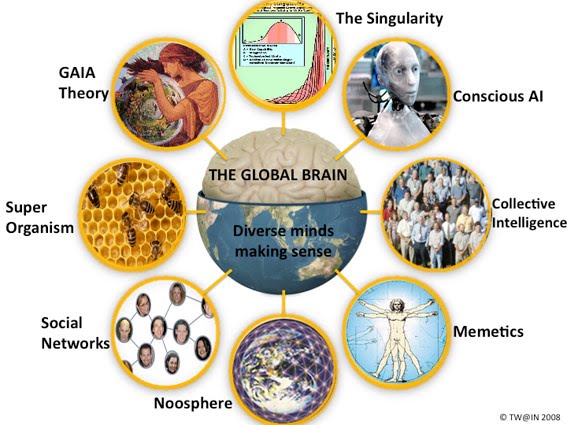
the-global-brain-google-knol-twain-26nov2008
The significant problems we face today cannot be solved at the same level of thinking we were at when we created them. – Einstein

For several years now, I’ve been studying the intersection of technology, culture and communication, the impacts of social media, the relationship between creativity, innovation and design, and the potential of various futures.

I’ve had this gnawing sensation at the edges of my mind that all these areas were held together by a common thread, but I couldn’t put my finger on the connection. My intention is that by taking this out of the incubation stage in my head and putting it into words, it will become clarified and provide some value.

First off, let me lay out a framework . My ideas are based on 3 main concepts:

* Social media is fundamentally changing the human experience.
* The world is increasing in complexity.
* We are experiencing accelerating change.

And a brief explanation of each: Continue reading

40 Great Resources for Developing a Community Management Strategy

Tags

Add to FacebookAdd to DiggAdd to Del.icio.usAdd to StumbleuponAdd to RedditAdd to BlinklistAdd to TwitterAdd to TechnoratiAdd to Yahoo BuzzAdd to Newsvine

A practical guide for Community Management strategies, best practices, and resources.

networking

Tools for Community Managers: Networks & Social Media Guidelines


Expectations & Salary


Frameworks:
Metrics:
Blogs to Explore:
Reports
Further linking:

update:

Back to Basics: Developing an Online Community Strategy

Why Education Needs Social Media

Tags

Add to FacebookAdd to DiggAdd to Del.icio.usAdd to StumbleuponAdd to RedditAdd to BlinklistAdd to TwitterAdd to TechnoratiAdd to Yahoo BuzzAdd to Newsvine

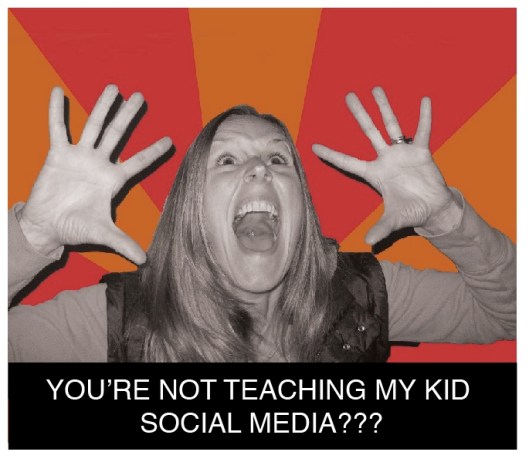
not teaching my kid social media?
I read an article the other day on John Merrow’s blog, titled ‘Technology in Schools: Problems & Possibilities.’ In it, he outlines three fears he has concerning the implementation of emerging media technologies into education:

1. the digital divide (gap between people with access to technology and those without)
2. schools will resist innovation and become irrelevant
3. schools will not use technologies in a strategic way

I spend a lot of time thinking about social technologies and the role they’re playing in our lives now and into the future, and I feel that though John’s fears are justified, they may prove to be unfounded as time progresses. Here’s why:

Fear #1: The Digital Divide

I agree that access to technology may be an issue (for now), but the barrier is continuing to drop. Frame it in terms of Moore’s Law or Kurzweil’s Law of Accelerating Returns, but either way, the rate at which technologies become more powerful and robust continues to increase, while the costs associated with producing them goes down. Based on this, the question of whether an individual from a lower income bracket can gain access to technology may become a moot point.

And I don’t think that means that all of a sudden everyone is going to have a computer at home. But what it could mean is that the ‘have-nots’ will get on equal footing via technological leapfrogging. As upcoming mobile technologies continue to transform cellphones into portable, handheld computers, it’s not hard to imagine that there will be a segment of the population that goes straight from no access to having smartphones that keep them fully connected. If you take a look at the latest Mobile Metrics Report by Admob, you’ll see that the mobile web has been experiencing massive growth globally. (ReadWriteWeb summarized the report nicely here).

So, in my mind, we don’t have to be in fear of a growing digital divide – if anything, we’re going to see it exponentially shrink.

Fear #2: Schools Resist Innovation

Yes, I certainly agree with this. Schools, like governments, are institutions that are notoriously slow to adopt new practices and adapt to change. By resisting integration of some technologies and blocking access to others, schools are creating the potential for a huge shake-up in the trust and validity we put into them.

Social Media isn’t a wild animal that needs to be caged and trained before it’s allowed to be pet by the neighbors. Social media is a paradigm shift in how humans communicate. If schools stop teaching students communication skills, we’re in trouble.

I don’t know if this is a case of ‘innovate of die,’ but if educational institutions don’t wake up, there will be a groundswell, and ‘the people’ will create solutions that are not dependent upon traditional learning structures.

I’d argue that in many ways this is already happening just in the act of participating in the social web. There’s so much to be said on that idea alone, I’ll save my expansion on it for an upcoming post.

Fear #3: Schools Embrace Technology Incorrectly

Like any project that is pursued with enthusiasm but without structure, trying to integrate social technologies into the classroom without a framework will fail. There are many, many individuals and organizations busy developing guidelines and best practices for how to teach ‘new media literacies’, so I will just provide a few examples as a reference. The MacArthur Foundation launched a $50 million digital media and learning initiative a few years ago, and has funded many great projects already. One that immediately comes to mind is New Media Literacies, a project pioneered by Henry Jenkins and the Comparative Media Studies program at MIT, which has a wealth of information to help educators effectively integrate new media into the classroom.

There will be a learning curve, especially since best practices are still being established, but fear cannot be the determining factor in whether technologies are implemented or not.

(BTW, for any ‘social media expert’ out there who wants to devote some time to learning how to apply their craft to the educational setting and do some consulting, there’s a huge opportunity there for a lucrative business model.)

Final Thoughts

I think this whole conversation requires a reorientation of how ‘social media’ is approached. Defining it as something that can exist separately from education is simply misguided. Information is coming at us at a dizzying pace, and social technologies are tools that help us filter the flow. They allow us to share, discover, and grow. We can digest information together, collaboratively refine our thinking, and restate ideas in new ways to help make sense of it all.

In essence, social media is a mandatory 21st century literacy, a set of communication skills that MUST be learned if we want to prepare today’s youth to be able to participate effectively in the global marketplace.

36 Awesome Idea Hubs to Spark Creative Thinking, Innovation, & Inspiration

Tags

Add to FacebookAdd to DiggAdd to Del.icio.usAdd to StumbleuponAdd to RedditAdd to BlinklistAdd to TwitterAdd to TechnoratiAdd to Yahoo BuzzAdd to Newsvine

There’s no limit to the number of good ideas out there that could help change the world. Many times, innovative solutions grow from previously existing ideas that are tweaked and customized for current needs. That said, below is a list of Idea Hubs from around the web to stimulate your mind, from conferences to user-submitted idea warehouses to resource centers. I’ve also included the twitter handles of those that have it. Enjoy!

Videos to Inspire

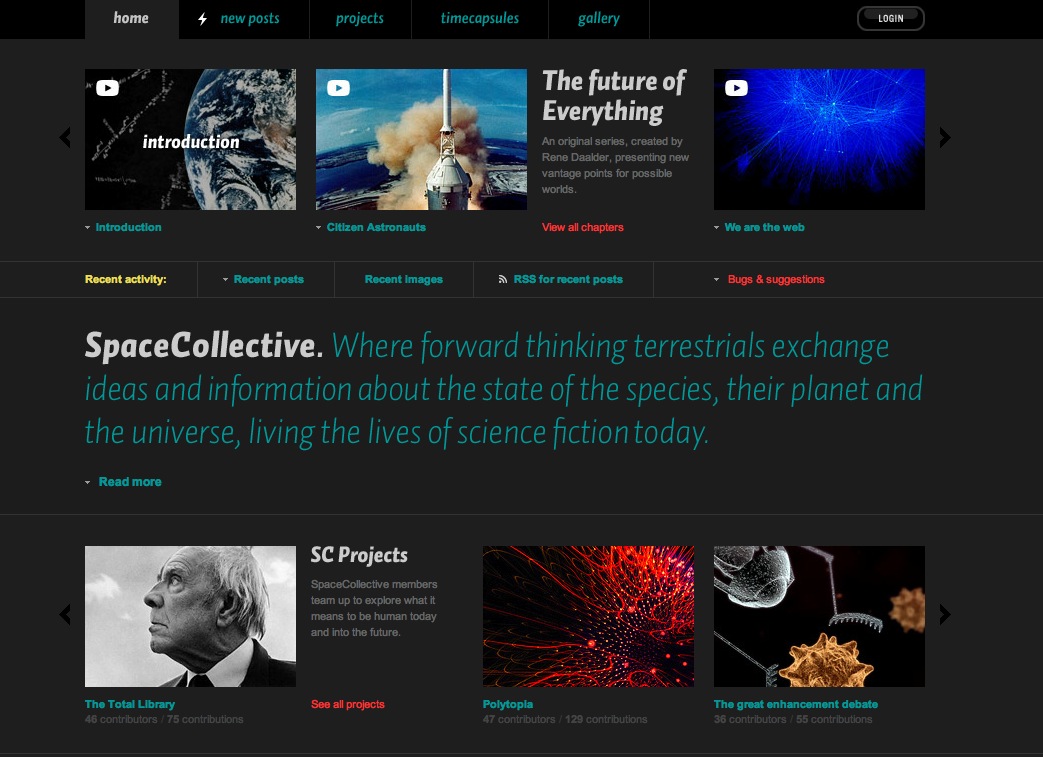
1. SpaceCollective: Where forward thinking terrestrials exchange ideas and information about the state of the species, their planet and the universe, living the lives of science fiction today.

spacecollective

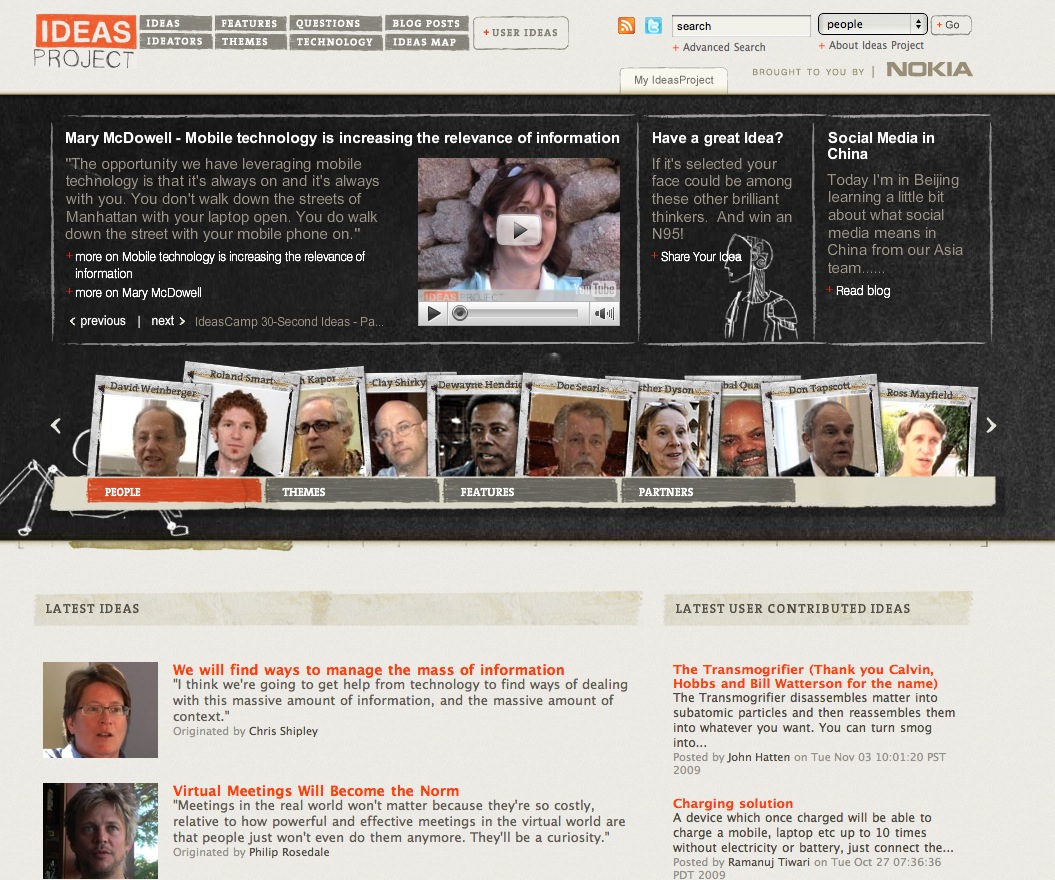
2. Ideas Project: Created by Nokia, it brings together big thinkers to contemplate the big ideas that matter most to the future of communications, joining them up through video clips, links, articles, podcasts and dynamic maps to push the boundaries of Web navigation and the thought process itself.
twitter: @IdeasProject

ideasproject

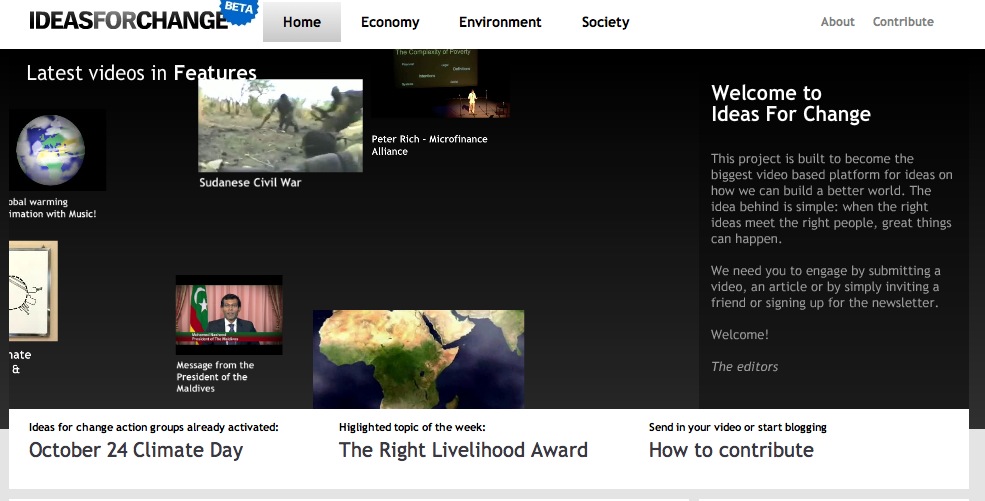
3. Ideas for Change: This project aims at becoming the biggest video based platform for ideas on how we can build a better world.

ideasforchange

4. Sputnik Observatory: Documenting, archiving, and disseminating ideas that are shaping modern thought by interviewing leading thinkers in the arts, sciences and technology from around the world.

sputnikobservatory

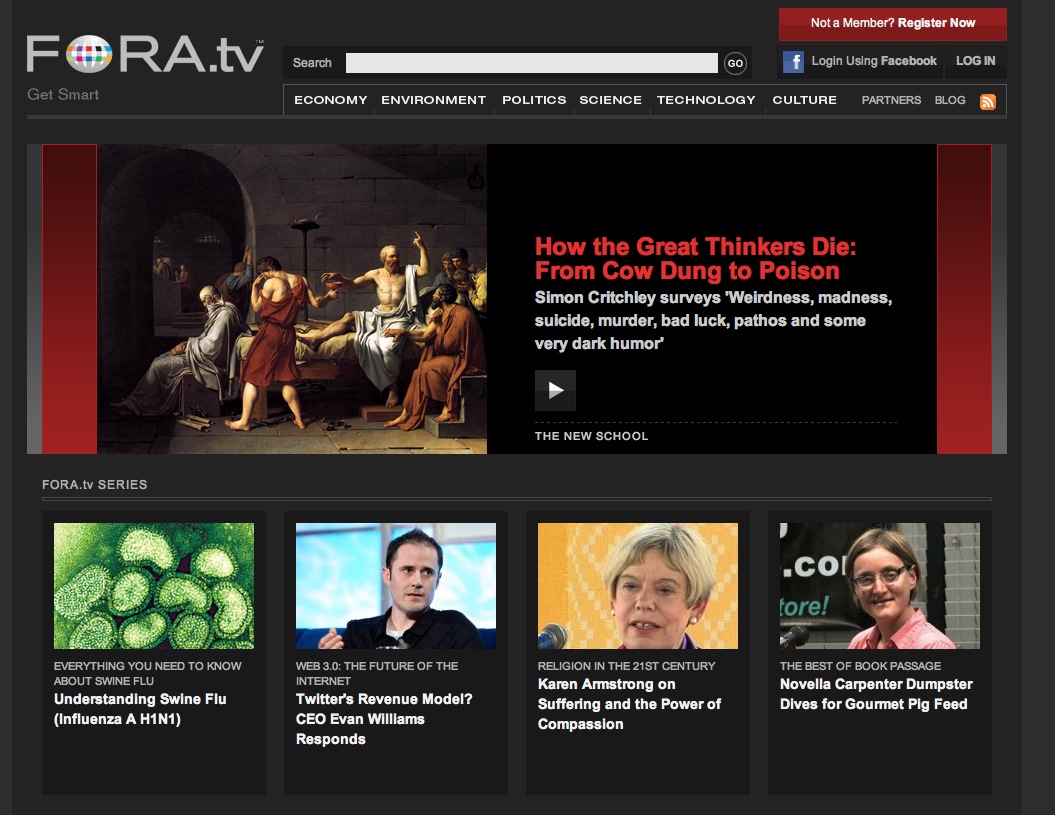
5. FORA.tv: Videos on the People, Issues, and Ideas Changing the Planet

fora.tv

Continue reading

Why Twitter Lists ARE NOT the New Ranking System in Social Media

Tags

I keep seeing this article about the importance of twitter lists getting retweeted, and I’m compelled to disagree.

Steven Hodson over at The Inquistr is making an argument that Lists are going to be the new ranking system in social media. He references an article at the Bivings Report about using twitter lists to judge influence, and then goes on to make some pretty bold blanket statements, like:

(a) “It is how you are now going to be able to measure your worth in the world from this day forth.Yes sir you can now measure your value by how many lists you have been lucky enough to find yourself on.”

(b) “Whether or not we get over being left out of other peoples lists doesn’t change the fact that Twitter Lists will become the new ranking system in Social Media. They will be the new measure of worth to a lot of people…..”

My response is that:

(a) no it isn’t.

(b) no it won’t.

My rationale:

Continue reading

Top 4 Reasons To Use Twitter Lists

Tags

Picture 44If you haven’t joined Twitter yet because it seemed too hard to find people saying anything that matters, it’s time to reconsider.

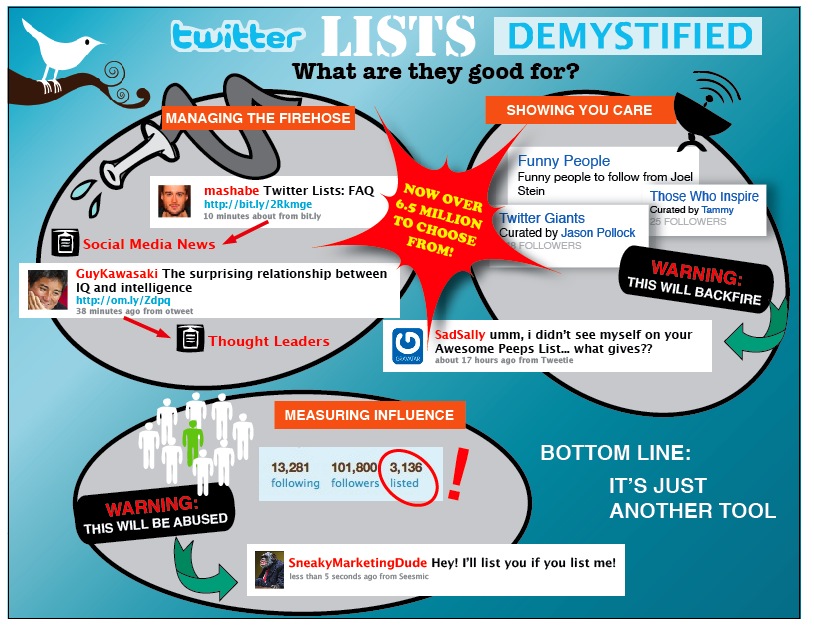
Twitter recently launched “Lists”, which is a way to group the people you follow into categories, so you can hone right in on the conversations/news that matters to you.

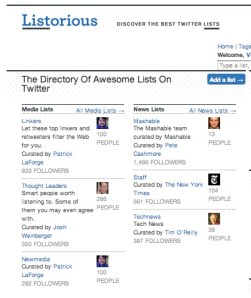
A wonderful complimentary service that also just launched is Listorious. It aggregates all the best lists that everyone has created. This is an AWESOME resource! As of yesterday, already over 6.5 million lists have been created, but you’ll see that the best filter to the top. You can type in just about any word at this point, (“news”, “music”, “humor”, “media”, etc), and will get to see the best lists out there.

Why does this matter?

Continue reading