It’s part of human nature to label, classify, and quantify the world around us. We feel empowered when we’re able to create structure and meaning out of our surroundings. Maps have been used for thousands of years to that end; enabling us to plot a course, make informed decisions of paths to take, and decide which trajectory will give us desired results. In today’s modern culture, digital media has taken mapping to a whole new level, giving us the ability to visualize our world in 3D, and on a global scale.
So what do maps have to do with social change? Potentially, everything. A map is a tool, and historically those that have the best maps win. Several digital and social media tools are in the process of converging to create unprecedented platforms for sharing information in real-time. Whereas software like Google Earth allowed us to visualize on a macro scale, these new tools map information on local levels. GPS software, location based tracking, souveillance, and geotagging are coming together to produce information-rich maps that can be visualized in both space and time. Powered by social media, a space is being created where real-time maps can be used to empower communities to connect and collaborate instantaneously.
GPS & Location Based Tracking
We’re all familiar with GPS systems. For those of us who are hopelessly spatially clueless, a navigation system in the car and on our mobile device has been a blessing. Now, there’s a move towards utilizing that tool at the social level. For example, Google recently announced the launch of Latitude, a located-based tracking application that can be downloaded to your phone. It allows you to see where your friends are on a map, and also stay in contact with them via text messaging or chat client. Though there are privacy issues that can be raised with this type of transparency, today’s digital culture lends itself to an exhibitionism that is changing the way we interact as a society.
Sousveillance & Geotagging
Just as surveillance denotes being watched by others, sousveillance indicates the practice of becoming the watcher by recording and streaming information individually. Digital cameras and camera phones, combined with distribution methods like blogs, YouTube, and Flickr allow citizens to generate and share content independently, without needing to rely on traditional media sources. In addition to being socially generated, the content can also be made geographically meaningful. Geotagging is the process of labeling information, in this case pictures or videos, by location. Content is no longer just about “what”, but “where”.
One of the most recent commercial examples of presenting information in this way is a project by the Washington Post, called TimeSpace. They’ve created an interactive map with a timeline that displays news (videos, pictures, articles, and commentary) that has been tagged by location. Users can then see the patterns of where and when events occurred, and watch how they unfolded over time.
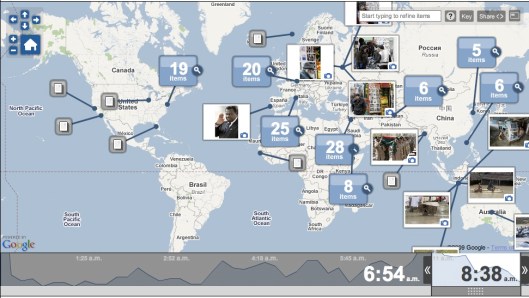
(via http://specials.washingtonpost.com/timespace/world/)
Social Media
Social media is the driving force as well as the glue that holds the rest of these elements together. Online social networks have created opportunities for people with similar interests, values, or ideas to connect, share information, and form relationships. The barrier has never been lower for collaborating with mass groups of like-minded individuals and mobilizing towards a common cause.
There is a project in the works right now called Groundcrew, that may set the stage for harnessing the power of social media for social change. With a public beta set for March 2009, their mission is “to make technology that changes how it feels to be alive”. Here’s how they describe the project:
“Using our web interface, worthy projects, organizations, and businesses can build “squads” of real-world helpers/participants. Organizers can view data from their squad in real-time, using text messaging and GPS; they can see who’s available at any moment; and they can give assignments—either mass assignments or systems of individual assignments—to help people work together.”
It will be fascinating to see how this idea plays out over the upcoming months. There are many social networks organized around specific causes or events, but this may be the first to create a system of stand-by volunteers on a local level ready to be coordinated for a project.
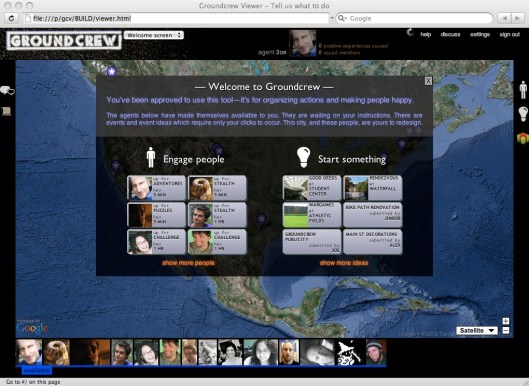
(via http://groundcrew.us/screenshots)
The Future?
Mapping and visualization tools combined with social media are introducing new ways of creating and sharing information-rich content, and then taking action. The ability to see people, things, and events spatially and over time affords us the opportunity to analyze and view the world in a new way. Maps transform information from static to fluid, from an object to a set of processes. By contributing content to the map, or time and resources to the social network, we participate in a cultural dialogue and in history. What kinds of social or economic impacts can we expect to see (or make) when we are better able to visualize the people and events around us, and our proximity to them? The goal could be something as simple as ‘supporting local agriculture’: Farms could upload photos and videos of their operations, notifying community members when their grass-fed beef or free-range chicken is ready for pickup. Community-based farm cooperatives could notify volunteers when to pitch in for the spring sowing or fall harvest. Groups could form in order to participate at farmers’ markets, organize a seed exchange, raise public awareness, or even share gardening tips.
Local level real-time mapping is making the world a seemingly smaller, more transparent and manageable place. The information it provides, like any map of value, helps us understand the patterns and relationships within our surroundings and gives clues about what action to take to achieve desired results. In this case, it could be a bottom-up approach to social change by self-organizing into groups to tackle real world problems. In an uncertain world with massive social issues to be faced, our success as a society is going to have to start with a good map.



 emergent by design