• about
  • projects
    • Beach Loft Interior Design
    • Contact Conference
    • Emerging Leader Labs
    • Junto
    • Open Foresight
    • The Future of Money
      • future of money, cont.
    • The Future of Facebook

emergent by design

Tag Archives: culture

Personal Alignment Precedes Group Flow

26 Thursday Apr 2012

Posted by Venessa Miemis in Uncategorized

≈ 16 Comments

Tags

culture, Design

I spent last week in an immersive personal development / coaching / business development retreat with a colleague, which spurred me to some new insights and opinions about collective intelligence, co-creation, and the general pursuit of goals and growth in life.

The hosts were the same team that ran a culture-hacking bootcamp at Agile Boston a few months back, who were kind enough to invite us to Seattle to be facilitated through a longer team alignment process together.

I went in with curiosity moreso than expectations, having a general understanding that we would do some kind of work that would clarify our agreements as well as sketch potential business models and strategies. I found myself a bit surprised by the deep dive we took into exploring emotions and desires as the entrypoint for the sessions. Continue reading →

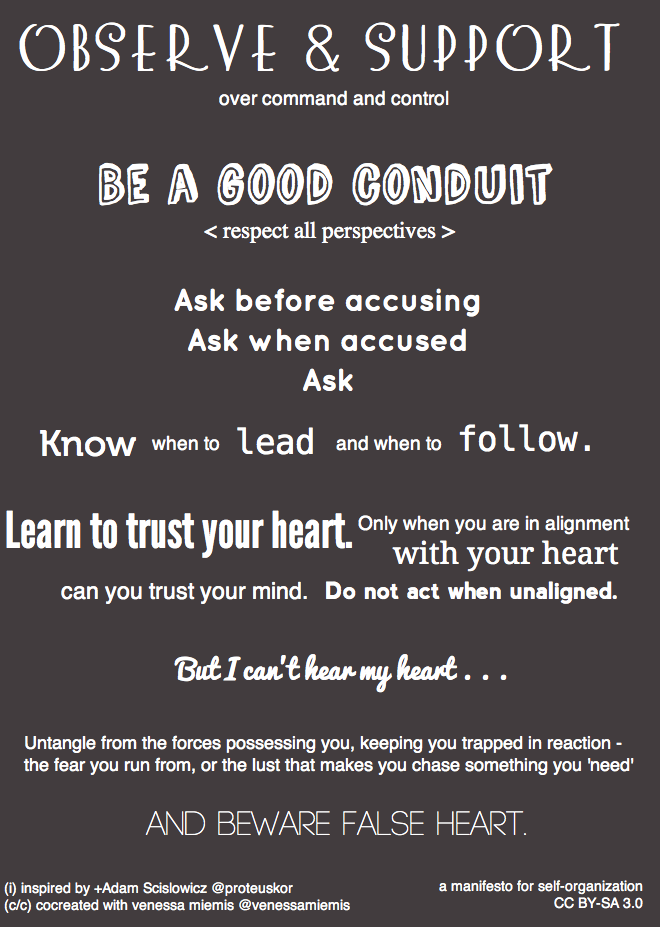
[Image]: A Manifesto for Self-Organization

27 Friday Jan 2012

Posted by Venessa Miemis in Uncategorized

≈ 4 Comments

Tags

culture


one of my fellow cocreators was drafting some core principles and guidance for self-organization today. i thought they were lovely and was inspired to make a picture. you can offer feedback or suggestions for improvement here.

Essential Skills for 21st Century Survival: Part 6: Storytelling

10 Saturday Dec 2011

Posted by Venessa Miemis in Uncategorized

≈ 18 Comments

Tags

communication, culture

This is part 6 in a 12 part series. The first five skills were Pattern Recognition, Environmental Scanning, Network Weaving, Foresight, and Conscious Awareness.

:: storytelling ::

The following video by Jonah Sachs, creative director at Free Range Studios has prompted me to get back to completing the next installment in this Essential Skills series. He does a beautiful job revealing the secrets of effective and high-impact storytelling.

Jonah Sachs at Compostmodern ’11 from AIGA San Francisco on Vimeo. Continue reading →

Conceptual Framework for Online Identity Roles

04 Wednesday Aug 2010

Posted by Venessa Miemis in Uncategorized

≈ 36 Comments

Tags

culture, Design

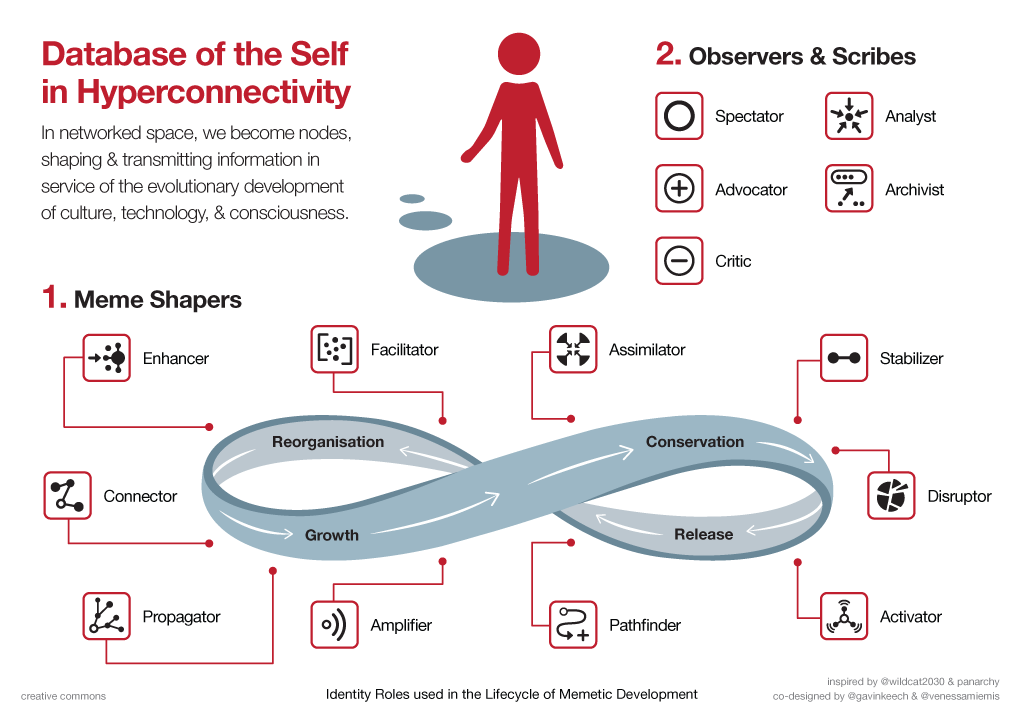
I just wrapped up a final project for an aesthetics course this semester, the assignment being to create a “Database of the Self.” I chose to make the database as a representation of the roles we play in terms of how we interact with information online. The roles are overlaid on a panarchy, which shows a visualization of adaptive lifecycles. Though the evolution of every idea or meme won’t necessarily follow this specific path, (it may in fact be rhizomatic, with multiple feedback loops), this begins to flesh out what we become as nodes within an enmeshed series of networks. Continue reading →

Junto: overview of concept, philosophy, and components

29 Tuesday Jun 2010

Posted by Venessa Miemis in Uncategorized

≈ 37 Comments

Tags

culture, projects

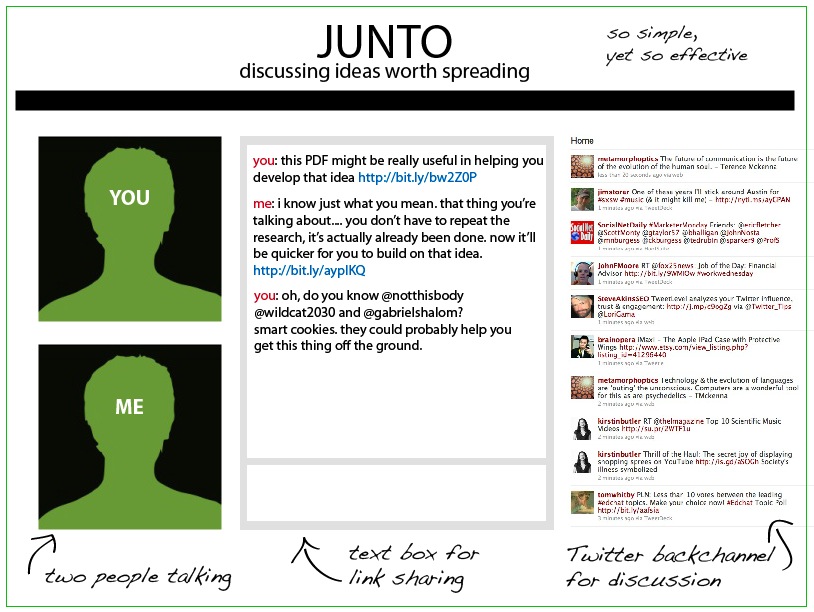
Hi all! In the past few months, there has been a lot of excitement and momentum building around the Junto concept, which has been great, and expanded all of our views of where it could go. I just wanted to take the time to reclarify the philosophy, definition, and components of Junto, so that we know what steps can be carried out to bring the vision closer to a reality. Thanks again for everyone’s involvement in this collective learning and building process! Continue reading →

Essential Skills for 21st Century Survival: Part 3: Network Weaving

01 Saturday May 2010

Posted by Venessa Miemis in Uncategorized

≈ 40 Comments

Tags

culture

Add to FacebookAdd to DiggAdd to Del.icio.usAdd to StumbleuponAdd to RedditAdd to BlinklistAdd to TwitterAdd to TechnoratiAdd to Yahoo BuzzAdd to Newsvine

So people learned from the angels of God how to build bridges, and therefore, after fountains, the greatest blessing is to build a bridge and the greatest sin to interfere with one. – Ivo Andric

Our first two topics in this 12 part series were Pattern Recognition and Environmental Scanning, both practices for enhancing the opportunity to create meaning from information and to assist in decision making. The next topic looks at how others can contribute to this process.

::Network Weaving::

The above quote was used by Lee Bryant during his recent presentation at the Social Business Edge conference, and I thought it fit in well with this concept.  One of the main topics we have been covering is the idea of breaking down silos – between fields, between organizational departments, between people, and even more deeply, between our own ideas about the values that defines us and who we really are – so the analogy of building bridges seems appropriate.

As I’ve been exploring how to build relationships online and create an environment where trust can be built, I naturally started introducing people from different communities to each other in hopes they could benefit from each other’s knowledge, wisdom, and experience. I noticed that different disciplines are having the same conversation, just packaged in the jargon of their field. What if we could cross-pollinate these conversations, allowing for new ideas to emerge?

This activity has been called “network weaving” on June Holley’s blog, Network Weaver. (There’s a wealth of information there on how to build online networks and create thrivable communities.) She defines the term as follows:

A Network Weaver is someone who is aware of the networks around them and explicitly works to make them healthier (more inclusive, bridging divides). Network Weavers do this by connecting people strategically where there’s potential for mutual benefit, helping people identify their passions, and serving as a catalyst for self-organizing groups.

June (@juneholley) and a few other amazing women I’ve started to follow (Jean Russell @NurtureGirl, Christine Egger @CDEgger) have been working on a google doc that explores ways to facilitate network weaving behavior, geared towards this weekend’s Wisdom 2.0 Conference.  June is also working on a Network Weaving Handbook, which I’m looking forward to reading. The Table of Contents sneak preview is available here.

Though the activity seems simple enough, I see it as an essential skill as we move forward to a more effective and collaborative society. It’s not just about being extroverted and great at making introductions, though. It’s about raising your awareness of others, learning how to identity their strengths and gifts, and knowing who they should know to amplify their abilities and potential contributions.

I started to outline this idea in Framework for a Strengths-based Society, and I think that a prerequisite for effective network weaving starts with thinking about people (and ourselves) not in terms of predefined roles or resumes, but by what we’re really about. This is often opaque – a mix of things like inherent qualities, tacit knowledge, and the values we adhere to, which are revealed by our actions and interactions.

As I’ve dug deeper into exploring those things about myself, it seems I’m able to more quickly identify them in others. It makes network weaving actually exhilarating. I feel I’m of more value to others now, because I have a sense of who they could team up with to mobilize their ideas.

As more of us adopt this practice, aligning people with different strengths and skills who all share a similar vision, what might happen? Could it ignite a snowball effect, accelerating the rate of positive change and making an impact in the world?

#

image from wikimedia commons

Essential Skills for 21st Century Survival: Part 2: Environmental Scanning

11 Sunday Apr 2010

Posted by Venessa Miemis in Uncategorized

≈ 76 Comments

Tags

culture

Add to FacebookAdd to DiggAdd to Del.icio.usAdd to StumbleuponAdd to RedditAdd to BlinklistAdd to TwitterAdd to TechnoratiAdd to Yahoo BuzzAdd to Newsvine

We recently discussed Pattern Recognition and the role it plays in understanding and decision making. The next topic in this 12 part series is pulled out of the Futures Thinking toolbox:

::Environmental Scanning::

Traditionally, environmental scanning is explained within a business context as a strategic approach to acquiring information in order to stay current on events, emerging trends, and external factors that could influence or impact an organization. It basically means paying attention to what’s going on within your industry, monitoring what your competitors are doing, what your customers are saying, and being sensitive to potential threats or opportunities along the way. Continue reading →

Junto: Discussing Ideas Worth Spreading

22 Monday Mar 2010

Posted by Venessa Miemis in Uncategorized

≈ 137 Comments

Tags

culture, Design

Add to FacebookAdd to DiggAdd to Del.icio.usAdd to StumbleuponAdd to RedditAdd to BlinklistAdd to TwitterAdd to TechnoratiAdd to Yahoo BuzzAdd to Newsvine

I’d like to start a Junto. (pronounced hoonto)

Originally, “The Junto was a club established in 1727 by Benjamin Franklin for mutual improvement. Its purpose was to debate questions of morals, politics, and natural philosophy, and to exchange knowledge of business affairs.” [wikipedia]

This seems rather amazing to me, and something that should always exist for knowledge sharing, information exchange, learning, personal growth, and empowerment. Not only does it make logical sense, a recent research study suggests deep, meaningful conversation actually makes us happier. The study, published in the journal Psychological Science, showed that when two people enter into a deep discussion, they create shared meaning of the world, strengthening their connections and bonds and interdependence, making them happy. (It feels good to relate to others!!! Did we need published research to really know that? Just check out the comments section of this blog, it’s living research.) Continue reading →

Why do you share?

04 Thursday Mar 2010

Posted by Venessa Miemis in Uncategorized

≈ 11 Comments

Tags

culture

Add to FacebookAdd to DiggAdd to Del.icio.usAdd to StumbleuponAdd to RedditAdd to BlinklistAdd to TwitterAdd to TechnoratiAdd to Yahoo BuzzAdd to Newsvine

Over the past few weeks, we’ve been building out the idea of how to facilitate innovation within organizations. My proposal includes a revealing of the social network structure of an organization, breaking down silos between departments, sharing knowledge and information, and amplifying people’s natural strengths and talents.

I’ve been thinking about the sharing aspect the past few days, and why it shouldn’t be so hard to create an environment that encourages it.

As is usually the case, the topics I’m focused on suddenly appear all around me and bring me new perspectives and insights. In the past few days, there’s been a new meme – the Social Learning Snake Oil Salesman. The first post I noticed, Social snake oil, came from Harold Jarche, a practitioner in creating collaborative learning environments in the enterprise. He talked about how the field of Knowledge Management was “hijacked” by software vendors trying to sell it as an IT solution, and social learning is on the path to the same fate.

As soon as the software vendors and marketers get hold of a good idea, they pretty well destroy it.

Now social learning is being picked up by software vendors and marketers as the next solution-in-a-box, when it’s more of an approach and a cultural mind-set.

Since then, I’ve seen several others within the field echoing these sentiments, leading me to think about this a little more deeply.

[As a quick aside, here are a few people worth checking out if the concept of social or informal learning is new:

Harold Jarche – Learning and working on the web (@hjarche)

Jay Cross – Internet Time Wiki (@jaycross)

Jane Hart – Social Media in Learning & Center for Learning & Performance Technologies (@c4lpt)

Jon Husband – Wirearchy (@jonhusband)

Dave Snowden – Cognitive Edge (@snowded)

Charles Jennings – performance.learning.productivity (@charlesjennings)

Clark Quinn – Quinnovation (@quinnovator)

John Seely Brown John Seely Brown (@jseelybrown)

Also, check out the #km hashtag on Twitter for links to more useful content on knowledge management and learning.]

So, why the attack on social learning? I feel like I’m seeing this same pattern emerging with Design Thinking Snake Oil, and it’s frustrating to see a good thing so badly abused. Companies seem to want to implement a quick and easy solution that will solve their organizational issues, not realizing that what’s needed is not a patch for a faulty system, but rather a new system. Banking on the power of buzzwords only puts money into the pockets of consultants and marketers. At the end of the day, you’re out a couple grand, and your organization is still in trouble. These words are just the packaging – the underlying solution is a shift in culture and thinking.

Facilitating collaborative learning doesn’t have to be overcomplicated. Trying to formalize informal learning misses the point. When it comes down to it, we want to create environments that allow people to grow. There has been plenty of research linking learning with improvements in workplace performance, productivity, loyalty, and happiness.

Why?

I was reminded of the premise Daniel Pink put forward in his new book, Drive. Based on several decades of scientific research, he identifies three elements of human motivation: autonomy, mastery, and purpose. Not surprisingly, these things are all tied to learning – from learning how to make informed decisions, to honing skills and working towards expertise, to discovering and developing inherent strengths and talents. People want to grow. People want to feel remarkable. And people want to participate in behavior that both enhance themselves and their networks. We like to share.

I decided to do some ethnographic research on this topic and asked you on Twitter: “Why do you share?” The responses are below, and show how very human we are.

Pay attention, Enterprise. Social learning isn’t something you have to gnash your teeth over and figure out how to “enforce.” Learning literally makes the soul rejoice. Set up the environment, encourage the culture, and watch what will happen.

#

@jeff_dickey Why share? So people learn, and other people learn that not everybody is happy to go along with the status quo.

@SemiraSK “shared joy doubles joy” as the Germans say :))

@KathyHerrmann Sharing = Connecting, companionship, discovery, extending, excitement, richer experience.

@jankoch The short answer is love

@petertwo I share because … others may obtain value … it is a natural act (aka @WestPeter)

@Cekent I share in order to receive what others share. For me it is reciprocity, not sharing.

@cole_tucker i #share because it connects me with others and brings forth more from each of us

@AndreaMeyer it’s fun &rewarding 2 share info that’s useful 2 others; engage w/ new folks worldwide, learn new things, laugh, build future

@fadereu “We’ll transmit in order to receive.” – Nikola Tesla

@renatalemos there´s such a joy in discovering, that sharing this joy becomes part of its excitement

@ScottLeamon Sharing is almost instinctual. What I find is more curious why some do not share.

@Tomgibbonstms It is an expression of identity which I think is the purpose of all behaviour…

@jwolfworks Share? to: expand the commons, connect others to valued ideas, become acquainted, inspire, help cream rise, reveal my thinking- then receive

@MarkTamis to hone my ideas thru exchange

@sanchezjb A belief that the information shared may help or benefit someone and in turn, may help make a difference somewhere, someway.

@chris23 All psychological speculation aside, I am simply compelled to share. This, to me, is a deep & natural instinct.

@Strng_Dichotomy we share w others 2 provide level of confidence that our work will b treated w respect. sharing and relationship are coupled

@jazzmann91 I share so that I don’t become completely invisible… 🙂

@DanielStocker for feedback and to give back

@bioZhena Trying to connect with those who need what we have, and with those we need to get our tech to market

@AmandaClay I share because I can’t help it. I need to distribute good information to people who might want it. I’m a librarian.

@HowToMakeMyBlog it just feels good to share good and educating material to other people, why keep it secret?

@ehooge A first question should be: what do I share? As I like to share things that sharing increases ie: knowledge, love, happiness

What is an expert?

25 Thursday Feb 2010

Posted by Venessa Miemis in Uncategorized

≈ 73 Comments

Tags

culture

Add to FacebookAdd to DiggAdd to Del.icio.usAdd to StumbleuponAdd to RedditAdd to BlinklistAdd to TwitterAdd to TechnoratiAdd to Yahoo BuzzAdd to Newsvine

In the last post, we talked about a visualization tool that would allow us to tag ourselves and each other, and how that could be helpful for locating talent and sparking innovation. There have been great comments and ideas, and I want to continue that conversation in the next post. In the meantime, the concept of ‘expert‘ has been on my mind.

As I thought about the potential pitfalls of self-tagging, I couldn’t help but remember that article on mashable from December – There are 15,740 Social Media Experts on Twitter and wondered how we’ll get around this problem in the future.

Calling yourself an expert doesn’t make you one. Continue reading →

Newer posts →

abundance anti-rivalrous authority biohacking books cognitive enhancement collaboration commerce communication community consciousness consciousness & evolution consciousness hacking creativity creativity + design culture currency decor Design digital literacy ello entheogens ethics evolution flow futures innovation interview microdosing money money + currency neurohacker collective neurohacking neuroscience neurotech nootropics personal development philosophy projects psychedelics psychotherapy reputation Resources response-ability scarcity self smart drugs social evolution social innovation Social Media social organization society sovereignty style sustainability technology technology + society Trends Video vision willpower women Work workshop

Archives

Blog Stats

  • 1,119,998 hits

Enter your email address to subscribe to this blog and receive notifications of new posts by email.

Join 1,187 other subscribers

Top Posts

  • A Step-by-Step Guide to Tribal Leadership: Part 1: The Five Stages of Tribal Culture
  • What is the Biggest Threat to Facebook?
  • Mapping the Identity Management Landscape: 29 Providers
  • Summary: The Postmodern Condition: A Report on Knowledge
  • Can We Design For Breakthrough Innovation?

Recent Posts

  • What it Means to Be A Neurohacker
  • Using Psychedelics to Increase Performance and Reprogram the Mind/Brain Interface
  • Why the World Needs Neurohacking Now
  • The Neurohacker’s Toolbox: Nootropics
  • What is Neurohacking?
  • when the mind hijacks my flow state
  • what mental slavery looks like: repressive & reactive patterns
  • Constructing the New Narrative
  • i am a consciousness with a society of personalities
  • on the forcing of willpower & the art of relaxation

@venessamiemis

Tweets by venessamiemis

Emergent by Design

Emergent by Design

Recent Comments

Venessa Miemis's avatarVenessa Miemis on Why the World Needs Neurohacki…
Monica Anderson's avatarMonica Anderson on Why the World Needs Neurohacki…
Venessa Miemis's avatarVenessa Miemis on The Neurohacker’s Toolbo…
bonnittaroy's avatarbonnittaroy on The Neurohacker’s Toolbo…
What is Neurohacking… on What is Neurohacking?
Creative Commons License
This work is licensed under a Creative Commons Attribution 3.0 Unported License.
  • RSS - Posts

Blog at WordPress.com.

  • Subscribe Subscribed
    • emergent by design
    • Join 1,187 other subscribers
    • Already have a WordPress.com account? Log in now.
    • emergent by design
    • Subscribe Subscribed
    • Sign up
    • Log in
    • Report this content
    • View site in Reader
    • Manage subscriptions
    • Collapse this bar
 

Loading Comments...