• about
  • projects
    • Beach Loft Interior Design
    • Contact Conference
    • Emerging Leader Labs
    • Junto
    • Open Foresight
    • The Future of Money
      • future of money, cont.
    • The Future of Facebook

emergent by design

Monthly Archives: February 2012

Reclaiming the Undomesticated Feminine

27 Monday Feb 2012

Posted by Venessa Miemis in Uncategorized

≈ 13 Comments

Tags

self

.

It feels like there’s a lot going on right now.

I’m consciously pushing myself to be better, trying out different ways of doing and being, existing much of the time outside my comfort zone, feeling afraid of failure or just plain confused.

I’m finally learning the importance now of self-care as I try to learn and grow. (thank you to all my friends who remind me of this constantly).

The week before last was super emotionally turbulent, and I felt like I was in a transformation period. I could *feel* old habits and ways of thinking and believing slowly loosening and dislodging themselves from my psyche. I felt like I was getting ready to step into something new, to sprout wings, and have a new stage of experimentation ahead.

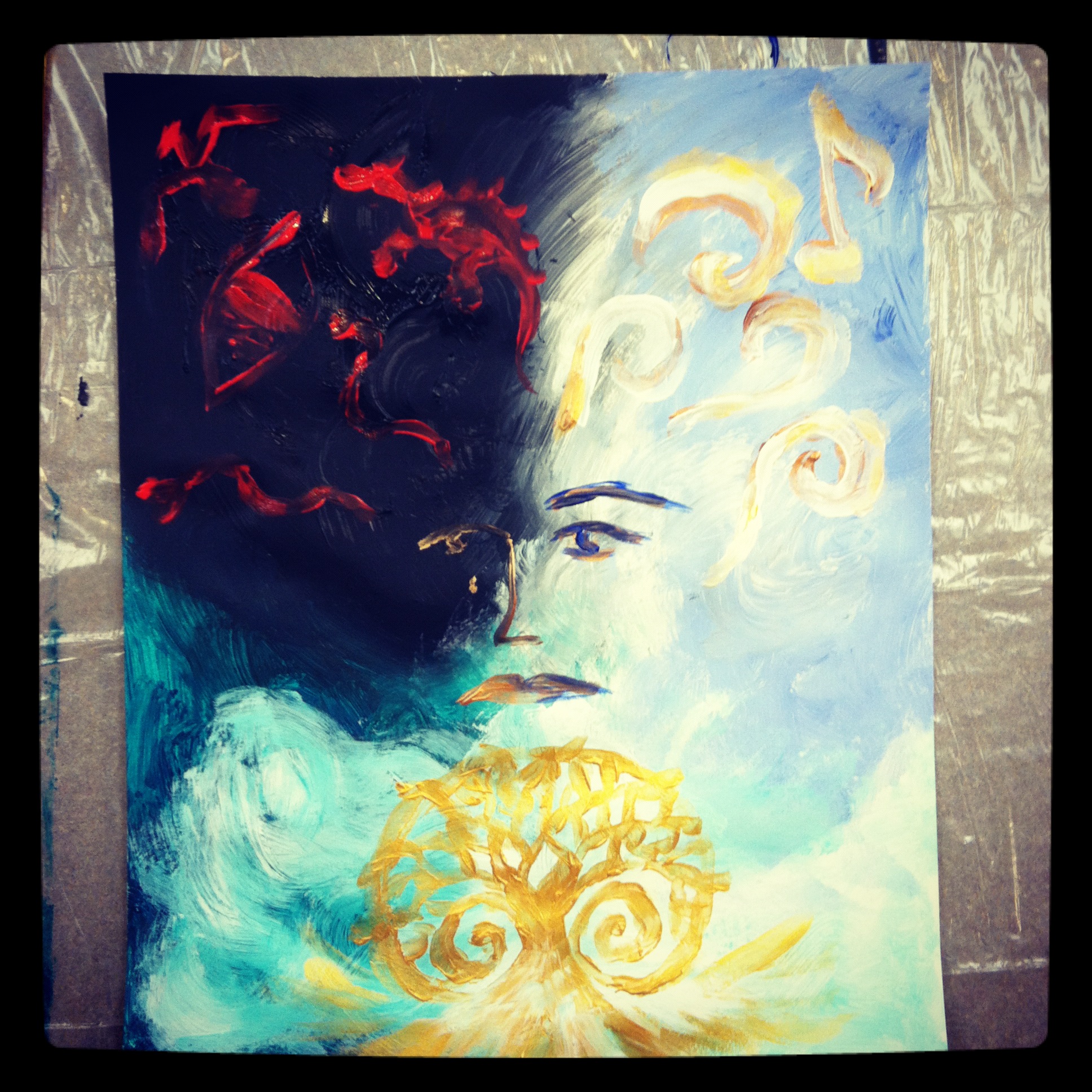
I wanted help and guidance, and so turned to one of my healers, Eileen O’Hare. Eileen is trained in a lineage of Andean Peruvian shamanism, and uses various indigenous techniques (inquiry, dialogue, song, art, visualization) to aid people in their personal growth and healing. I went to her last Sunday for a session. It was supposed to last about an hour and a half, but we ended up going for nearly 4 hours. It was a powerful experience I’d like to share, with the intention that it inspires a path to healing or self-inquiry for you. Continue reading →

When Passion Isn’t Enough

24 Friday Feb 2012

Posted by Venessa Miemis in Uncategorized

≈ 14 Comments

Tags

community

I recently had an email exchange with a colleague, who was sharing his frustrations about “following one’s passion.” It seems he’s looking critically inward at the alignment between his drives and motivations, and checking that against the reality of his actions.

Is change being made, or just spoken about?

He acknowledges the comfort of his siutation, which enables him to not have to act, but seems to be coming to a place where he chooses to act anyway. It may be more scary than philosophizing from the sidelines, but it means a direct experience of life.

I’ve been going through a similar thought/emotional process myself, and could relate to what I interpret as feelings of hypocrisy. The raising of self-awareness has been forcing me to ask myself continuously if I’m practicing what I preach, and realizing that if/when the answer is no, I’m best to just keep my mouth shut.

I was touched by this friend’s courage to face his own truth, and what appears to be a coming to terms with choosing what to *do* and not just what to say.

Below is his reflection, posted with permission. Continue reading →

The Critical Need for Self-Care When World Building

21 Tuesday Feb 2012

Posted by Venessa Miemis in Uncategorized

≈ 68 Comments

Tags

self

There’s a lot going on right now.I’m in the process of federating with a large number of people across the globe to form a new kind of living systems organization, and lay down infrastructures that we intend will lead us towards a desired socioeconomic paradigm and human operation system. We’re pioneering practices in cultural design, systems intelligence, and coordinated creative action at scale.It’s really, really hard.

It would seem that if one wants to engage in real transformation in the world, a shift has to take place, which is expressed through culture, but begins within.

Here’s an experiential exercise you can try, to simulate how I see it:

First, take your index finger, and point it away from you, and out into the world.

This is what all of us are familiar with doing, in some way. It’s identifying all the problems out there that need fixing. And there are many, many things, aren’t there? If only people would listen, things would finally change.

This is life from the bleachers.

Now, slowly redirect your index finger to point towards yourself, and bring it in until it’s touching the center of your chest. Perhaps you say out loud, “I AM.”

This is life on the field.

This is what world builders are doing. Continue reading →

How do we form tribes of greatness?

17 Friday Feb 2012

Posted by Venessa Miemis in Uncategorized

≈ 22 Comments

Tags

collaboration, Work

.
I’ve just returned from a two-day workshop sponsored by Agile Boston called The Core Protocols BOOTCAMP. The purpose was to go through an immersive experiential learning process to understand the fundamental mechanics and dynamics of forming GREAT TEAMS. Specifics included:
  • Results-oriented behaviors
  • How to enter a state of shared vision with a team and stay there
  • How to create trust on a team
  • How to stay rational and healthy
  • How to make team decisions effectively
  • How to move quickly and with high quality towards the team’s goals

The course was facilitated by an amazing couple, Jim and Michele McCarthy, authors of the book Software For Your Head.

My Takeaways

The outcome of the past two days is that my focus has been sharpened and honed on some critical components for forming extraordinary teams that can SHIP, scaling, and ultimately impacting epic cultural transformation.

The learning community in which I participate has actually been noodling over this inquiry for several months now, framed something like:

If we were to form a ‘next-gen Agency’ that utilizes swarm intelligence to build solutions, what is the most rapid and elegant way to:

1. Form a team.
2. Envision a product.
3. Agree on how it would be made.
4. Design and build it.

Turns out this is the exact simulation we ran through at BootCamp. Continue reading →

The Covenant-Formed Base Community: Personal Liberty, Corporate Power, and Cocreativity

17 Friday Feb 2012

Posted by Venessa Miemis in Uncategorized

≈ 8 Comments

Tags

books

I had the pleasure of spending time yesterday with Eric Harris-Braun & Arthur Brock of the Metacurrency Project, sharing thoughts about the federation of tribes we are forming, and the principles upon which this type of living systems organization should be founded. Eric shared this excerpt from the book Sanctuary For All Life by Jim Corbett, which felt powerful and true to me. I’d love to hear your perspective:

“A socialist collective and a capitalist corporation have the same organizational form, whatever the difference in their goals. Comrades, workers, and shareholders subordinate some of their rights of self-determination to a managerial command that unites them into a collective force for achieving an objective. Military mobilization is the historical taproot and conceptual paradigm for this kind of goal-directed solidarity.
This is a particularly effective way to overcome enemies, competitors, and other obstacles, whatever the means and regardless of side-effects. It is the way to defeat the Nazis, put a man on the moon, or mobilize a government-industrial complex that can compete globally. However, for human society to flourish as an association of cocreators, a common cause can’t replace a common ground of rights and responsibilities – not even when the corporate body’s directors are chosen democratically. A collectivity of comrades who serve a good cause fails to substitute for a society of friends who are free partners under no command.”

——

more excerpts from the book via eric’s blog

image

F-Suites for C-Suites: 4 Futures Thinking Toolkits To Help C-Suite Leaders Thrive in a World of Change

13 Monday Feb 2012

Posted by Venessa Miemis in Uncategorized

≈ 10 Comments

Tags

futures

Imagine your mind as a construct – a series of models, assumptions, biases, values, beliefs, memories, past hurts and joys, experiences, expectations, and blind spots.

It’s running a real-time simulation of the world 24/7, creating stories, scenarios, predictions of what could happen next and how a situation might play out. We run a cost/benefit analysis of the range of choices we could make, and then make decisions based on what we think will lead to our preferred outcomes.

This mind of ours is both a blessing and a curse.

On the one hand, an open, creative and imaginative mind has the capacity to envision futures that at first glance seem impossible or absurd, but on second glance make you go “hmmmmm.” On the other, our minds are fantastic of filling us with fears, envisioning scenarios of what could go wrong, and ultimately paralyzing us from taking any action at all.

It’s easy to get trapped in our most comfortable assumptions and models. It feels safe and familiar in there, where the territory is predictable and we have reference points for understanding situations likely to be confronted in ‘the real world.’

The bad news is, we’re in transition. The world is changing. Things are moving, shifting, adapting, at an accelerating rate.  Comfortable and familiar mental models may feel safe, but pretty much leave us with our pants down when a new system or paradigm emerges that reframes “how things work.”

You’ll wonder why you didn’t see it coming.

The good news is, the mind is plastic, flexible and pliable. We ARE capable of expanding our thought architecture to accommodate the imagining of new models and “crazy ideas” that actually just might work.

The ecosystem around is alive and buzzing right now, ripe for an explosion of innovations and shifts that will transform how things function at a multitude of levels.

Who’s going to harness the opportunities first? And how is it done?

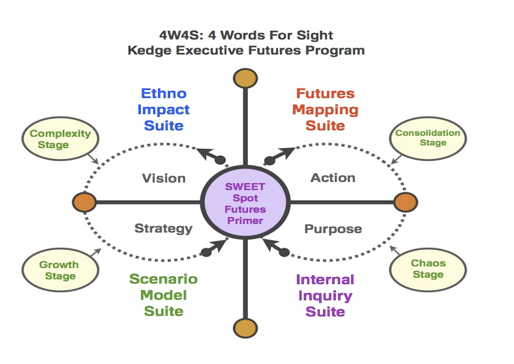
I decided to touch base with my colleague Frank Spencer, founder of the foresight and design consultancy, Kedge. I asked him to share his views on which futures thinking “suites” he’s found to be the most useful for C-Suite leaders committed to expanding their mental horizons in order to pioneer new ground.

Below are 4 he believes should be in every leader’s toolbox:

—
—
:: Internal Inquiry Suite ::

:: Internal Inquiry Suite ::

The Futures Thinking tools in this group not only give an individual or organization a glimpse into how they think about the future, but also help in getting past assumptions and biases so that they are open to alternative outcomes, potential risks, and hidden opportunities.

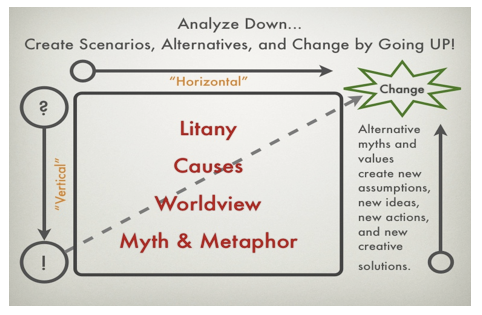
The star of this set is known as Causal Layered Analysis (CLA), a method for digging beneath the obvious facts and events that we all see on the “surface” of everyday life.

Layer 1 – THE “FACTS” (official unquestioned view of reality)

CLA begins by having the user write down the facts around an issue (ex. “The Stop Online Piracy Act [SOPA] seeks to put an end to the illegal activity surrounding the intellectual property of the entertainment industry by online file-sharing sites”.) This factual information (the first layer of CLA known as the “litany”) is then analyzed through 3 more layers, each addressing a deeper level of internal meaning that caused the litany to be constructed in its present state.

Layer 2 – THE “SYSTEM’ (social system/structure informing ‘reality’)

The level at which the user uncovers the structures and actors that are causing the litany to appear on the “surface” in its present form.

(ex. “The entertainment industry has a monetary interest in protecting their IP from piracy. The present system is set up in such a way that entertainers create a product or IP, and sell to consumers through various means of delivery such as CDs/DVDs or digital downloads via online stores such as iTunes. The internet creates a huge disruptor to this model, and government legislation is the means to police and protect the present global economic model.)

Layer 3 – THE “WORLDVIEW” (deeper unconsciously held assumptions)

The “worldview” that is creating this present systemic approach.

(ex. Government intervention is needed across sectors and domains in order to assure economic protection. Government and industry must partner in order to assure global growth and stability. 2-way monetary exchange of goods is the only means to job development and economic growth. Big government is good.)

Layer 4 – THE “MYTH & METAPHOR” (unconscious emotional narratives about reality)

The “myth and metaphor” layer that reveals the deep ideas that an individual or culture holds that are giving birth to any singular worldview. This level can be expressed in statements, pictures, imagery, or any other means that helps to unveil the deeper cosmology of the user.

(ex. Tribalism, scarcity, and fear are universal motivators of human activity. “Might makes right.” Power is the chief means to social change. The great law-giver. etc.)

With this model in mind, a CLA map might look something like this:

.
Other tools in this suite include:
  • Spiral Dynamics Integral (SDi), used to understand and inform personal and collective growth through internal modeling.
  • Theory U, a change management method that targets inner knowing and innovation in leadership, helping leaders break past unproductive patterns of behavior and realize future possibilities.
  • Action Inquiry, a tool to initiate progressive problem solving through understanding the underlying causes surrounding personal and organizational change, increasing the wider effectiveness of our present and future actions.
—
—
:: Environmental Impact Suite ::
.

:: Environmental Impact Suite ::

Headlining this suite is a method called Futures Wheels, a means for envisioning the future implications of any critical issue, focal decision, or emerging trend. These implications are then used by leaders to inform strategy and action in an organization, creating a more robust and resilient outcome. Though the tool is not limited in the amount of implications that can be developed, most Futures Wheels exercises use 3 expanding levels – far enough out from the original trend or decision to get a good look at the possible risks and opportunities that could impact the organization.

Other tools in this suite include:

  • Organizational Culture Assessment (OCAI), a method for gauging the health of any organization’s internal culture and external connection.
  • STEEP and Environmental Scanning, a system for identifying the emerging trends and issues across the various driving forces, and categorizing them around patterns that indicate future possibilities.
  • VERGE is also an environmental scanning tool. Rather than focusing on the “point of origin” as is the case with STEEP (social, technological, environmental, economic, political), this tool scans the driving forces from the perspective of the “point of impact.” (i.e. how will trends and issues define the end-user.)
  • Probability/Impact Matrix is a tool that categorizes emerging trends as to their degree of probability and impact. For example, if a rising event has a fairly high degree of happening, and such an event would have a substantial impact, then a leader of company should make provisions for that event in their strategy.
—
—
:: Futures Mapping Suite ::


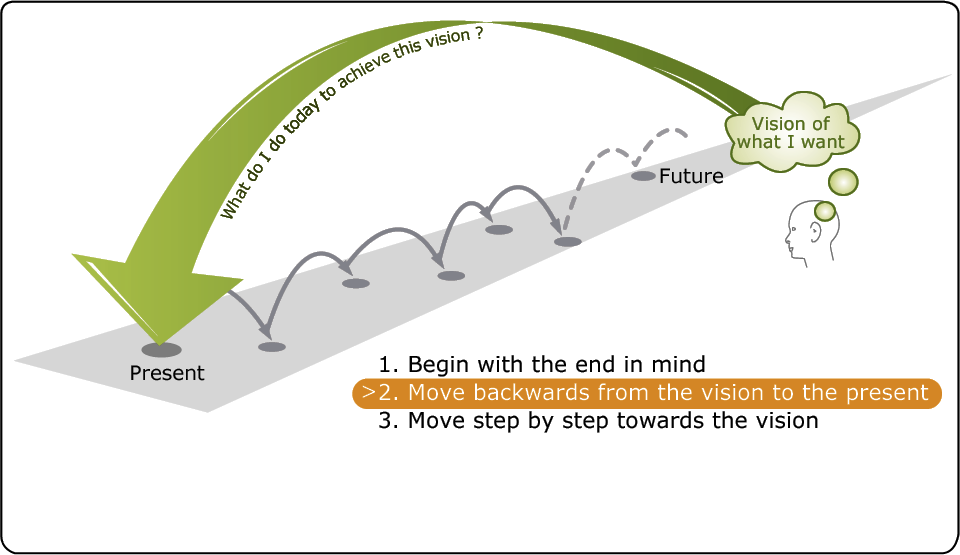
(image via http://cindyu.files.wordpress.com/2010/03/backcasting_allbox.png)

:: Futures Mapping Suite ::

One of the more popular tools in this suite is known as Backcasting. Through this method, strategic teams can begin at a preferred or aspirational future and work backwards over time to identify specific strategies that will be needed to support that future. In this way, leaders can clearly understand not only what strategies and actions will be needed, but also the time increments in which those strategies must be implemented or obtained.

Other tools in this suite include:

  • Metamatrix is a tool used to map the natural growth curves of any organizational vision, strategy, or product, highlighting points of breakthrough as well as breakdown. In this way, a map is developed for reaching preferred futures and uncovering new and untapped opportunities.
  • Migration Landscaping is like backcasting in reverse, and is useful in identifying the obstacles or points of contact for an organization’s journey toward a certain future outcome.
  • Systems Thinking has become very popular in many disciplines over the past 10-20 years, and for good reason: mapping a business or organizational system not only reveals why certain outcomes are occurring, but also allows the user to see which players and structures in the system can be added, deleted, or moved in order to change future outcomes.
—
—
:: Scenario Modeling Suite ::


(image via http://www.softwarebee.com/preview/scenario-planning-mba-19590.jpg)

:: Scenario Modeling Suite ::

One of the most popular methods associated with Futures Thinking is Scenario Planning & Development. In employing this tool, companies can understand how the future will “play out” under different emerging trends and alternative outcomes. With the well-informed stories of multiple futures in-hand, leaders can then make their strategies much more robust and adaptive, ensuring both surviving and thriving no matter which future unfolds.

Other tools in this suite include:

  • Trend Cards is one of the most popular methods with groups because it allows them to imagine, create, and play! In this method, a small group is given 3 or 4 “trend cards” (each card explains a different emerging trend and comes from a different driving force), and they are then asked to develop a short story that describes a world where these trends intersect and define the landscape.
  • Design Fiction is a fairly new method of imagining the future of a particular strategy, action, or product, connecting the disciplines of design and futures thinking. Science Fiction is a natural medium for design fiction, describing new technologies and worlds that are products of a world beyond today. Some fantastic design fiction projects have been created in the last several years in which actual products, magazines, technological prototypes, and advertising campaigns were placed in public locations, forcing individuals to interact with a future they may not have imagined.
  • Scenario/Strategy Matrix, a tool that is often used after a scenario planning and development project. This method allows the user to gauge the “future-readiness” of their organizational strategies under the various scenario conditions, ensuring that attention is given to making each strategy robust, adaptive, and transformational.
  • Signposts can be added to the end of a scenario planning project as well, suggesting scenario times frames, and pointing out the specific emerging obstacles that could put the brakes on any particular strategy.
—

Now imagine these “suites” as one comprehensive learning program, each piece building on the last to help leaders across disciplines to integrate the competency of futures thinking. That’s exactly what Kedge has done in creating our Executive Futures Program, with an eye on working alongside the leaders of the 21st Century to raise the “foresight IQ” in organizational and social enterprise. This means promoting leadership that understands the necessity of viewing the future through the lens of alternatives rather than linear outcomes. This emerging breed of new thinkers knows that complexity is a birthplace for opportunity rather than an enemy to be avoided at all costs, and that a picture comprised of multiple outcomes holds the key to answering our greatest challenges.


As our present landscape of volatility has many leaders scrambling to create “survival manuals,” those who are learning and employing the skill of Futures Thinking are realizing that we can operate out of an entirely different mindset – trailblazing a path into new organizational structures and ideas, new entrepreneurial ventures and social innovations, and new economic terrain that will allow us to thrive.

—-

Prior to founding the futures & foresight, innovation, and strategic design consultancy Kedge, Frank spent 15 years as a leadership coach and developer with entrepreneurs, social communities, networking initiatives and SMEs, helping them to create social innovation, organizational development, and transformational inititives. He holds a Master of Arts in Strategic Foresight from the School of Global Leadership and Entrepreneurship at Regent University, and is a member of the Association of Professional Futurists and the World Futures Studies Federation. With a strong background in both business and academic foresight, Frank created the first futures and foresight course for developing solutions to “wicked problems” at the Duke University TIP Institutes (“The Futures Institute: Creating Tomorrow Now”), is on the organizing team to develop the MSc in Foresight and Innovation at ISTIA/The University of Angers in France, and will begin teaching a course on advanced foresight in organizations at The Savannah College of Art and Design Spring 2012. As a partner at Kedge, Frank has created future-ready strategy, opportunities, and action for companies such as Marriott, Mars, Kraft and Disney, and has spoken to various groups and conferences over the last 20 years on topics such as leadership development, community and social architecture, the importance of the skill of futures thinking, creating corporate foresight divisions, recognizing the impact of emerging trends and issues, identifying and seizing unseen opportunities, and reaching business aspirations and preferred futures. Find Frank on twitter @frankspencer.
.
.

Further Reading:

3 Reasons CIOs Need Scenario Planning
This Is Generation Flux: Meet the Pioneers of the New (and Chaotic) Frontier of Business
Foresight Education and Research Network
Acceleration Studies Foundation
World Future Society

Bootstrapping Humanity’s Next OS

09 Thursday Feb 2012

Posted by Venessa Miemis in Uncategorized

≈ 42 Comments

Tags

projects

(Photo credit: Vicky Brago-Mitchell www.abm-enterprises.net/wallpaper.html)
.
Whew, what a month!
.
2012 is moving forward at a rapid clip, and construction of our new operating system is manifesting before my eyes!
.
Here’s what I’m seeing happen:
.

The last few years have been spent building our networks. Getting plugged in, getting connected, and sending out probes to “find our tribes.” We are RAPIDLY finding each other now, and nodes are beginning to form as people cluster around shared intention and define new organizational dynamics of how they’d like to align and join forces.

I’m seeing people “wake up” to the realization that there is a massive amount of value to be unlocked as we shift away from old metrics of “what we value” and into new metrics for wealth and meaning. The new metrics are emergent, but clearly multidimensional and human-centered.

So what’s changed?
.
The guidance system itself that we’re plugging into is shifting. The externally-oriented system that we previously relied upon was rooted in the masculine-dominated expressions, valuing individual outcomes in a zero-sum game with a “winner take all” mentality focused on short-term rewards. (ie – if i win, you lose).Now, the guidance system is more internally sourced and hard-coded towards a non-zero sum game, where winning means generating more abundance for both the individual and the entire ecosystem. It’s interdependent and synergistically oriented for the collective epic win, while expressing reverence for our individual autonomy, and the uniqueness of what each of us is capable of calling forth into the world.
.

Here are some of the axies I see in shift:

– from scarcity to abundance
– from finite to infinite value
– from ownership to stewardship
– from transactional to relational
– information hoarding to knowledge creation
– from isolation to cocreation
– from passive consumer to active producer

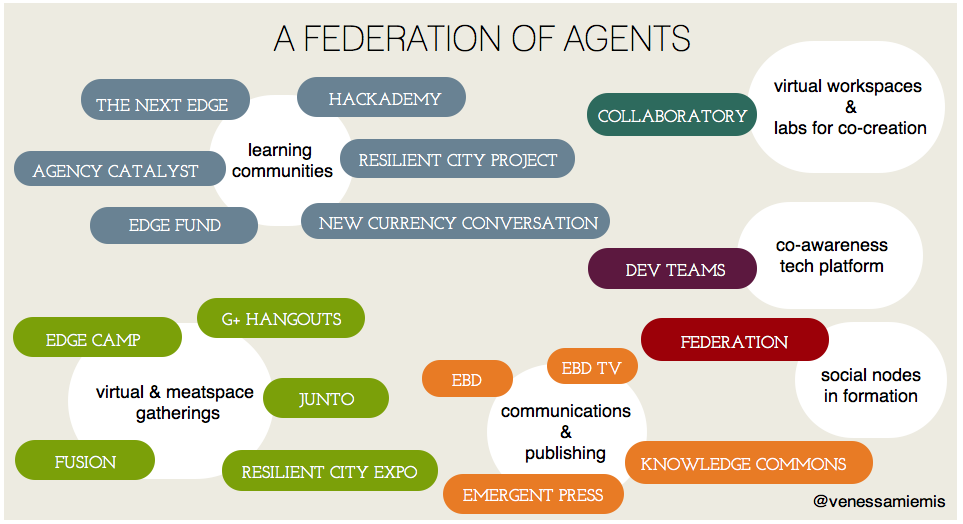
These shifts are visible in many new forms, and I’m excited to be a part of the evolution. Below is a visual of exciting projects in gestation, new platforms and products under development, and adaptive chaordic organizations in formation — all of which I’m playing in.


w00t!
I’ll share more specifics about these initiatives soon.
.
For now, our next steps include:
.
– establish initial coherence among those who choose to play
– self-select based upon vision, intention, and project interest area
– create an architecture for how people can plug in to each other via a sustained connected framework
– demonstrate collective epic wins 🙂
.
These steps will enable us to begin prototyping the human protocols for swarm behavior around time-based projects, which we believe is the cutting edge of the future of work.
.

There are many swarms of similar activity taking place across the planet, with many “BuilderShips” approaching liftoff. As part of humanity’s new OS, we anticipate these nodes will become interconnected, mutually informing, and co-arising.

.

What other nodes do you see forming?

–
this post was cocreated by venessa miemis and kirstin ohm

ANNOUNCING: Aevolution :: An Auto-Evolutionary Treatise

09 Thursday Feb 2012

Posted by Venessa Miemis in Uncategorized

≈ 7 Comments

Tags

social evolution

This is a guest post by Lynne Desilva-Johnson, cross-posted from her blog, The Trouble with Bartleby

——-

So… I’ve begun writing a book. On Evolution.
(What?! I know. It sounds crazy to me too.)It’s hard to start a sentence with “basically” about the book’s concept, but it boils down to the idea that we are “aevolving,” or, “auto-evolving.”

That is to say, I propose that we are in the process of evolving our selves, not only generationally but laterally.

Which brings us to The Big Caveat:
I am not an empirical scientist, nor is the book by any means an empirical exercise.

If there must be a title, I am a philosopher (and poet) …though I am fond of “alchemist,” as well.

While I am the first to admit that while my background includes a love of an relationship to hard science, I also wish to stress from the outset that neither I nor this book intends or suggests to offer the type of “truth” allowed for via empirical methodologies.

In fact, this study relies on the opposite: an understanding of strict empiricism as limited by our own perceptual limitations. At the same time, though, it always allows for and wishes to engage with those instances where (despite our limitations) we feel, intuit, perceive, detect, and are able to document “proof” allying with my theoretic explorations — in the lab or beyond.

The first hint in cyberspace that this project was underway was my recent call for “forward thinking evolutionary biologists or similar” which went out into the twittersphere as well at to the Next Edge and Federation/Emergence Collective groups via Facebook — a move which has already and will continue to prove essential to the evolution of the book, in ways that in fact demonstrate some of the concepts I will outline as we move forward.

That is to say — our evolution, in the way I propose (which isn’t necessarily a new phenomenon) has been accelerated to the point of visibility only via its collusion with a peak in technological/systems capabilities that have allowed our patterns of communication to begin operating at a similar speed and in similar, seemingly “chaotic” patterns — algorithms central to other organic/universal (ie, biologial, mathematical, ecological, astological) phenomena.

Not only do I have no wish to claim this book as empirically “true,” I also have no desire for a traditional, academic-intellectual-ontological “ownership” of its evolution in my own psyche. As I pull from my various inputs and experiences, the exponential bibliography of study and happenstance that has led to my being able to derive and put forth this treatise, I wish to humbly put forth that this is OUR book. I happened to have the series of personal, epistemological crises necessary for its emotional outcropping and eventual writing but I also know it to be the outcome of interactions, systems, energies, and knowledge far beyond my capacities.

This book, in its writing, has been and will be pulled from a range of resources. It relies on an intellectual tradition (as well as silenced counternarratives), personal and social observation, and perceptual phenomena both personal and shared. Critically, it relies on a vast pool of shared resources, drawing for each of its chapters from the deep wells of inquiry I have the priveledge to be privy to across a wide range of disciplines both intellectual and spiritual. Friends, friends of friends, and contacts from every area of my life — all of whom I like to consider friends in deed.The intention is to document the process of this books own Aevolution as I write via chapter treatments and research, posted via my blog and concurrently on Emergent by Design.

Considering that I still, somehow, work two jobs totalling 50-odd hours a week (neither of which are at a computer), am doing my very best to give all I can in support of Beckett Rose and her Daddies, and co-edit a magazine launching next month, I am grateful to still have the mental acuity to write this at all! What this means, though, is that posts more frequently than monthly are unrealistic.

In the interim, of course, I will continue to seek collaborators and resources, and of course will be very grateful for any guidance towards (or offers of) funding to help me complete this project. I may, in fact, decide to Kickstart it… but I’m still very Borges-like in my fear of over-publicizing something yet so nascent beyond a controlled sphere.

What you see below is a guiding quote, from French lettrist Gabriel Pomerand, and my working Table of Contents. I hope that within a week or so I’ll be able to post another introductory blog further unpacking the essential theoretical components behind this hypothesis… please note that as these first theoretical ideas form they are not always entirely ready for deconstruction and deep dissection, and as such I may not automatically engage in theoretical debate (yet).

However, please contact me if you feel inspired to share personal observations or stories, contacts, resources, structural or practical meta-suggestions, or other (gentle) thoughts of any kind. I thank you for your time, your support, and your (anticipated) patience during this process — I could not have, can not, and will not be able to do it without you.

ONWARD!
Lynne DeSilva-Johnson
2.9.2012

_________________________________________________________


AEVOLUTION :: An Auto-Evolutionary Treatise


I want to work the miracle which is precisely the act
whereby one comes to no longer believe one’s own eyes.
– Bernard Pomerand


Contents May be Under Pressure

Preface:  Intention and Goals, Framework, Intellectual Heritage
Introduction: “Aevolution” unpacked: theory and practice

BACKGROUND THEORY

The Science and Spirituality Dialectic:


Hard Science (Pun Intended): Empirical Underpinnings
Magical Realism: Esoteric Wisdom Traditions


OBSERVABLES

Cultural Output/Materia

Avant Garde/Creative Experimentation and Expression
Evolution of “Language”/Universal Communication

Channels of Practice: Tattoos, Technology, and Transcendence

– Auto-Aesthetic and Interperceptual Markmaking – Includes/not limited to Body Modification and Dress

– U-Topia: Liminal/Palimpsestic/Rhizomatic Environments/Rituals/Events/Use of Space
– Emergent Efficiencies: New Technologies, Avatar Activity and Quantum Simultaneity
– Queer to Stay: Genderfluity as an Evolved Body/Mind State
– Transcendence: Lightwork, Psychedelia and Energy Bodies


Conclusion: AEvolutionary Manifestation and Intention: A Practical Guide

___
**the image here is from Esther Johnson, a contemporary artist residing in Mississippi, USA
—–
Lynne DeSilva-Johnson prefers to be described in the universal language we’ve only begun to (re-)learn. In lay English she can be called Poet, Educator, Philosopher, Alchemist, Friend, Artist, Writer, Healer, Conduit, Rogue, Free Spirit, Instigator and occasionally Curmudgeon. Her students think she is Eccentric, and she likes that very much indeed.She can be found at The Trouble with Bartleby, via @onlywhatican, and lurking in the cobwebbed corners of the mental universe.

7 Values of a Next-Gen Agency

06 Monday Feb 2012

Posted by Venessa Miemis in Uncategorized

≈ 8 Comments

Tags

books

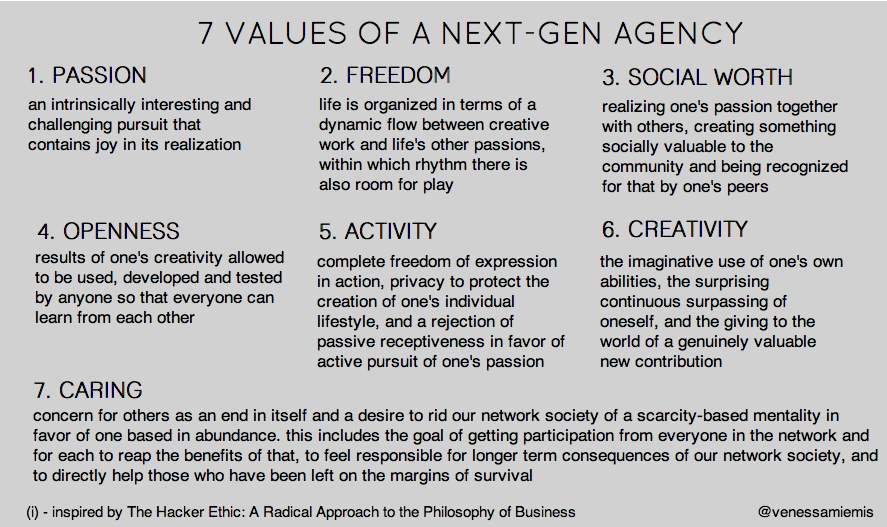
As some of you know, I’m in the midst of helping build a chaordic living systems enterprise. Our core group is currently having fascinating conversations about mission, values and the kind of culture we want to cultivate amongst ourselves, which in turn will inform what we model and inspire in the world.

As the days go by, we’re becoming more comfortable opening up to each other and really unpacking our core beliefs. This is helping us find alignment and coherence, which must happen before we construct our shared vision and lay our foundation.

I’ve been thinking a lot about open-source philosophy, creative work, and a passion-driven lifestyle. While on my flight out to San Francisco yesterday, I reread a book from my graduate work called The Hacker Ethic: A Radical Approach to the Philosophy of Business. (a hacker, btw, is defined as “an expert or enthusiast of any kind”). They laid out some core values of the hacker ethic, which felt very much in alignment with the way I operate and how I’d want to interact with my colleagues in this creative economy.

How do these 7 values strike you?

Tribe Dynamics: Appreciating Your Team’s Strengths to Build Coherence & Trust

04 Saturday Feb 2012

Posted by Venessa Miemis in Uncategorized

≈ 8 Comments

Tags

Design

coherence ::

1. the quality or state of cohering: as

a : a systematic or logical connection or consistency
b : integration of diverse elements, relationships, or values
2. the property of being coherent <a plan that lacks coherence>

How can we best surface our gifts and strengths?

How can we engage in meaningful work that motivates us through the elements of autonomy, mastery and purpose?

How do we amplify the strengths of our peers and cocreators?

How do we appreciate those strengths and align with them in order to build dynamic, high-performance, and highly coherent work teams?

As I’m participating in projects more and more with people across disciplines and boundaries, we’re experimenting with new ways to ask and answer these questions.

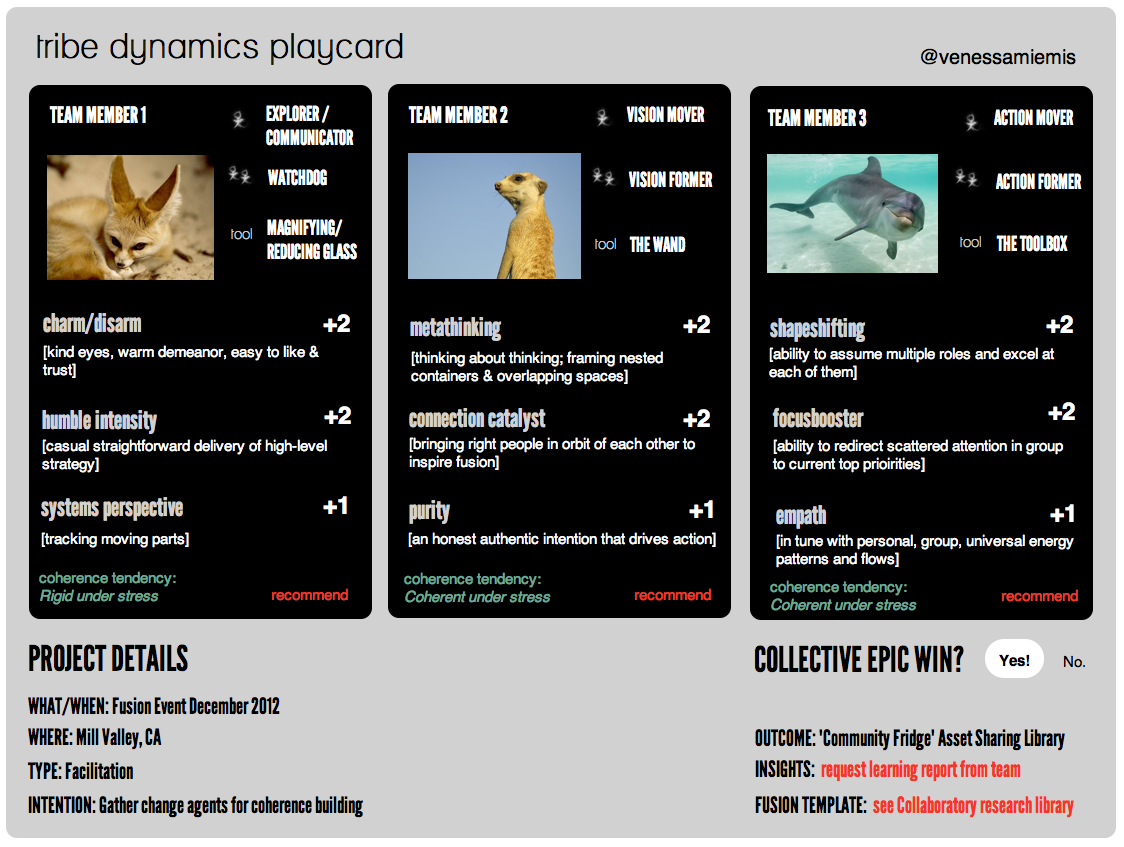
In December I ran a Fusion event in California with David Hodgson, Kirstin Ohm, and Adam Scislowicz. When the even was done, David suggested an exercise for us to show our gratitude and appreciate for the things we noticed as the inherent talents of the others.

We distributed 5 points per person in any combination to rank the person’s “superpowers” (performance, attitude, awareness, etc). We logged these responses into a google spreadsheet with the following columns:

[person giving] / [personal receiving] / [experience points] / [gifts acknowledged] / [assessment]

Then we hopped on a google hangout and shared our thoughts with each other and gave specific examples about when we saw each person’s gifts shine.

A few great things came of this process.

For one, it was fun. I’d never been challenged before to identify people’s natural gifts in this way — usually it’s just the opposite – you’re asked to examine the “failures” and figure out “what went wrong.” There were things that didn’t go as planned during the event, but starting our session with appreciation for each others’ efforts created a safe environment for being open and honest. We were then able to honestly discuss the things that played out suboptimally, and then described scenarios for how we could handle that type of situation more effectively in the future.

Secondly, it helped me to better understand our ‘tribe dynamics’ – how our personalities and styles can actually amplify the overall performance of the team, if acknowledged and understood coherently.

And lastly, it taught me more about myself. I’m finding it very interesting to learn that the way I see myself, or the things I think I bring to the table, are not always the things that others acknowledge or appreciate in me. Some of the acknowledgements i was given in this exercise were “story weaving,” “emergent facilitation,” and “completion,” all of which I would probably rate myself as a novice or apprentice. And yet these were the hidden gems that they could see were waiting to be polished up and brought forth.

I plan to continue participating in this type of process, not just on co-facilitated events or projects, but on a regular basis as I’m interacting with the people in my learning community. Participating in these feedback loops and productive discussions accelerates all of our learning. We get clarity on who we really are and where we excel, receive continuous feedback from trusted peers and mentors, and generally get a better understanding of ourselves, each other, and the dynamics between them.

In the larger context of the creative economy that we’re bootstrapping, these kinds of practices seem to be part of the foundational structure that will build trust and cultivate the kind of culture that is favorable for the kinds of change we want to see in the world.

—

further exploring:

The Gabriel Institute – role-based assessments / organizational dynamics / technology of teaming

Drive – Daniel Pink


abundance anti-rivalrous authority biohacking books cognitive enhancement collaboration commerce communication community consciousness consciousness & evolution consciousness hacking creativity creativity + design culture currency decor Design digital literacy ello entheogens ethics evolution flow futures innovation interview microdosing money money + currency neurohacker collective neurohacking neuroscience neurotech nootropics personal development philosophy projects psychedelics psychotherapy reputation Resources response-ability scarcity self smart drugs social evolution social innovation Social Media social organization society sovereignty style sustainability technology technology + society Trends Video vision willpower women Work workshop

Archives

Blog Stats

  • 1,120,676 hits

Enter your email address to subscribe to this blog and receive notifications of new posts by email.

Join 1,187 other subscribers

Top Posts

  • A Step-by-Step Guide to Tribal Leadership: Part 1: The Five Stages of Tribal Culture
  • Mapping the Identity Management Landscape: 29 Providers
  • 4 Trends Shaping the Emerging "Superfluid" Economy
  • 3 Patterns of Behavior Blocking Your Path to Mastery
  • 5 Key Issues Impacting the Future of Facebook

Recent Posts

  • What it Means to Be A Neurohacker
  • Using Psychedelics to Increase Performance and Reprogram the Mind/Brain Interface
  • Why the World Needs Neurohacking Now
  • The Neurohacker’s Toolbox: Nootropics
  • What is Neurohacking?
  • when the mind hijacks my flow state
  • what mental slavery looks like: repressive & reactive patterns
  • Constructing the New Narrative
  • i am a consciousness with a society of personalities
  • on the forcing of willpower & the art of relaxation

@venessamiemis

Tweets by venessamiemis

Emergent by Design

Emergent by Design

Recent Comments

Venessa Miemis's avatarVenessa Miemis on Why the World Needs Neurohacki…
Monica Anderson's avatarMonica Anderson on Why the World Needs Neurohacki…
Venessa Miemis's avatarVenessa Miemis on The Neurohacker’s Toolbo…
bonnittaroy's avatarbonnittaroy on The Neurohacker’s Toolbo…
What is Neurohacking… on What is Neurohacking?
Creative Commons License
This work is licensed under a Creative Commons Attribution 3.0 Unported License.
  • RSS - Posts

Blog at WordPress.com.

  • Subscribe Subscribed
    • emergent by design
    • Join 1,187 other subscribers
    • Already have a WordPress.com account? Log in now.
    • emergent by design
    • Subscribe Subscribed
    • Sign up
    • Log in
    • Report this content
    • View site in Reader
    • Manage subscriptions
    • Collapse this bar
 

Loading Comments...