• about
  • projects
    • Beach Loft Interior Design
    • Contact Conference
    • Emerging Leader Labs
    • Junto
    • Open Foresight
    • The Future of Money
      • future of money, cont.
    • The Future of Facebook

emergent by design

Category Archives: Uncategorized

Thoughts on the Future of Work

03 Thursday Dec 2009

Posted by Venessa Miemis in Uncategorized

≈ 3 Comments

Tags

Work

Add to FacebookAdd to DiggAdd to Del.icio.usAdd to StumbleuponAdd to RedditAdd to BlinklistAdd to TwitterAdd to TechnoratiAdd to Yahoo BuzzAdd to Newsvine

This article is cross-posted on unstructure, in response to Julian Birkinshaw’s post, Will the role and influence of the employee be different in the new world of work?

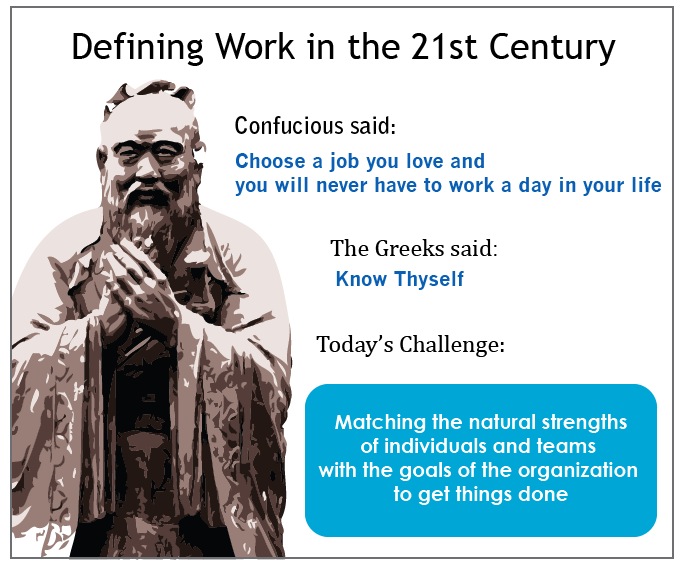
Berkinshaw’s article focuses heavily on analyzing motivation and its drivers as an approach to discussing new management models. Defining motivation and breaking it down into categories is fine, but as Marc Buyens (@mbuyens) said in the comments section, it may be a way of overcomplicating a relatively simple concept.

We know that humans are driven by some motivation for every action that is taken. In terms of how to motivate workers, it seems like it can be simplified into a sentence:

People want to perform work that matters to them. Continue reading →

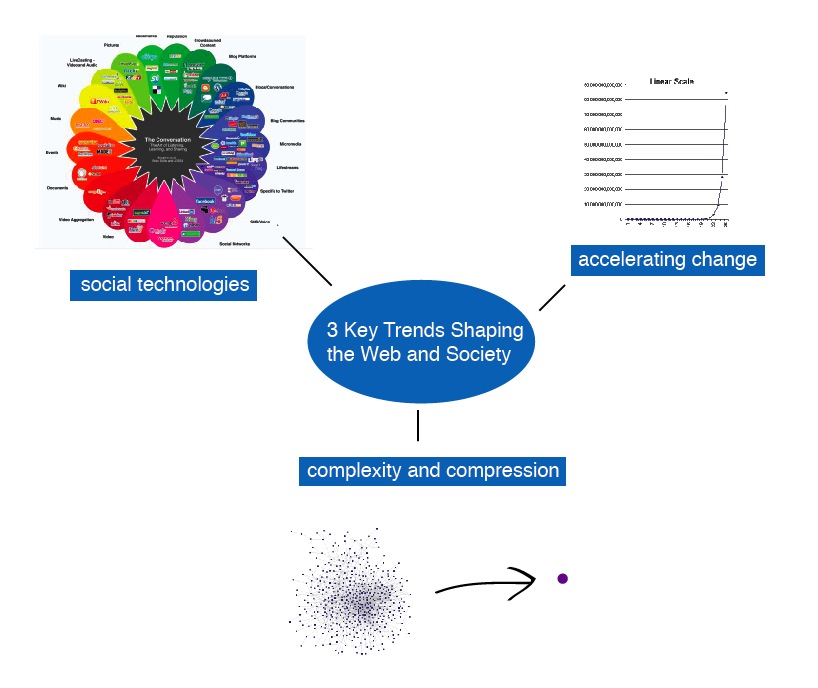
3 Key Trends Shaping the Web and Society

02 Wednesday Dec 2009

Posted by Venessa Miemis in Uncategorized

≈ 33 Comments

Tags

social evolution

Add to FacebookAdd to DiggAdd to Del.icio.usAdd to StumbleuponAdd to RedditAdd to BlinklistAdd to TwitterAdd to TechnoratiAdd to Yahoo BuzzAdd to Newsvine

Can we better equip ourselves to deal with constant change by seeing things through a new lens?

I started exploring this question with the Metathinking Manifesto, and I’m going to try and flesh out those ideas a bit further. Continue reading →

Twitter’s Intelligent, Welcome to Web 3.0

26 Thursday Nov 2009

Posted by Venessa Miemis in Uncategorized

≈ 36 Comments

Tags

Social Media

Add to FacebookAdd to DiggAdd to Del.icio.usAdd to StumbleuponAdd to RedditAdd to BlinklistAdd to TwitterAdd to TechnoratiAdd to Yahoo BuzzAdd to Newsvine

“Collective Intelligence (CI) is the capacity of human collectives to engage in intellectual cooperation in order to create, innovate, and invent.”
– Pierre Levy + James Surowiecki + Mark Tovey

I wrote a post a few days ago, Is Twitter a Complex Adaptive System?, that proposed the idea that Twitter may be evolving into an entity of sorts, a collective intelligence. I’ve come across some new posts that are amplifying that meme, and I just want to keep the thoughtstream going.

Insight #1

I was reading an article by Nova Spivack from 2006 over on Ray Kurzweil’s site, titled The Third-Generation Web is Coming. In it, he lays out the evolution from Web 1.0 –> Web 2.0 –> Web 3.0, a more intelligent web “which emphasizes machine-facilitated understanding of  information in order to provide a more productive and intuitive user experience.”

He also lays out the key technology trends driving the evolution. Among them are Ubiquitous Connectivity (broadband, mobile internet), Network Computing (SaaS, P2P, cloud computing), and Open Information (open APIs, open-source software, OpenID).

Sound familiar? Continue reading →

85+ Resources: Educator Guide for Integrating Social Media

24 Tuesday Nov 2009

Posted by Venessa Miemis in Uncategorized

≈ 38 Comments

Tags

Resources

Add to FacebookAdd to DiggAdd to Del.icio.usAdd to StumbleuponAdd to RedditAdd to BlinklistAdd to TwitterAdd to TechnoratiAdd to Yahoo BuzzAdd to Newsvine

I hope this post will be a handy reference guide, especially for those teachers new to social media technologies and how to integrate them into the classroom. This resource is by no means exhaustive, but it’s a good starting point for finding the information and people that will help you make the transition into a ’21st century learning environment’. I intend for this to be a wikipost (I will update resources as they are shared with me by others), so feel free to bookmark the page and check in periodically for new material. Enjoy. Continue reading →

Is Twitter a Complex Adaptive System?

17 Tuesday Nov 2009

Posted by Venessa Miemis in Uncategorized

≈ 64 Comments

Tags

Social Media

Add to FacebookAdd to DiggAdd to Del.icio.usAdd to StumbleuponAdd to RedditAdd to BlinklistAdd to TwitterAdd to TechnoratiAdd to Yahoo BuzzAdd to Newsvine

I’ve seen a bunch of posts bubble up over the past few days that are really sparking my curiousity about what is really going on with Twitter, so I need to do a little brain dump. Bear with me.

Insight #1

An article by Rosabeth Moss Kanter was just published today on the Harvard Business Review website, titled On Twitter and in the Workplace, It’s Power to the Connectors. In it, she highlights the fact that there is an organizational trend moving away from the hierarchical networks of the 20th century, and towards complex, distributed, non-hierarchical structures of business organization and leadership.

She also points out that success today is based on a person’s ability to leverage power and influence within their social networks, to act as “connectors” between people and information, and in turn build social capital.

She leaves the evaluation of the significance of Twitter open-ended, but she lays out a few characteristics of Twitter that I found most interesting:

In the World According to Twitter, giving away access to information rewards the giver by building followers. The more followers, the more information comes to the giver to distribute, which in turn builds more followers. The process cannot be commanded or controlled; followers opt in and out as they choose. The results are transparent and purely quantitative; network size is all that matters. Networks of this sort are self-organizing and democratic but without any collective interaction.

(just keep those points in mind, I’m going to come back to it) Continue reading →

Filtered Twitter Accounts

16 Monday Nov 2009

Posted by Venessa Miemis in Uncategorized

≈ 17 Comments

Tags

Social Media

I came across an article Robert Scoble wrote yesterday about the new method he’s going to use to organize his Twitter accounts. He’s been getting really excited lately as he figures out how to efficiently use Twitter to access good information that’s important to him. I’m going to write about the importance of media scanning as part of a “metathinking” framework in an upcoming post, so I’ll leave the commentary about what he figured out about Twitter lists for later.

Basically, Scoble decided to create multiple Twitter accounts to organize the different types of information he produces:

scoble text

The value to this is much deeper than it may appear at first. Twitter is an amazing experimental grounds in figuring out how to leverage the power of the real-time web. Besides being an incredible platform that essentially operates as an “idea exchange”, where we can chew on ideas and news together collectively, it’s an amazing source of information acquisition. Continue reading →

A Metathinking Manifesto

15 Sunday Nov 2009

Posted by Venessa Miemis in Uncategorized

≈ 36 Comments

Tags

social evolution

Add to FacebookAdd to DiggAdd to Del.icio.usAdd to StumbleuponAdd to RedditAdd to BlinklistAdd to TwitterAdd to TechnoratiAdd to Yahoo BuzzAdd to Newsvine

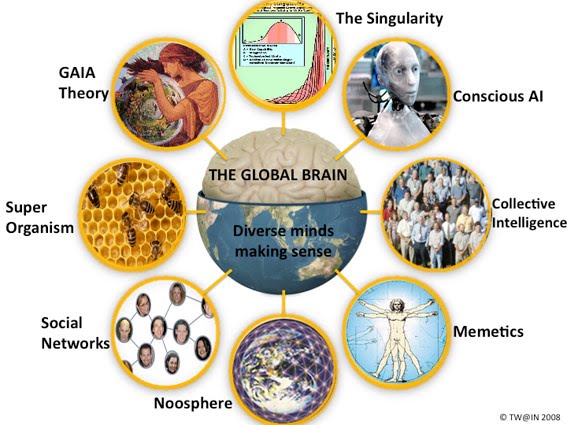
the-global-brain-google-knol-twain-26nov2008
The significant problems we face today cannot be solved at the same level of thinking we were at when we created them. – Einstein

For several years now, I’ve been studying the intersection of technology, culture and communication, the impacts of social media, the relationship between creativity, innovation and design, and the potential of various futures.

I’ve had this gnawing sensation at the edges of my mind that all these areas were held together by a common thread, but I couldn’t put my finger on the connection. My intention is that by taking this out of the incubation stage in my head and putting it into words, it will become clarified and provide some value.

First off, let me lay out a framework . My ideas are based on 3 main concepts:

* Social media is fundamentally changing the human experience.
* The world is increasing in complexity.
* We are experiencing accelerating change.

And a brief explanation of each: Continue reading →

40 Great Resources for Developing a Community Management Strategy

13 Friday Nov 2009

Posted by Venessa Miemis in Uncategorized

≈ 9 Comments

Tags

community

Add to FacebookAdd to DiggAdd to Del.icio.usAdd to StumbleuponAdd to RedditAdd to BlinklistAdd to TwitterAdd to TechnoratiAdd to Yahoo BuzzAdd to Newsvine

A practical guide for Community Management strategies, best practices, and resources.

networking

Tools for Community Managers: Networks & Social Media Guidelines

  • The Community Roundtable
  • Database of 107 Social Media Policies


Expectations & Salary

  • What is an online community manager?
  • Community Manager Job Description
  • Community Manager Responsibilities & Goals
  • Online Community Managers: What Do They Do?
  • Online Community & Social Media Compensation
  • Community Manager Salary


Frameworks:
  • 10 Rules for designing Social Networks
  • The Unspoken Role in Community Management
  • The 11 Fundamental Laws Of Building Online Communities
  • On Managing A Community
  • 18 Ways to Engage Users Online: A Guide for Community Managers (PDF)
  • 6 Ways to Build a Strong Community
  • The Four Tenets of the Community Manager
Metrics:
  • How To Measure Social Media ROI
  • 17 Areas to Benchmark for Social Media Optimization
  • 35 Social Media KPIs to Help Measure Engagement
  • Measuring the Effectiveness of Social Media
  • Social Media Measurement
  • Online Community ROI
Blogs to Explore:
  • Altitude Branding (Amber Naslund, @AmberCadabra)
  • Being Peter Kim (Peter Kim, @peterkim)
  • Chris Brogan (Chris Brogan, @chrisbrogan)
  • Community 2.0 (@community20)
  • CommunitySpark (@martinreed)
  • Community Strategist (Connie Bensen, @cbensen)
  • Social Media Explorer (Jason Falls, @JasonFalls)
  • Fast Wonder (Dawn Foster, @geekygirldawn)
  • FeverBee (Richard Millington, @RichMillington)
  • Jeffbulas’s Blog (Jeff Bulas, @jeffbulas)
  • John Haydon (John Haydon, @johnhaydon)
  • PR 2.0 (Brian Solis, @briansolis)
  • Shepherding 2.0 (Andrew Hemingway, @AndrewHemingway)
  • Six Pixels of Separation (Mitch Joel, @mitchjoel)
  • Steve Rubel (Steve Rubel, @steverubel)
  • The Viral Garden (Mack Collier, @MackCollier)
  • Web Strategy by Jeremiah Owyang (Jeremiah Owyang, @jowyang)
Reports
  • ReadWriteWeb’s Guide to Online Community Management
Further linking:
  • Harold Jarche’s Community Management bookmarks on delicious
  • Mack Collier’s bookmarks on delicious

update:

Back to Basics: Developing an Online Community Strategy

Why Education Needs Social Media

11 Wednesday Nov 2009

Posted by Venessa Miemis in Uncategorized

≈ 8 Comments

Tags

digital literacy

Add to FacebookAdd to DiggAdd to Del.icio.usAdd to StumbleuponAdd to RedditAdd to BlinklistAdd to TwitterAdd to TechnoratiAdd to Yahoo BuzzAdd to Newsvine

not teaching my kid social media?
I read an article the other day on John Merrow’s blog, titled ‘Technology in Schools: Problems & Possibilities.’ In it, he outlines three fears he has concerning the implementation of emerging media technologies into education:

1. the digital divide (gap between people with access to technology and those without)
2. schools will resist innovation and become irrelevant
3. schools will not use technologies in a strategic way

I spend a lot of time thinking about social technologies and the role they’re playing in our lives now and into the future, and I feel that though John’s fears are justified, they may prove to be unfounded as time progresses. Here’s why:

Fear #1: The Digital Divide

I agree that access to technology may be an issue (for now), but the barrier is continuing to drop. Frame it in terms of Moore’s Law or Kurzweil’s Law of Accelerating Returns, but either way, the rate at which technologies become more powerful and robust continues to increase, while the costs associated with producing them goes down. Based on this, the question of whether an individual from a lower income bracket can gain access to technology may become a moot point.

And I don’t think that means that all of a sudden everyone is going to have a computer at home. But what it could mean is that the ‘have-nots’ will get on equal footing via technological leapfrogging. As upcoming mobile technologies continue to transform cellphones into portable, handheld computers, it’s not hard to imagine that there will be a segment of the population that goes straight from no access to having smartphones that keep them fully connected. If you take a look at the latest Mobile Metrics Report by Admob, you’ll see that the mobile web has been experiencing massive growth globally. (ReadWriteWeb summarized the report nicely here).

So, in my mind, we don’t have to be in fear of a growing digital divide – if anything, we’re going to see it exponentially shrink.

Fear #2: Schools Resist Innovation

Yes, I certainly agree with this. Schools, like governments, are institutions that are notoriously slow to adopt new practices and adapt to change. By resisting integration of some technologies and blocking access to others, schools are creating the potential for a huge shake-up in the trust and validity we put into them.

Social Media isn’t a wild animal that needs to be caged and trained before it’s allowed to be pet by the neighbors. Social media is a paradigm shift in how humans communicate. If schools stop teaching students communication skills, we’re in trouble.

I don’t know if this is a case of ‘innovate of die,’ but if educational institutions don’t wake up, there will be a groundswell, and ‘the people’ will create solutions that are not dependent upon traditional learning structures.

I’d argue that in many ways this is already happening just in the act of participating in the social web. There’s so much to be said on that idea alone, I’ll save my expansion on it for an upcoming post.

Fear #3: Schools Embrace Technology Incorrectly

Like any project that is pursued with enthusiasm but without structure, trying to integrate social technologies into the classroom without a framework will fail. There are many, many individuals and organizations busy developing guidelines and best practices for how to teach ‘new media literacies’, so I will just provide a few examples as a reference. The MacArthur Foundation launched a $50 million digital media and learning initiative a few years ago, and has funded many great projects already. One that immediately comes to mind is New Media Literacies, a project pioneered by Henry Jenkins and the Comparative Media Studies program at MIT, which has a wealth of information to help educators effectively integrate new media into the classroom.

There will be a learning curve, especially since best practices are still being established, but fear cannot be the determining factor in whether technologies are implemented or not.

(BTW, for any ‘social media expert’ out there who wants to devote some time to learning how to apply their craft to the educational setting and do some consulting, there’s a huge opportunity there for a lucrative business model.)

Final Thoughts

I think this whole conversation requires a reorientation of how ‘social media’ is approached. Defining it as something that can exist separately from education is simply misguided. Information is coming at us at a dizzying pace, and social technologies are tools that help us filter the flow. They allow us to share, discover, and grow. We can digest information together, collaboratively refine our thinking, and restate ideas in new ways to help make sense of it all.

In essence, social media is a mandatory 21st century literacy, a set of communication skills that MUST be learned if we want to prepare today’s youth to be able to participate effectively in the global marketplace.

36 Awesome Idea Hubs to Spark Creative Thinking, Innovation, & Inspiration

09 Monday Nov 2009

Posted by Venessa Miemis in Uncategorized

≈ 11 Comments

Tags

Resources

Add to FacebookAdd to DiggAdd to Del.icio.usAdd to StumbleuponAdd to RedditAdd to BlinklistAdd to TwitterAdd to TechnoratiAdd to Yahoo BuzzAdd to Newsvine

There’s no limit to the number of good ideas out there that could help change the world. Many times, innovative solutions grow from previously existing ideas that are tweaked and customized for current needs. That said, below is a list of Idea Hubs from around the web to stimulate your mind, from conferences to user-submitted idea warehouses to resource centers. I’ve also included the twitter handles of those that have it. Enjoy!

Videos to Inspire

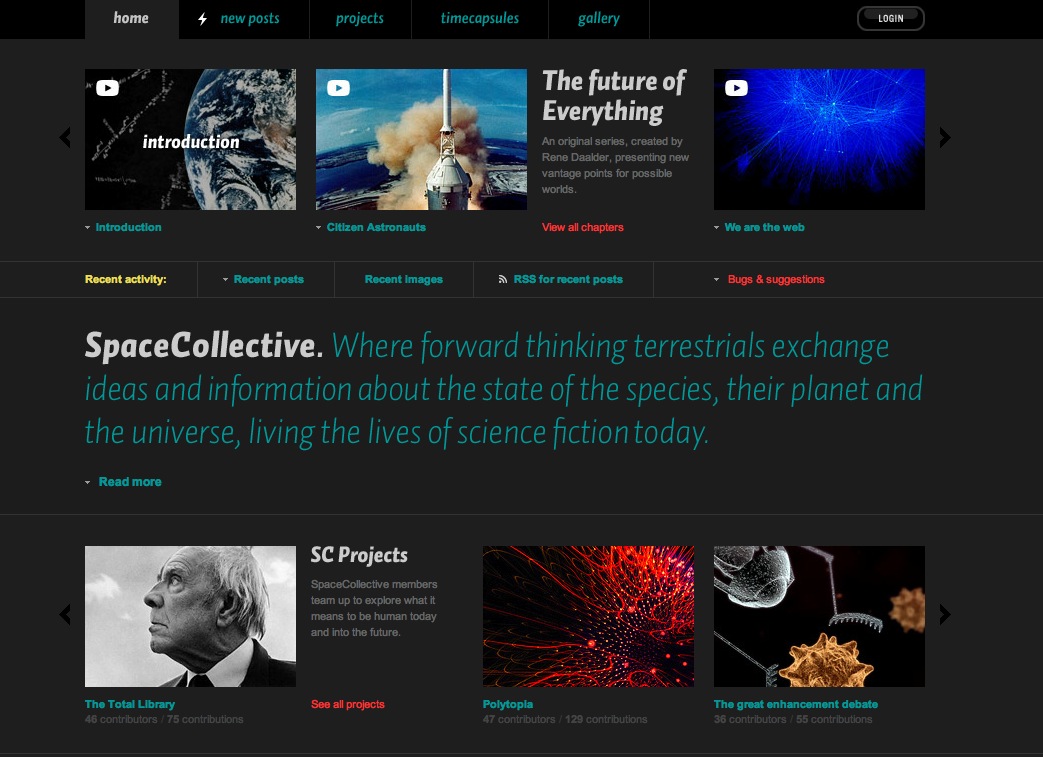
1. SpaceCollective: Where forward thinking terrestrials exchange ideas and information about the state of the species, their planet and the universe, living the lives of science fiction today.

spacecollective

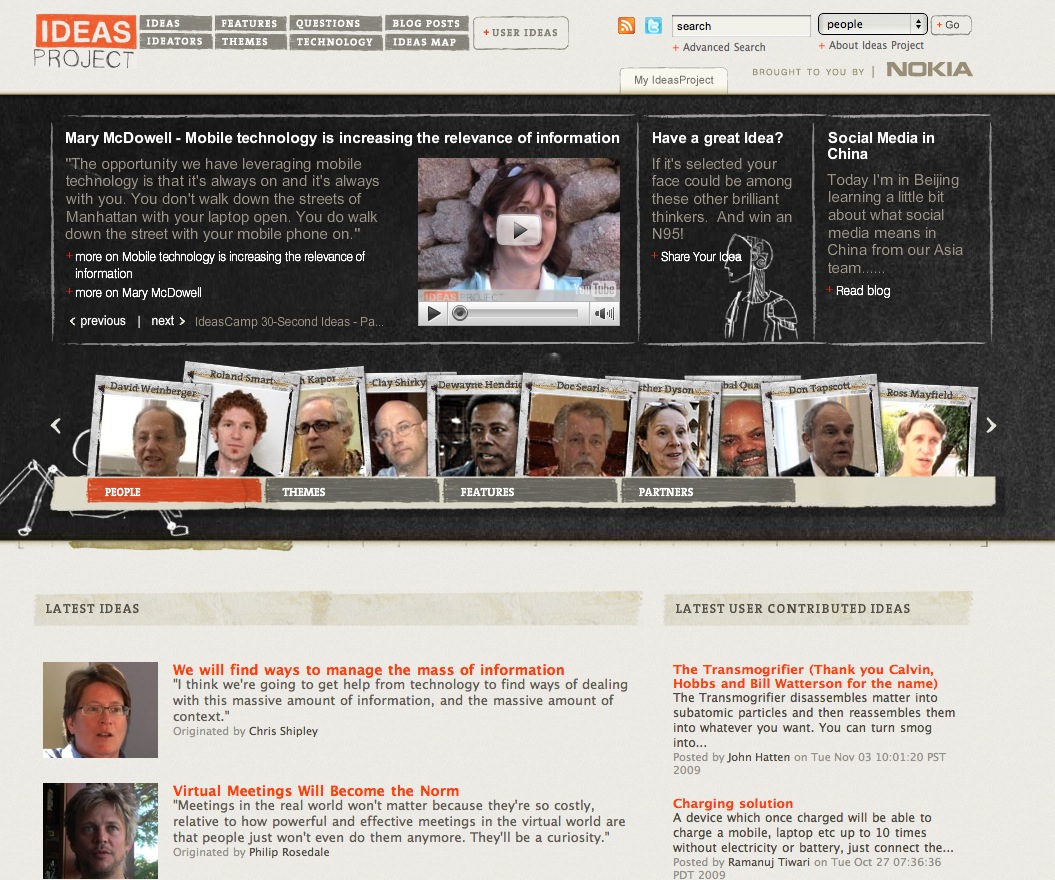
2. Ideas Project: Created by Nokia, it brings together big thinkers to contemplate the big ideas that matter most to the future of communications, joining them up through video clips, links, articles, podcasts and dynamic maps to push the boundaries of Web navigation and the thought process itself.
twitter: @IdeasProject

ideasproject

3. Ideas for Change: This project aims at becoming the biggest video based platform for ideas on how we can build a better world.

ideasforchange

4. Sputnik Observatory: Documenting, archiving, and disseminating ideas that are shaping modern thought by interviewing leading thinkers in the arts, sciences and technology from around the world.

sputnikobservatory

5. FORA.tv: Videos on the People, Issues, and Ideas Changing the Planet

fora.tv

Continue reading →

← Older posts
Newer posts →

abundance anti-rivalrous authority biohacking books cognitive enhancement collaboration commerce communication community consciousness consciousness & evolution consciousness hacking creativity creativity + design culture currency decor Design digital literacy ello entheogens ethics evolution flow futures innovation interview microdosing money money + currency neurohacker collective neurohacking neuroscience neurotech nootropics personal development philosophy projects psychedelics psychotherapy reputation Resources response-ability scarcity self smart drugs social evolution social innovation Social Media social organization society sovereignty style sustainability technology technology + society Trends Video vision willpower women Work workshop

Archives

Blog Stats

  • 1,124,746 hits

Enter your email address to subscribe to this blog and receive notifications of new posts by email.

Join 1,179 other subscribers

Top Posts

  • A Step-by-Step Guide to Tribal Leadership: Part 1: The Five Stages of Tribal Culture
  • 3 Tools for Futures Thinking & Foresight Development
  • What is Design Thinking, Really?
  • Maintaining Your Garden of Trust
  • Towards a Distributed Internet

Recent Posts

  • What it Means to Be A Neurohacker
  • Using Psychedelics to Increase Performance and Reprogram the Mind/Brain Interface
  • Why the World Needs Neurohacking Now
  • The Neurohacker’s Toolbox: Nootropics
  • What is Neurohacking?
  • when the mind hijacks my flow state
  • what mental slavery looks like: repressive & reactive patterns
  • Constructing the New Narrative
  • i am a consciousness with a society of personalities
  • on the forcing of willpower & the art of relaxation

@venessamiemis

Tweets by venessamiemis

Emergent by Design

Emergent by Design

Recent Comments

Venessa Miemis's avatarVenessa Miemis on Why the World Needs Neurohacki…
Monica Anderson's avatarMonica Anderson on Why the World Needs Neurohacki…
Venessa Miemis's avatarVenessa Miemis on The Neurohacker’s Toolbo…
bonnittaroy's avatarbonnittaroy on The Neurohacker’s Toolbo…
What is Neurohacking… on What is Neurohacking?
Creative Commons License
This work is licensed under a Creative Commons Attribution 3.0 Unported License.
  • RSS - Posts

Blog at WordPress.com.

  • Subscribe Subscribed
    • emergent by design
    • Join 1,179 other subscribers
    • Already have a WordPress.com account? Log in now.
    • emergent by design
    • Subscribe Subscribed
    • Sign up
    • Log in
    • Report this content
    • View site in Reader
    • Manage subscriptions
    • Collapse this bar
 

Loading Comments...