14 Great Sites Pulling Us Towards A Better Future

Tags

Add to FacebookAdd to DiggAdd to Del.icio.usAdd to StumbleuponAdd to RedditAdd to BlinklistAdd to TwitterAdd to TechnoratiAdd to Yahoo BuzzAdd to Newsvine

I’ve been meaning to pull together a post to highlight a few sites out there that I think do a nice job informing, inspiring, questioning reality, pushing the envelope, and calling for a brighter, better, more sustainable future. Hope they’re useful for you too, and please share your list with me!

.

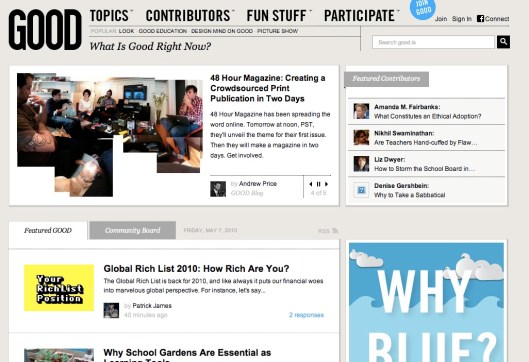
1. GOOD (@GOOD)

“GOOD is a collaboration of individuals, businesses, and nonprofits pushing the world forward. Since 2006 we’ve been making a magazine, videos, and events for people who give a damn.”

. Continue reading

Essential Skills for 21st Century Survival: Part 3: Network Weaving

Tags

Add to FacebookAdd to DiggAdd to Del.icio.usAdd to StumbleuponAdd to RedditAdd to BlinklistAdd to TwitterAdd to TechnoratiAdd to Yahoo BuzzAdd to Newsvine

So people learned from the angels of God how to build bridges, and therefore, after fountains, the greatest blessing is to build a bridge and the greatest sin to interfere with one. – Ivo Andric

Our first two topics in this 12 part series were Pattern Recognition and Environmental Scanning, both practices for enhancing the opportunity to create meaning from information and to assist in decision making. The next topic looks at how others can contribute to this process.

::Network Weaving::

The above quote was used by Lee Bryant during his recent presentation at the Social Business Edge conference, and I thought it fit in well with this concept.  One of the main topics we have been covering is the idea of breaking down silos – between fields, between organizational departments, between people, and even more deeply, between our own ideas about the values that defines us and who we really are – so the analogy of building bridges seems appropriate.

As I’ve been exploring how to build relationships online and create an environment where trust can be built, I naturally started introducing people from different communities to each other in hopes they could benefit from each other’s knowledge, wisdom, and experience. I noticed that different disciplines are having the same conversation, just packaged in the jargon of their field. What if we could cross-pollinate these conversations, allowing for new ideas to emerge?

This activity has been called “network weaving” on June Holley’s blog, Network Weaver. (There’s a wealth of information there on how to build online networks and create thrivable communities.) She defines the term as follows:

A Network Weaver is someone who is aware of the networks around them and explicitly works to make them healthier (more inclusive, bridging divides). Network Weavers do this by connecting people strategically where there’s potential for mutual benefit, helping people identify their passions, and serving as a catalyst for self-organizing groups.

June (@juneholley) and a few other amazing women I’ve started to follow (Jean Russell @NurtureGirl, Christine Egger @CDEgger) have been working on a google doc that explores ways to facilitate network weaving behavior, geared towards this weekend’s Wisdom 2.0 Conference.  June is also working on a Network Weaving Handbook, which I’m looking forward to reading. The Table of Contents sneak preview is available here.

Though the activity seems simple enough, I see it as an essential skill as we move forward to a more effective and collaborative society. It’s not just about being extroverted and great at making introductions, though. It’s about raising your awareness of others, learning how to identity their strengths and gifts, and knowing who they should know to amplify their abilities and potential contributions.

I started to outline this idea in Framework for a Strengths-based Society, and I think that a prerequisite for effective network weaving starts with thinking about people (and ourselves) not in terms of predefined roles or resumes, but by what we’re really about. This is often opaque – a mix of things like inherent qualities, tacit knowledge, and the values we adhere to, which are revealed by our actions and interactions.

As I’ve dug deeper into exploring those things about myself, it seems I’m able to more quickly identify them in others. It makes network weaving actually exhilarating. I feel I’m of more value to others now, because I have a sense of who they could team up with to mobilize their ideas.

As more of us adopt this practice, aligning people with different strengths and skills who all share a similar vision, what might happen? Could it ignite a snowball effect, accelerating the rate of positive change and making an impact in the world?

#

image from wikimedia commons

Assembling a Game Changer at The New School

Tags

Add to FacebookAdd to DiggAdd to Del.icio.usAdd to StumbleuponAdd to RedditAdd to BlinklistAdd to TwitterAdd to TechnoratiAdd to Yahoo BuzzAdd to Newsvine

Today is officially one month since we proposed the idea for a new tool for conversation and collaboration (Junto: Discussing Ideas Worth Spreading). Energy has been building over the weeks, and people around the world have been stepping forward to help make this thing happen. Last Wednesday, I met and with an assistant professor of media design at Parsons who expressed interest in helping on the front end of the project. (Parsons, a leading art and design college, is one of eight sister schools that make up The New School.) We met last week on Wednesday to discuss a prototype, and by Friday the first version was up. I just want to say a quick public “thank you” to Dave Carroll and Parsons for hosting this prototype while we work on how to scale it globally.

Quick Background

I’m currently completing graduate research at The New School in NYC in their Media Studies program, with a focus on media theory and digital ethnography. When I was originally pondering where to do graduate work, the New School piqued my interest. It has a rich history and a reputation for housing avant-garde, free thinking intellectuals. But, what sealed the deal for me was finding out that futurist Alvin Toffler (author of Future Shock) taught the first university futures course in the U.S. at the New School back in 1966. As a budding futurist myself, I thought this must be a sign.

So, it only seems appropriate now that Junto, an application for forward-thinking intelligent dialogue and collaboration should be born here!

It also makes perfect sense in terms of the school’s initiative to break down silos and unify as a collaborative university. Many institutions are in trouble, as their bureaucracies and fear of openness prevent them from seeing the long view of “competition through collaboration,” and they are losing relevance, as talented individuals choose to pursue their studies elsewhere. In the past few days, faculty support for this free platform has been coming in across divisions. Not only does it have the potential to be an excellent collaborative tool for the professors and administration, but it could serve as a bridge linking students that are currently existing mainly within their own division. The call for interdisciplinary study and sharing in general has become more pressing than ever, and the gains from doing so are clear. This example in itself, with a connection between myself within the Media Studies department and Dave within Parsons is a testament to the value of aligning around a shared vision.

The “Business Model”

This is the foundation for this to “work”: The platform itself has to be free. It is intended to become a 3D conversation landscape, like a commons. Value is co-created by what people can do while using the platform, but the platform itself must remain pure and non-commercialized. The entire idea is based on a foundation of trust, openness, shared values, ethics, and the collaborative spirit – which, in my opinion, is not something to be monetized. It is a public, and should remain a neutral zone. (This model is similar to the FCC established rules of amateur radio – non-commercial and decent communication required – except it is not using a limited frequency spectrum.)

Unlike other social networks that don’t state an intended purpose, or who change their financial models on you midstream after you’ve put in the time and effort to build a community, or who continually violate your trust and privacy by changing the rules without permission – this platform is different. It is intended from the outset for the free exchange of ideas and knowledge so that new ideas and knowledge can be built. Interactions and exchanges are available to be shared by the public so that we can experience mutual benefit from the results of cocreation and synchronicity.

I suggest that the benefit of usage will outweigh the cost of contributing server support. I would also imagine that universities and institutions around the world who are committed to positive change, learning, and growth will find it makes sense to be a part of this mission. Eventually, server support could be completely distributed, and maybe one day when the energy crisis is solved, be taken off the grid completely.

Our Responsibility

I said this during my presentation at the Social Business Edge conference on Monday, but it bears repeating:

Technology is the tool, not the builder. We are the builders.

Technology is not going to save us, we can only save ourselves. And as many intelligent people are aware, we already have the resources needed to alleviate the world’s big problems, they’re just misallocated. And we already have the solutions to solve the problems, they’re just behind silos or aching to cross-pollinate with ideas across fields.

As a generalist, I pay attention to what’s going on in many different sectors and industries, and it seems to me that many people are saying the exact same thing, just packaged for their audience. Many people are calling for change, but the methods to get there are often more of the same. As Einstein said, “the definition of insanity is doing the same thing over and over again and expecting different results.” Perhaps the modern day equivalent is Obama’s quote of “lipstick on a pig.”

If there are so many organizations committed to change, why aren’t things changing?

Perhaps we need to rethink what collaboration means, and redefine the most effective avenue to getting there. I’m not suggesting we scrap everything we have – not at all. But I do think there can be another channel that can operate in parallel to the current system. It doesn’t have to be one or the other – we need both. While institutional initiatives have their merit, of course, I am continually stunned by the speed and agility of a distributed network of passionate, committed people to take a concept from idea to action.

What if we would start doing this on a global scale? Instead of wishing ourselves into a better future, what about a truly innovative proposal for getting things done?

Project Overview

I’ve written a few updates already, in the Junto is Born! post and the Open Letter to Tim Berners-Lee,  but here is a general overview of what we’re thinking about:

  • Bandwidth Challenges

The big issue we’ve been discussing around the growth of the platform is the availability of bandwidth. To be scalable, it’s going to require the ability to have live, real-time video and audio for all users, anywhere.

A recent email suggested our university might have a better solution:

We have Internet 2 (the ultra high speed Internet just for universities) but we currently don’t use it for anything. The best angle we have to win the interest of the bureaucracy is to frame this as a potential use of Internet 2 and the role of Universities to build the next Internet experience. According to my source, there’s been discussion of getting rid of it, despite the fact that we only pay $10k per year which is an astonishing bargain considering the potential we could offer the world.

Another email suggested we are capable of achieving an “infinite amount of bandwidth” by using an OC3 (fiber-optic line), which is supposedly the equivalent to about 100 T1 lines.

I don’t understand all of this exactly, but it seems to imply that the bandwidth challenge is solvable.

  • Open Source Telepresence

The other serendipitous recent news came two days ago: Cisco confirms open source Telepresence. This is perfect timing. According to the article, “the TIP code will go under Apache license on July 1, at Sourceforge,” giving us just about two months to get people on board with this and start developing the platform so we can integrate with the telepresence system when it’s released. In the meantime, we can experiment with effective group dynamics in these large scale collaborations. The technology is there, what’s needed is some social engineering.

  • Data Visualization

This is a huge component of what we want to integrate as the platform evolves. The big picture is for real-time speech to data visualization capabilities, so that one could literally talk and then concepts would be generated before them. This would be particularly advantageous for scientists, mathematicians and physicists developing models for nanotechnology. For the rest of us, it would enable us to “see” what each other is talking about, watch patterns pop, and create an environment where new insights can emerge.

Though we’re not quite there yet, I was intrigued by Gary Flake’s recent TED Talk revealing Microsoft Pivot. Pivot looks like a tool that would be very useful within the ebiidii platform. Check out the video to see the potential of this:

  • Real-Time Collaboration

Another collaborator has been speaking with Prezi about developing a real-time collaborative version of their application. It’s still too early for any commitment, but they’ve expressed interest in seeing where things may go. If not Prezi, we will find something else, but we definitely want features for real-time collaborative presentations, mindmaps/concept maps, and a whiteboard. We’ve also been looking at Compendium for this.

  • Open Source Code Repository

As we’re playing with the prototype, we’d like to also get a source code repository set up so we can start building.

Slideshow: Drupalcon keynote by Tim O’Reilly: Open Source and Open Data in the Age of the Cloud

  • Sentiment Analysis, Emotional/Intuitive Tagging, Metadata, Social Impact

I’m not quite up to speed on all the dimensions of this to be able to explain it clearly, as our focus has been on getting a stable discussion platform running first. But, this is the main topic of in #junto sessions so far. [We’ve also been talking about the need for a Junto Calendar page, where people can list sessions they’re planning on having so others can plan ahead and join in. In the meantime, our sessions have been rather impromptu, but we’re tagging it with the #junto hashtag.]

We’re looking at Storygarden, a “web-based tool for gathering and analyzing a large number of stories contributed by the public. The content of the stories, along with some associated survey questions, are processed in an automated semantic computing process for an immediate, interactive display for the lay public, and in a more thorough manual process for expert analysis.” We haven’t had a chance yet to see how this tool might be integrated, but have definitely been talking about a way to visually see what the main points and sentiments around an idea are, so if this particular tool is unavailable, we will find one that is.

We’re also looking at a symbol based emotional tagging language and an Artificial Intuition system.

Many big thinkers have been posting their work on some of the potential implications and longer term impacts of these social technologies on SpaceCollective, which is being sent to the Polytopia project, in case you’d like to read up on the theoretical/philosophical aspects. Other organizations thinking about this are Fibreculture, institute of network cultures, nettime, and more links provided here by the Institute for Distributed Creativity.

  • Next Steps

I just received an invitation by Tim O’Reilly to attend Foo Camp in June, so I’m excited to share this project with more people and see who else is interested in collaborating. I’m also hoping that other progressive universities (i.e. MIT, Stanford) will join in and contribute server space to keep this alive, so that it eventually snowballs into a bigger global effort. I also ran into someone at Monday’s conference who supposedly has access to an open source community that may be enticed to help. Other than that, I’m looking at other organizations and groups who would seem to naturally be aligned with this vision, such as the Open Metaverse Foundation, P2P Foundation, Wikimedia Foundation, Aspen Institute, Skoll Foundation, Macarthur Foundation, Buckminster Fuller Institute, Acceleration Studies Foundation, The Forward Foundation, Institute for the Future, and other futurist think tanks and initiatives.

It’s exciting to watch this unfold, and it seems to only be a matter of time before it all comes together. It’s already happening. It’s just a matter of how quickly we’ll assemble the pieces so that we have a way to connect with each other in a productive, effective way, and an ability to be as real with each other as possible in a mediated space.

Radical? Sure. Necessary? Probably. Game Changer? I’d like to find out.

Would you?

#

Storygarden developed by Dave Snowden (@snowded), Jon Husband (@jonhusband), and others

zoacode symbol language – Ishan Shapiro (@notthisbody)

Syntience, Artificial Intuition – Michael Gusek (@mgusek555)

@jeff_dickey @VenessaMiemis I like the idea of DVCS; Bazaar & Mercurial are great. I still use SVN. (TOOLS!) http://j.mp/czhCGc http://j.mp/cUAqha #junto

@jeff_dickey @VenessaMiemis Git > SVN if your team is as the Linux kernel jocks. Beyond that, it’s all attitude, pretense, and howlingly immature tools.

@Visionscaper @VenessaMiemis If you’re going completely open source sourceforge.net provides free version control (SVN) hosting http://bit.ly/czbuDG

@alecperkins @VenessaMiemis free hosting for open source projects that use Git ver control: http://github.com (git > svn)http://whygitisbetterthanx.com/

alecperkins @VenessaMiemis GitHub emphasizes social coding and acts like a social network for coders and the projects themselves.

What Can You Accomplish With Your Trust Network?

Tags

Add to FacebookAdd to DiggAdd to Del.icio.usAdd to StumbleuponAdd to RedditAdd to BlinklistAdd to TwitterAdd to TechnoratiAdd to Yahoo BuzzAdd to Newsvine

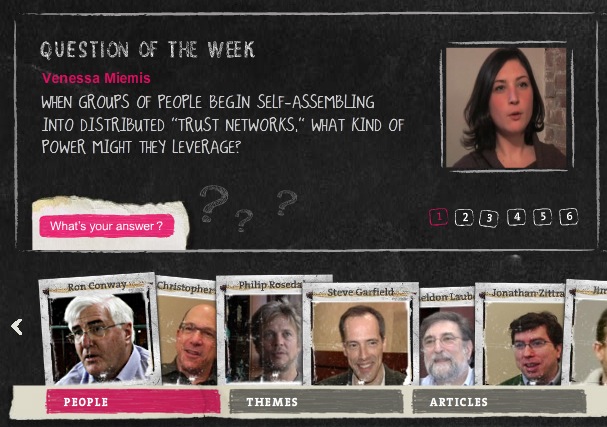
One of the major catalysts that broke me out onto the technology scene was an invitation by Ideas Project to submit a video for their site. In case you’re unaware, Ideas Project is hosted by Nokia, and features videos and articles by people who are thinking about the future of communication and technology. Anyone can submit an idea (like I did), and the site can keep you busy for hours learning about new technological developments, inspiring projects being done, and disruptive ideas about where things are headed.

At the moment, they’re running a “Question of the Week” series, and this week they posted mine. I only had so many characters for the question, so I want to frame it within its context a little better, and maybe you can submit a comment to the site if you’re intrigued. Continue reading

Open Letter to Tim Berners-Lee: Help Us Build Junto

Tags

Hi Tim,

I wanted to let you know about a platform/infrastructure I am trying to inspire. This idea has been buzzing for months, but it finally came together in my head. Here’s a quick post about it:

Junto is Born!

The Junto is just the conversation platform, but everything is built upon it. We launched the alpha prototype on Friday night, and without “advertising it”, we had nine of us in there live on video, and about 500 people in the backchannel watching.

People are already writing blog post reviews of it:

Me, We, and Junto

Playing with Junto

I think this could be huge, but there needs to be a way to be certain it remains open source and free and distributed. There needs to be a new infrastructure built to distribute the bandwidth of the video streaming. I don’t really understand the technical aspects of this, but there needs to be some kind of alternative internet structure to run this, but I see it. It starts with a 3D conversation interface, where we interact in a floating space similar to the look of the Virtual Choir, and the only components it needs is a live video stream of the people, data visualization (a la Pivot), a way to record the conversations, and an AI to parse and summarize the conversations so they’re searchable.

All the components already exist, we just have to put them together, and it needs to be a global cooperative effort.

The interface is like a 3D landscape of conversations, with 2 people engaged in dialogue, and an “audience” (backchannel) of people around them listening in or taking turns to speak. The individual in the conversation has a view something like shown below. When the conversation itself is the focus, the 2 video boxes are center stage on screen. When a document or shared whiteboard or concept is the focus, the video boxes shift to the side, and the item of discussion becomes center stage. The entire platform is a concept/idea generation engine.

Personal profiles are generated by the contents of your conversations and the people you’re talking to. There is no ability or need for assertion – you are what you talk about and what you do and who you talk to. Profiles are data visualizations generated by your actions.

There’s more, but we’re talking about a microfinance platform on top and a virtual currency system. This is disruptive.

If you can help me, please contact me.

Thanks,

Venessa Miemis

Junto is Born!

Tags

,

Many of us have been inspired by the cooperation meme lately, and it appears that our collective spirit has given birth to Junto!

In case you haven’t been following along, Junto is a concept we’ve been discussing for a global communications and collaboration platform. It starts with a simple interface, combining video chat with a text box and a twitter backchannel, all streaming in public, real-time. It could be used for any number of projects or goals – organizations could use it for open innovation or to show how they are taking social responsibility in the world, groups with similar initaitives could use it for huge group discussions and meetings in order to accelerate the process of organizing and taking projects from idea to action, and individuals could use it to engage in dialogue and create shared meaning and shared understanding across geographic and cultural barriers. For more context, check out the original post here.

The longer term goal is to build in a family of tools and functionality that will aid in thinking and development, such as:

– live collaborative whiteboard
– concept mapping, possibly linked with twitter in order to automatically send links to specific areas of a project
– Junto video sessions to be time-coded and tagged for easy search and later reference
– emotional/intuitive symbol language to express feelings around ideas and concepts
– data visualization, heat-mapping and sounds linked to information to quickly visually & auditorily “get” a piece of information
– tools for checking cognitive biases around information

There are other high-level concepts floating out there, but I think these are the ones that are immediately being looked at. While these aspects are being explored, a trust-based profile structure is being created, which is intended for people to be able to express inherent strengths, values, skills, social connections, and where they can contribute within a process, so that we have the opportunity to reach out to one another, make a connection, and team up to get things done!

And beyond that, it’s for us to evolve as people. If you’ve followed along here over the months, I talk about getting back to the fundamentals of who we really are, about deep values, interconnection, social learning, building intelligence, and raising consciousness. It works for some by sitting in meditation alone on a mountaintop, but I think it also happens when we make connections with people who unexplainably resonate on our frequencies and pull us forward. It doesn’t replace real life interaction – but the Web sure does allow us to make beautiful music together. 😉

So here’s a quick overview of where we’re at and who’s stepping forward so far:

David Carroll (@aquarious) – [Location: NYC] – Manifestor

Dave emailed me a few weeks ago, offering to help with prototyping the initial platform. We met up on Wednesday, and now, 2 days later, the first version of Junto “0.01” (ha) has emerged. Dirty prototype here:

Junto  lobby: http://dave.parsons.edu/junto/

We played with it a bit last night, and had nine people on video, and around 500 people who came in over the course of the evening to check it out. Here’s a quick video of what it looked like. (We were having some audio issues, so everyone is being quiet, but essentially we have the initial components of video boxes, text box, and Twitter backchannel (which is offscreen).

We’re just using this as a “proof of concept” – we’d like to build the whole thing from scratch for the real version, so hopefully some developers will start getting interested in the project. (hint hint)

Gavin Keech (@gavinkeech) – [Location: Adelaide, Australia] – UI & UX Designer

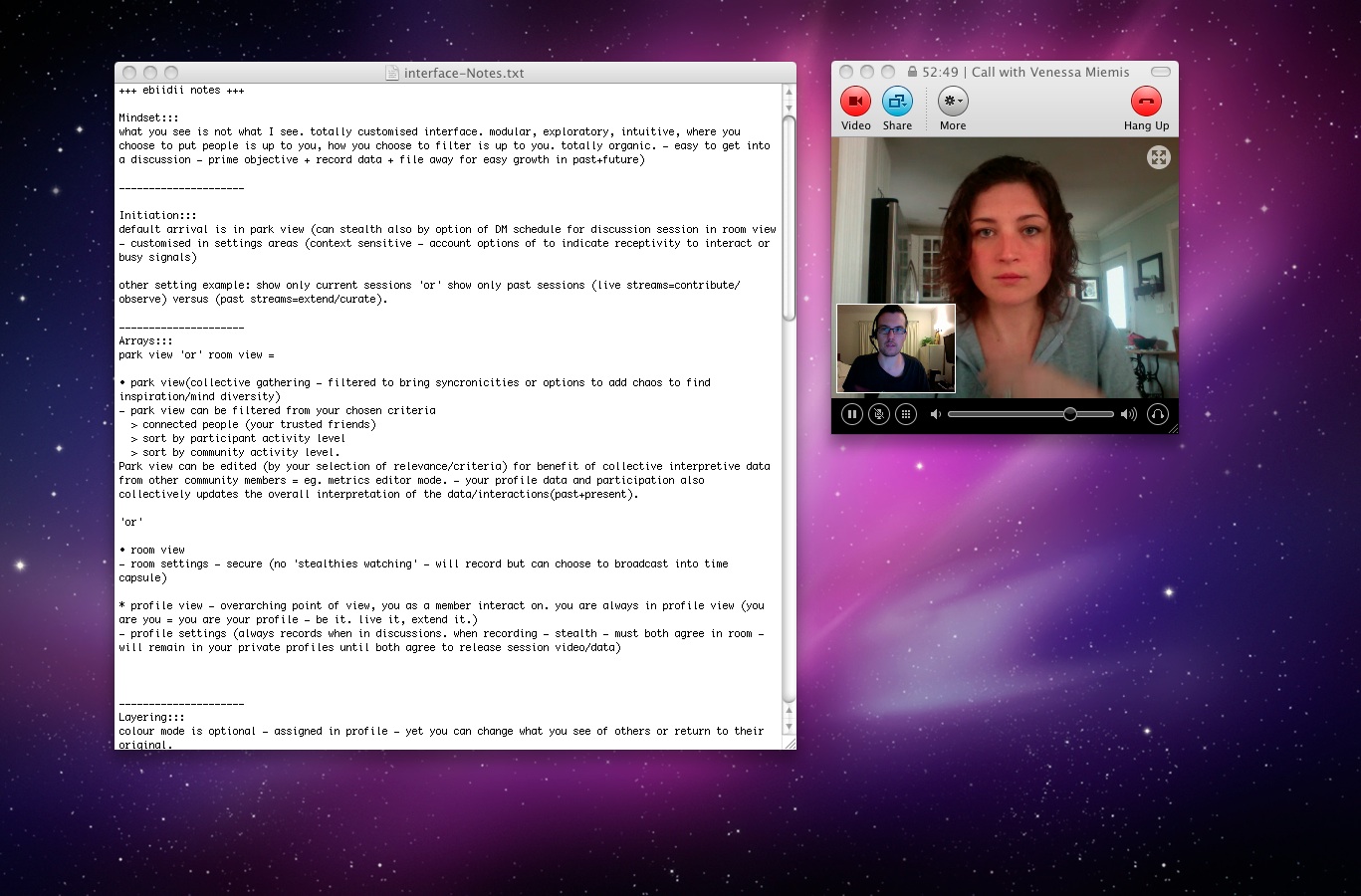
Gavin has a very creative mind, and has come up with some interesting sketches and ideas about what the interface could look like, how it could function within a layered visual system, and how it ties in with the profile system. He’s also helping us think about the bigger picture of what this platform will become after it goes beyond the Junto discussion platform. We’re talking about calling it ebiidii – ebii for short.We realized that Junto is just the discussion… so what’s the other thing that it’s encapsulated by? We were trying to think of a word that describes the essence of cooperation, collaboration, manifestation, and intentional evolution, but so many times words are already laden with meanings and preconceived notions, so we wanted to create something new. We noticed how people have been shortening the name of this blog to E.B.D., hence ebiidii. Not only does the acronym describe what we want to be (Emergent by Design), but the letters seem to have a lot of symbolism in themselves. The ‘e’ could be for emergence, evolution, energy….. the b and d are like mirrors, representing how we can reflect ourselves to others, and how others are mirrors of ourselves, and the double ii’s are like two groups meeting, but also the iiii gives a feeling of an echo, or a frequency, or a resonance. We thought that that was pretty cool, and it almost named itself. And the shortened version of ‘ebii’ is just so darn cute.

Gunther Sonnenfeld (@goonth)  – [Location: Los Angeles, CA] – Change Catalyst

Gunther and his colleagues are working on developing a platform to help local communities create infrastructure and affect change. Here’s a bit from his site:

Our partnership with CIF (The Canadian Institute for the Future) is leading us down a swift path towards a new dynamic publishing platform, designed to build infrastructure in local communities by way of transmedia development and a robust microfinancing engine. Basically, we’re hoping to re-engineer the storytelling process and make it profitable (and equitable) for entire groups of people. In our humble belief, participatory culture is something that must be empowered if we want to affect real change in the near and long term.

We’ve also been talking about how a conversation platform could evolve to include a way for individuals and groups to reach out and help each other, via a virtual currency or microfinance implementation, so it seems of mutual benefit for us to co-create this platform. This was encouraging news, as this idea can manifest more quickly with access to their financial resources. We’re also both aligned with the idea that this is to be an open source, publicly available platform for anyone to use and benefit from.

Ishan Shapiro (@notthisbody) – Narrative Architect

Ishan is an active member on SpaceCollective and recently attracted my attention with a project he’s working on to develop an emotion/intuition-based symbol language, called “zoacodes.” It builds on Ebon Fisher’s work, and they’re just on the front end of teaming up with designers and typographers to craft this new thing. We’re not sure yet how everything fits, but it’s unfolding. He’s also been working on how reputation works in online spaces, and has been tracking that work in on Twine under ‘Friendships in Hyperconnectivity.’

Gabriel Shalom (@gabrielshalom) – [Location: Berlin] – Videomusician, Immediator, Transmedia Narrative Design

Gabriel recently reached out to me after my ‘Future is Networks’ post, and has a lot of ideas about the future of open source video http://vimeo.com/6668034 and visual storytelling. As the discussion platform evolves, and video sessions can be recorded and parsed and tagged, we’re hoping Gabe will share some insights into what that could look like.

Michael Gusek (@mgusek555)  – [Location: San Raphael, CA] – Evolver

Michael is working with Syntience, a company pioneering a holistic approach to understanding data, called Artificial Intuition. Once our platform is sufficiently developed, we’re going to see how their software could accelerate our ability to make sense of information, connect with each other, and make ideas manifest.

The other big thinkers that have been shaping these idea over the months are Bernd Nurnberger (@CoCreatr) [Location: Yokohama, Japan] ), Ned Kumar (@Nedkumar) [Location: US], Spiro Spiliadis (@spirospiliadis) [Location: Canada], Mark Frazier (@openworld) [Location: Virginia], Michael Josefowicz (@ToughLoveforX), Cole Tucker (@cole_tucker) [Location: North Hampton, MA], and Nuno Raphael Relvao (@UnfoldedOrigami) [Location: Coimbra, Portugal]. There are many more – this is a global effort, after all – but I’m going to stop here for now. Because this is a distributed effort, energy levels will rise and fall, people will come and go, and everyone will participate and contribute as long as it stays pure and fun. I’m going to just keep calm and collected and keep doing what I’m doing, and we’ll see where things go from here. 🙂

In case you’re interested, here’s the results of a brief survey I tweeted last week, just to gauge initial interest in this. We’ve also begun a Google Wave for collaboration until people decide that something else is more effective.

I’m so excited to see how all these different groups and people across space and time are coming together around this shared vision of creating something that will better help us help ourselves.

We don’t know how it’s going to unfold, but it is incredibly inspiring to see the interest mounting, and I’m eager to see more collaborators and participants getting involved!

Next steps are to entice more developers and coders to build the infrastructure so that this system can emerge, and to begin experimenting with the look and functionality of this site so that it can be as simple, intuitive, and beautiful as possible so that the largest number of people can quickly benefit from using it.

Onward & Upward!

Essential Skills for 21st Century Survival: Part 2: Environmental Scanning

Tags

Add to FacebookAdd to DiggAdd to Del.icio.usAdd to StumbleuponAdd to RedditAdd to BlinklistAdd to TwitterAdd to TechnoratiAdd to Yahoo BuzzAdd to Newsvine

We recently discussed Pattern Recognition and the role it plays in understanding and decision making. The next topic in this 12 part series is pulled out of the Futures Thinking toolbox:

::Environmental Scanning::

Traditionally, environmental scanning is explained within a business context as a strategic approach to acquiring information in order to stay current on events, emerging trends, and external factors that could influence or impact an organization. It basically means paying attention to what’s going on within your industry, monitoring what your competitors are doing, what your customers are saying, and being sensitive to potential threats or opportunities along the way. Continue reading

Maintaining Your Garden of Trust

Tags

Add to FacebookAdd to DiggAdd to Del.icio.usAdd to StumbleuponAdd to RedditAdd to BlinklistAdd to TwitterAdd to TechnoratiAdd to Yahoo BuzzAdd to Newsvine

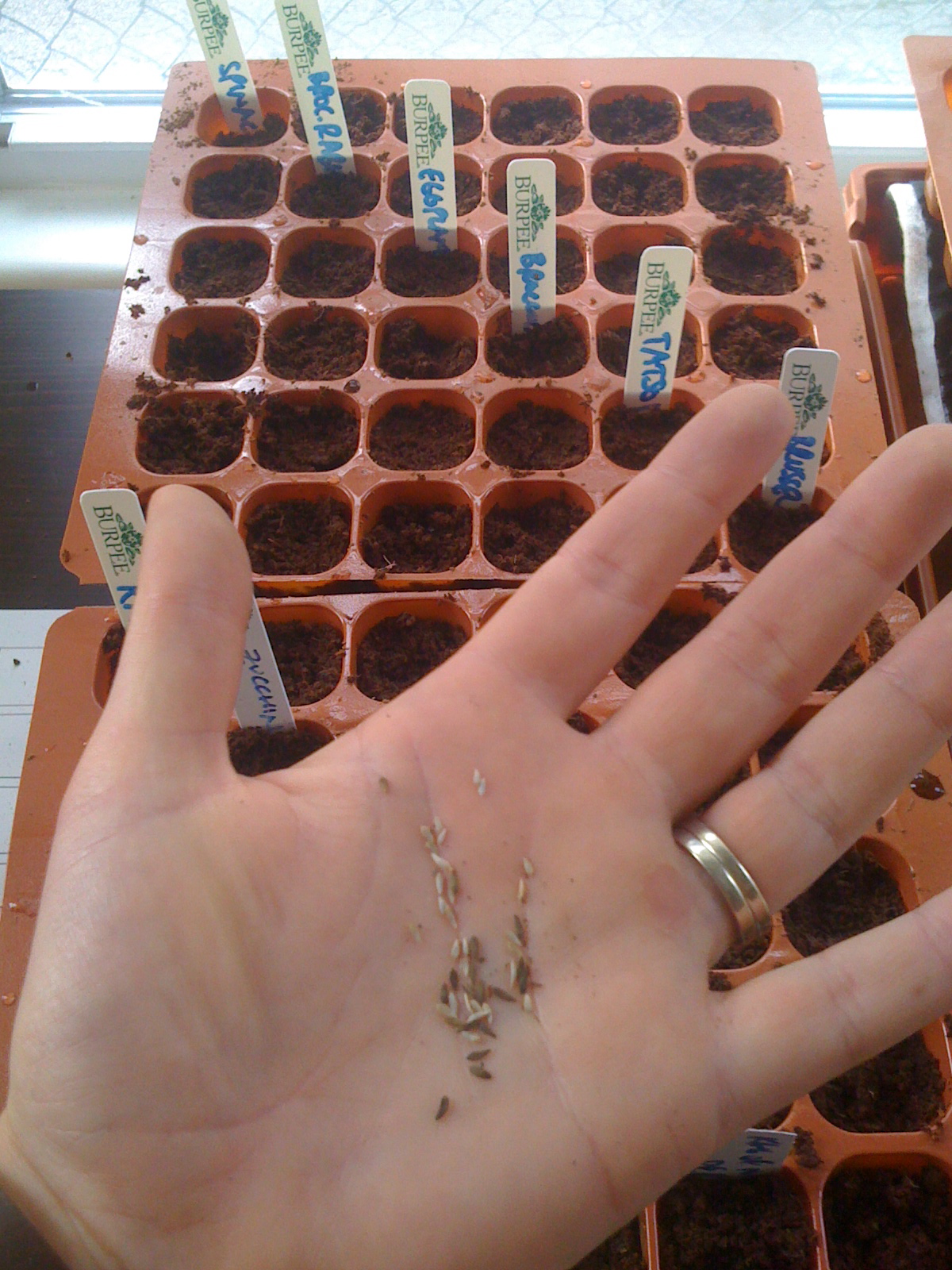
This morning I was getting some seeds started for my garden, and I was reminded of a tweet from a few weeks ago where I said something to the effect of ‘customer service is now more like gardening and less like hunting – nurture relationships.’ Well, the SCRM crowd (social customer relationship management) pushed back. [@wimrampen @grahamhill @ekolsky @myjayliebs @mkrigsman @SameerPatel @pgreenbe @kitson, you know who you are!] They said this wasn’t the case, and that studies had shown that customers don’t really want a relationship with a brand. To me, “relationship” doesn’t have to mean I’m going to have you over for dinner. There are levels. It can just mean that I will recommend you to a friend. I let it go at the time, but I want to go for Round 2.
I think that gardening is as powerful a metaphor as any for the life-cycle of a process, and I do see a correlation between what it takes to grow a garden and what it takes to build trust with a potential customer, client, or future alliance. Here’s how I see it:

Continue reading

Essential Skills for 21st Century Survival: Part I: Pattern Recognition

Tags

Add to FacebookAdd to DiggAdd to Del.icio.usAdd to StumbleuponAdd to RedditAdd to BlinklistAdd to TwitterAdd to TechnoratiAdd to Yahoo BuzzAdd to Newsvine

Over the past few months, we’ve been discussing the various skills needed for effectively operating in a world characterized by information and accelerating change, and I’ve been assembling these ideas into a framework for a new thought architecture. This post will be the first in a 12 part series, and draws its influences from the fields of Futures Studies, Complexity Science, Systems Theory, Cybernetics, Social Network Analysis, Knowledge Management, common sense, and exploration into my own thinking.

All of the skills I’ll be covering are already in practice in our brains – it’s just a matter of becoming more aware of them so we can sharpen them. I imagine them all happening concurrently and all reinforcing each other, creating constant feedback loops that raise consciousness and build intelligence. Though I’ll be identifying 12 areas, they’re mostly components of each other, so we’ll see how we might expand or refine these as the series rolls out.

– :: Pattern Recognition :: –

The ability to spot existing or emerging patterns is one of the most (if not the most) critical skills in intelligent decision making, though we’re mostly unaware that we do it all the time. Combining past experience, intuition, and common sense, the ability to recognize patterns gives us the ability to predict what will happen next with some degree of accuracy. The better able we are to predict what will happen, the more intelligent we become. So, you might say that the purpose of intelligence is prediction. Continue reading

Where We’ve Been and Where We’re Going

Tags

Add to FacebookAdd to DiggAdd to Del.icio.usAdd to StumbleuponAdd to RedditAdd to BlinklistAdd to TwitterAdd to TechnoratiAdd to Yahoo BuzzAdd to Newsvine

Fellow Travelers,

This post is intended to serve as a benchmark for the progress we’ve made since the inception of this blog. What started as a personal exploration into the self and the emerging Network Culture has evolved to be a collaborative effort to better understand ourselves and our process, to share resources and gifts, and to learn and grow.

I am continuously humbled by the level of participation, the depth of thought and insight, and the consistent support and encouragement that have been contributed here daily. And not just to me, but to each other.

I believe we have reached a new level of cooperation in this past few weeks, and it bears acknowledgement before we progress further. I want to take an opportunity to reflect on what I perceive has happened so far in this collective learning loop, to capture this moment, so that we’ll always have a point of reference as we continue on this journey. I can only imagine that things will get more exciting and innovative from here on out. Continue reading