What is Open Foresight?

Tags

We recently introduced the concept of ‘Open Foresight’ as a process we’re developing to analyze complex issues in an open and collaborative way, and to raise the bar on public discourse and forward-focused critical thinking. It’s a work in progress and constantly evolving, but here are some of the basic principles we’ve developed so far.1) What is Open Foresight?

In simple terms, open foresight is a process for building visions of the future together.

2) The Big Picture Context

If you look around, it’s undeniable that there’s a new global narrative emerging in the way we fundamentally understand ourselves as humanity – how we do business, how we learn, how we generate value together, how we interact. This transformation is being driven both by new communication technologies, and by the emergent behaviors these tools enable. The context of our relationships is shifting, and we still don’t know exactly what that means for us as a species. We’re asking ourselves questions like:

  • What happens when social networks connect us on a global scale?
  • How do new social and virtual currencies challenge our ideas about what money is and how value can be created and exchanged?
  • How can we form globally distributed enterprises and collaborative teams?
  • What do these emerging business models look like?
  • How do we build knowledge together and become more effective learners?
  • How are our notions of democracy and governance evolving?
  • What role do social technologies play in the evolution of human consciousness?

These are all challenging questions, and we don’t know the solutions because we haven’t yet created them.

That may sound terrifying and disruptive, or like an incredible opportunity to shape and bring about the future we deserve. Or, most likely, a bit of both. Continue reading

5 Key Issues Impacting the Future of Facebook

Tags

As part of the Future of Facebook Project and Open Foresight process, we’re asking the crowd for their opinions and forecasts on the same 15 questions we’ve asked our interviewees. Questions are posted on Quora, but can also be answered here on the blog or on our Facebook Page.

Here are some interesting and thought-provoking answers we’ve seen so far. We’ll be integrating our favorites into the final video series, so add your thoughts and join us as producers of the future!

1. Social Graph & Sentiment Data Usage


I believe the biggest issue facing Facebook is how it chooses to use the massive amounts of data it collects on everyone of us. Facebook is a unique window into our minds and has the potential to know what we want even before we do. How it chooses to capitalize on this fact and the tools it builds could propel commerce, content and communication for the next 5 to 10 years.

John Hazard

2. Partnerships with Brands


Let’s face it – brands are the ones who are bringing the revenue. But as of today, Facebook has a very closed-in environment with very limited support for brands and limited consideration for brands’ needs. They have also been missing some key things brands are looking for (like capability to easily segment audience within one fan page for the brand to avoid defragmented fans base/presence across Facebook, etc).

Ekaterina Walter

3. Higher Education

The London School of Business is already offering an International MBA delivered via a Facebook App…. The quality of Facebook Higher Education delivery will be no better or worse than current online and blended online and face-to-face courses already being offered by universities. The difference is that instead of using walled off course management tools offered by universities and publishers, Facebook will deliver an open and transparent education that allows more real time interaction and collaboration with experts in the outside world. Students will not be limited by location and will shift to educational brands that deliver quality social experiences online forcing many local and regional Higher Education institutions out of business in the next five years. The world will truly be the classroom.

Dr. William J. Ward

4. Signal to Noise Ratio

I think a major issue going forward for Facebook, and other social sites, will be finding a better way to sift out relevant posts from noise. We’re all guilty of following / friending more people than we actually care about. Social graphs contain invaluable personal data; being able to analyze that data and make content more meaningful, contextual and separate value from the noise will be critical as social networks continue to explode .

Mike Beauchamp

5. How We See Ourselves and the World

…my focus tends to be on the utility of FB and its popularity as a vehicle for emergent properties… it will be interesting to not only see how social media continues to play a part in physical protests against oppressive governments worldwide, but how that same spirit of revolution loops back into the virtual world and online psyche – a place where we are only beginning to understand the implications of global connectivity (i.e. virtual cities of thought/memes that supercede physical city, national, corporate and cultural boundaries; open source educational models and the reframing of “learning”; speculative gaming as a means for simulation/big picture solutions; etc.).

Frank W. Spencer IV

—-

Add your views to the Future of Facebook Project topic on Quora!

Check out our kickstarter video here

Thanks to Producers Sean Park, Dr. William Ward, and Debra Farber, and to all supporters of the Future of Facebook Project!

Announcing: Open Foresight & The Future of Facebook Project

Tags

,

In a world characterized by increasing complexity and accelerating change, we need tools that help us understand future possibilities in order to make more informed decisions today. The field of Futures Studies, or Strategic Foresight, has already developed many such tools, but they are still not commonly utilized by the general public.

So, I’ve partnered up with a colleague, Alvis Brigis, to help elevate the ‘futures thinking’ meme. We’re developing a process called Open Foresight, which aims to serve as an updated model for harvesting collective insight, generating scenarios, and creating strategic roadmaps into the future.

By combining available data, opinions from the experts, and the conventional wisdom of the crowds, we’ll be able to analyze a topic from a wide range of perspectives and viewpoints. We’ll then distill that down into a series of animation-rich videos that summarize these insights. The methodologies used will help us all gain a better understanding of the risks, opportunities, and implications surrounding the issues important to us. All of the content we collect will be made available via Creative Commons SA by-cc so that it can be reused, remixed, and built upon by others.

The first project to employ this framework was launched on Kickstarter today – The Future of Facebook video series.  (video above) Using the STEEP forecasting methodology, we’ll be viewing the challenges and opportunities for this company through the lenses of Society, Technology, Environment, Economics, and Politics. Each of these five categories will become a short focus video that fleshes out that topic area. The final video will be a big picture overview of the potential pathways for the evolution of Facebook.

by @EricaGlasier

Interviews are still underway, but here’s a look at who we’ve talked to so far:

by @gavinkeech

To launch the public arm of the project, we’ve posted the same 15 questions we asked all interviewees onto Quora. We’ll be monitoring the topic for the most insightful and provocative answers you’ve got. The people with our favorite answers will be invited to participate in an interview with us for inclusion in one of the final videos. You can add your visions to “The Future of Facebook Project” topic here.

We’ve also created a Facebook page, aptly named “Future of This Social Network.” 😉 Please follow our developments, video releases, and conversations there as well as on Twitter with the hashtag #fofb.

We hope this will be the first of many upcoming foresight projects that teach us to better harness our collective intelligence to understand complex issues in a way that’s open, collaborative, and fun.

Please help us develop this initiative by supporting the Future of Facebook project on Kickstarter and contributing your thoughts and insights through the various channels listed above.

We’re looking forward to developing Open Foresight with you!

Towards a Distributed Internet

Tags

In preparation for the Contact conference that I am helping to organize this October in NYC, I’ve been in discussion with many different communities about the types of initiatives they would like to bring to the table. The purpose of the event is to ‘realize the true potential of social media,’ and determine what infrastructures need to be in place to enable peer-to-peer commerce, culture, and governance.

My goal is to help facilitate these conversations now, so that come October, there is already a higher level of awareness and understanding of these issues, and more connections between groups working on similar objectives.

To that end, one of the conversation threads that has begun, with the help of Paul B. Hartzog, Richard C. Adler, and Sam Rose of the Future Forward Institute, is:

What are the fundamental requirements and building blocks of a distributed internet?

We’ve already seeded the question out on Quora and a google group, and found that developers will answer this question in many ways, because it raises many questions. Such as:

  • Is a ‘distributed internet’ one thing or many things (one internet or many internets?)
  • Should the focus be on hardware or software? Perhaps both in parallel, as a linked ecosystem of interoperable parts?
  • Could we make more progress by building on the existing internet architecture, or would an entirely new architecture offer a better set of advantages?
  • What about hybrid architectures of old and new (mesh networks conntected with community-owned ‘trunks’ for instance)?

Our plan is to get a sense of the various perspectives and opinions around these questions, find the common ground, and see what patterns and insights emerge. It’s not an either/or solution.. it’s probably more like both/and. As nature has shown us, diversity is a good thing. When you have a monoculture, you’re much more susceptible to collapse and catastrophic failure. Resilience is often associated with options.

So if we’re using evolutionary processes as our model, it would make sense to have a multitude of experiments and prototypes out there, with an understanding that “failure” is actually a necessary component of more agile iteration and adaptability.

As these conversations continue and we get a clearer understanding of the current landscape, a roadmap will start to come together with implementable ‘next steps.’ Once the basics are understood, we’ll start asking the harder questions, like:

  • What are the political, economic, and technological reasons for a distributed internet(s)?
  • Are distributed systems for technologically efficient?
  • Do distributed systems afford more freedom?
  • What are the core principles of a distributed internet(s)? (technology layers, philosophy, etc)
  • Who are the key players in terms of people implementing hardware ann software, participating in co-governance, and exploring legal issues around emerging infrastructures?
  • How do economics change when all of the participants are co-owners in the system?

And so on.

I hope this will be an opportunity for many of the communities, groups, and organizations to come together in a common forum and work through these questions together. This area is relatively new to me, so while I am aware of some groups, like the Electronic Frontier Foundation, the Peer to Peer Foundation, and the Free Software Foundation, I know there are many more that I have yet to discover and engage.

If you have suggestions of people and groups that should be involved in the conversation, please pass it on! Another initiative we are working on is to map out an infographic that lists as many of the stakeholders associated with a distributed internet, as well as the many projects that are currently underway, in order to make sense of it as a larger ecosystem. Also, if you know of places where these conversations are already happening, please give us a heads up so we can direct people to those places as well.

As a start, we’ve posted the first question on Quora –

What are the fundamental requirements and building blocks of a distributed internet?

A google group was also started:

Building a Distributed Decentralized Internet

We’ll be distilling all the responses and posting results here within the next week or two, and then move through the various questions together.

As always, looking forward to learning with you!

This post co-authored by Paul B. Hartzog, Samuel Rose, Richard Adler, and Venessa Miemis

16+ Projects & Initiatives Building Ad-Hoc Wireless Mesh Networks

Tags

For those interested in alternative internet infrastructures, I’ve been assembling a list of projects and initiatives working to build mesh network solutions, as well as communities and resources around this topic. I’ve also posted this on Quora. Please feel free to add any projects I’ve missed. We’re hoping to understand the landscape of this initiative and how these projects & communities can better coordinate their efforts, in preparation for the Contact Conference in NYC this October 20, 2011.

Projects:

Open Mesh Project – building a mesh network for Egypt
Open Source Mesh – group looking at how to build a reliable open source meshing software
B.A.T.M.A.N. – better approach to mobile ad-hoc networking; routing protocol for multi-hop ad-hoc mesh networks
Roofnet – 802.11b/g mesh network in development at MIT CSAIL
GNUnet – framework for secure p2p networking that doesn not use any centralized or otherwise trusted services
Dot-P2P – a free, decentralized, and open DNS system
SMesh – seamless wireless mesh network being developed at John Hopkins University
Coova – open source software access controller for captive portal (UAM) and 802.1X access provisioning
Babel – a loop-free distance-vector routing protocol for IPv6 & IPv4
SolarMESH – solar powered IEEE 802.11 wireless LAN mesh network  and relaying infrastructure solution
WING – wireless mesh network for next-generation internet; partially built on Roofnet
Daihinia – a tool for WiFi; turns a simple ad-hoc network into a multi-hop ad-hoc network
P2P DNS – building a distributed p2p DNS system
Digitata.org – develop an inexpensive infrastructure (low bandwidth internet terminals) for basic internet exposure to children in African countries
Netsukuku – an ad-hoc netowork that uses only WiFi connectivity and a specifically-built adddress system that allows direct communications between machines without resorting to the HTTP protocol
Tonika – open source organic network project; administration-free platlform for large-scale open-membership (social) networks with robust security, anonymity, resilience and performance guarantees

Communities:

We Rebuild – cluster of net activists who have joined forces to collaborate on issues concerning access to a free internet without intrusive surveillance
Freifunk – non-commercial initiative for free wireless networks, in english here
Athens Wireless Metropolitan Network – grassroots wireless community in Greece
Wireless community networks by region – list on wikipedia
wlan ljubljana (in slovenian) – open wireless network in ljubljana
The Darknet Plan – reddit thread dedicated to organizing anad creating a decentralized VPN as the first stage of the darknet plan
the connective – Q&A for a citizen-owned internet

Resources:

Border Gateway Protocol – free and open source implementations of BGP
XO laptop by OLPC – resource for mesh networking details
Ad hoc network routing protocols – list on wikipedia
list of ad-hoc mesh network routing protocols that can be used during an ‘internet kill switch’ – reddit thread

Commercial:

Meraki – cloud-hosted networking systems bringing enterprise-class networking to organizations
Open Mesh – creates ultra low-cost zero-config, plug & play wireless mesh network solutions
firetide – manufacturer of wireless networking equipment & provider of wireless infrastructure mesh for video surveillance

—–

related:

How to Remain Connected if your Internet Gets Shut Off

How to Communicate if the US Government Shuts down the Internet

How To Set Up An Open Mesh Network in Your Neighborhood

How Do We Communicate if the Internet Goes Down? (Quora)

Diaspora-dev on google groups

– What true P2P networking projects exist or are in development, which may spring into action if the Internet is ever unacceptably co-opted or controlled? (Quora)

Program or Be Programmed: 10 Commands for a Digital Age

Tags


Thanks to digital technologies and networked activity, we’re living through a global transition that is redefining how culture and commerce operate. We’re presented with the opportunity to be active participants in this process, steering ourselves into new modes of civilization, verse being just passive spectators.  But if we don’t understand the biases of the tools and mediums we’re using, we’ll risk being slaves instead of masters.

This is not the first time this has happened, but it may be the most significant one so far. Every media revolution has given the people a sneak peek of the control panel of civilization, and a chance to view the world through a new lens. When humans developed language, we were able to pass on knowledge and experiences, and allow for progress. We could both listen and speak.

When we developed alphabets and literacy, we were able to create laws and accountability, and a new kind of authority. Of course, it was the elites that knew how to read these symbols – the masses could just gather in the town square and listen.

With the invention of the printing press, a society of readers developed. But the elites still controlled the means of production, the access to the presses themselves. We’ve seen the same patterns with broadcast radio and television. We don’t create, we watch and consume. Continue reading

Has the Online Privacy Backlash Begun?

Tags

Though some may like to believe that the age of privacy is dead, recent developments in Do Not Track browser options would suggest otherwise.

Microsoft recently announced a new feature for Internet Explorer 9, called Tracking Protection Lists, enabling consumers to limit the data third-party sites can collect about them. Yesterday, Mozilla announced they will incorporate a Do Not Track header into the upcoming Firefox 4.1, which would essentially notify each website the user visits that they want to opt-out of third party, advertising-based tracking. And Google just made a new Chrome extension available called Keep My Opt-Outs, which permanently opts your browser out of online ad personalization via cookies.

While these efforts are underway for our browsers, tools are also being developed for our social networks. WSJ just covered a new tool called uProtect.it, whose tagline is “Protection from Facebook on Facebook.” The free app encrypts your comments and posts, making them inaccessible to unwanted viewers, including Facebook itself.

This flurry of recent activity indicates a larger trend:

People may finally be ready to demand intuitive privacy settings, ownership of personal data, and opt-out rather than opt-in as a default.

While many would argue that openness and transparency are a good thing, it should be at an individual’s discretion to decide how public they want to be, and to have control over who gets to see what. In that positive vision of the future, we’re able to choose how we share and exchange information on a peer to peer level, and actually create value together, instead of having it extracted from us.
If that battle is lost, the web may continue to devolve into a playground for advertisers, embedded with increasingly fine-tuned mechanisms to exploit our preferences, behaviors, and social graph.

A Tool for Building Resilient Cities

Tags

Yesterday, this tweet by @thesuperfluid went through my stream:

(Superfluid is a site that enables people to collaborate and exchange favors using their virtual currency, Quids.)

Apparently they will be here in NYC on Monday, demo-ing thier product at the NY Tech Meetup, and wanted a cool idea they could bring to life in front of the crowd. So, I emailed them with my idea, something that’s been filed away in my mind as “The Resilient City Project.”

the one line description would be something like:

a tool that helps local communities share resources and reduce expenses using geolocation, interactive mapping, and visualization

To unpack that a bit, let’s start with the components of a resilient city.

I found a cool Community Resilience Toolkit that was put together for the San Francisco Bay Area, which breaks down aspects of resilience into these topic areas:

  • food
  • water
  • energy
  • transportation and housing
  • jobs and economy
  • civic preparedness and social services

Ok, so the idea is, how can we strengthen those things so that a community can weather tough economic times or uncertainty?

I was thinking something along the lines of Ushahidi meets sustainability. Ushahidi is an open source platform that was originally used to map incidents of violence and peace efforts in Kenya, and has since expanded to be a customizable tool for information collection, visualization, and interactive mapping. With just a mobile phone, you can upload info that gets transformed into a real-time visualization.
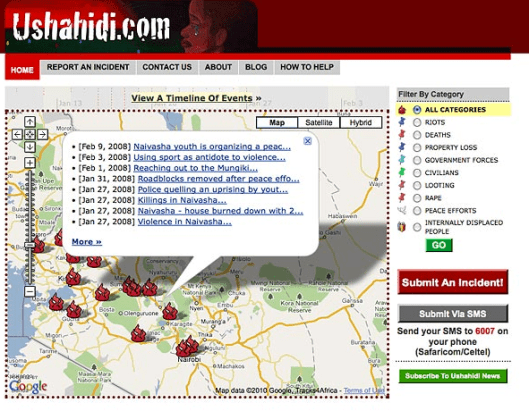
the original web mash-up

So, how could this be used to help people within a community display their resources/assets, needs, or initiatives towards resilience?

I live in Beacon, about 60 miles north of NYC, a small city of around 15,000 people. I’ve always thought it would be a perfect testbed for something like this. Basically you have a Google map, and everyone can ‘claim’ their property/residence, and make stuff visible so that it can be made more efficient/effective. (we care about the stuff we can measure). For instance:

Energy example –

How could we reduce the energy used citywide? Having dabbled in real estate here, I know that I can call Central Hudson (our utility provider) and find out the average monthly electric bill on any property. So the information is publicly available. What if we could map those numbers on every property, and have a dashboard that displays the overall energy usage in the city.

Then, what if we organized, say, a light-bulb exchange initiative, where we began getting the city switched over to energy star bulbs/CFLs. When a household/business converts, they get a “badge,” that can then be displayed on the site when you scroll over that property. (we could also make actual stickers that could be displayed in the window of storefronts and people’s homes showing they’ve gotten the energy badge…. i saw something like this in Boulder, Colorado several years ago.) The real-time city data would also reflect the change, showing some kinds of graphs or pie charts displaying the increase in efficiency.

Food example –

We had many local farms in the area and options for food co-ops. We also have a lot of people who have gardens and have excess produce in the summer that they’d be happy to swap for other goods. We have a lot of people who brew beer. We have people who would be happy to go in together to get a deal on buying a ¼ steer or some quantity of grass-fed beef from a farm, or dairy products, or whatever. What if people could make this information available, so they could more easily make arrangements to invest in local food?

Transportation & Housing example –

I’ve been inspired by all the “collaborative consumption” services I’ve seen spring up over the past few years. There’s car sharing (ZipCar), bike sharing (Bcycle), land rental for gardening (landshare), or room rental for travelers (Airbnb). How could we implement similar services, or use those existing services as plugins? (getting a car or bike sharing program going is clearly a large initiative, and trickier than just offering a plot of your backyard as common gardening ground, but you get the idea.)

Jobs and Economy example –

If economy is about the exchange of goods and services, what are the peer to peer services out there that could duplicated/implemented? For instance, there’s Freecycle for reuse of goods, Swap for trading, and Zilok for renting out any kind of thing you might have – electronics, tools, whatever. Can we hook into these services or make a simple local version? Google map + stuff that’s for offer + stuff that’s available. Same idea for exchanging services and collaborating on projects… using something like superfluid, perhaps?

We already have a great coworking space here in town, BEAHIVE, that’s been itching to be a catalyst to coordinate more real-world local initiatives and projects. It seems like we have a lot of the things necessary to be a prototype city for resilience building.

Where You Come In

Well, the guys at superfluid suggested I provide as much info & visuals as possible to reinforce the idea. And they want it within 24 hours. (eek!)

So…… what can we whip up?

If anyone has suggestions for a name for this, logo ideas, better description, etc, please pass em along. Any kind of video / graphical / text assets to communicate the vision also appreciated. My Illustrator skills are pretty amateur, but at the least I’ll take a screenshot of a google map and overlay an info bubble on top of it to convey some of the elements I’ve described above.

If this thing manifests, the intention is for it to be a free tool for any community us utilize, so I hope it’s intriguing! I’m eager to prototype it in Beacon.

Looking forward to your input, as always.

via @yodelheck

list of mapping software

Community Impact Through Mapping

via @Deborah909

A community garden as a use case for interoperable capacity mapping and resource matching tools

2010 in review

Tags

wordpress delivered these stats to my inbox the other day… cool to see how the community blossomed this year!

The stats helper monkeys at WordPress.com mulled over how this blog did in 2010, and here’s a high level summary of its overall blog health:

Healthy blog!

The Blog-Health-o-Meter™ reads Wow.

Crunchy numbers

Featured image

The Louvre Museum has 8.5 million visitors per year. This blog was viewed about 170,000 times in 2010. If it were an exhibit at The Louvre Museum, it would take 7 days for that many people to see it.


In 2010, there were 69 new posts, growing the total archive of this blog to 98 posts. There were 208 pictures uploaded, taking up a total of 53mb. That’s about 4 pictures per week.

The busiest day of the year was February 2nd with 5,297 views. The most popular post that day was iPad: Overhyped Flop or a case of Great Design Thinking?.

Where did they come from?

The top referring sites in 2010 were twitter.com, stumbleupon.com, wordpress.com, facebook.com, and Google Reader.

Some visitors came searching, mostly for emergent by design, venessa miemis, collaboration, ipad flop, and design thinking.

Attractions in 2010

These are the posts and pages that got the most views in 2010.

1

iPad: Overhyped Flop or a case of Great Design Thinking? February 2010
153 comments

2

The Rise of Collaborative Consumption October 2010
83 comments and 86 Likes on WordPress.com

3

What is Design Thinking, Really? January 2010
98 comments and 3 Likes on WordPress.com

4

who’s the architect? March 2009
37 comments

5

36 Awesome Idea Hubs to Spark Creative Thinking, Innovation, & Inspiration November 2009
7 comments and 2 Likes on WordPress.com

Humanity’s Next God: You?

Tags

In a recent article in The Economist, futurist Paul Saffo claims humanity’s overdue for a new god. He points out that throughout history, great new religions took shape during times characterized by uncertainty and social unrest, combined with an ability to spread compelling new ideas and world views virally.

And here we are today, he says, equipped with the Web as our communication channel, and a cultural climate bubbling with that same potential for something new to emerge. The article ends there, with only an image of worshippers gathered around an iPad to suggest where we might be placing our faith next.

It was just a prompt, but it’s made me wonder.. is this where we’re headed? Will the next “great” mythology be a story about how technology is going to save us? And can we do better?

If a new zeitgeist were to capture the minds of billions, what might it look like?

Externalizing our saviors, whether in personified gods or computerized devices, is a convenient way to bring us hope when we feel powerless or misdirected, but it can also relieve us of the burden of taking responsibility for our actions or inactions.

Perhaps it’s time to advance our collective story.

We continue to grow more connected, more informed, more intelligent, and more dangerous. Many are aware that the fictions being thrown around about how the world works are just that – fictions. Things are not working all that optimally, and that reality is only thinly veiled. We see the shift underway – with some trying to reveal “truth” by making information free, allowing open communication across borders, and giving people the tools to decide for themselves what’s what and how they want to live and participate. Opposing that effort, as has always been the case, are the ones terrified to lose control.

But how much longer can we continue this charade? It’s clear that our environments and economies are interwoven. We impact each other more and more every day, and our commonalities become apparent just as quickly as our differences. We must be nearing a tipping point.

Can we find a common ground? Can we put the games aside and be honest about things, perhaps agree upon some baseline for sustainability and thrivability on the planet? Can we wake up to our own potential to change the way things are and shape the way they can become?

Or or ideologies too entrenched? Are those in power too enchanted by their own stories to even attempt a reality that could be better for us all?

And while we watch those bigger forces biding time and maintaining illusions, we are given the option to become the change agents – to influence, inspire, and lead ourselves into a brighter future.

Will we act?

Or just pray?