7 Values of a Next-Gen Agency

Tags

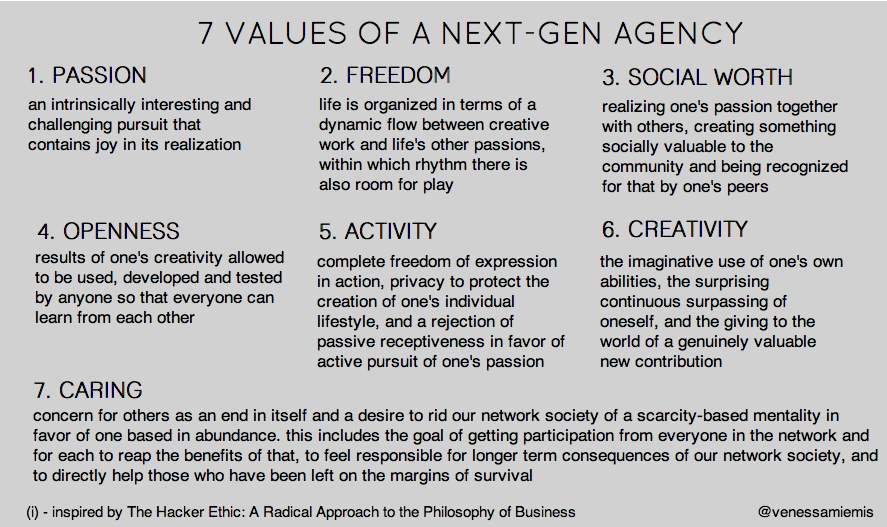
As some of you know, I’m in the midst of helping build a chaordic living systems enterprise. Our core group is currently having fascinating conversations about mission, values and the kind of culture we want to cultivate amongst ourselves, which in turn will inform what we model and inspire in the world.

As the days go by, we’re becoming more comfortable opening up to each other and really unpacking our core beliefs. This is helping us find alignment and coherence, which must happen before we construct our shared vision and lay our foundation.

I’ve been thinking a lot about open-source philosophy, creative work, and a passion-driven lifestyle. While on my flight out to San Francisco yesterday, I reread a book from my graduate work called The Hacker Ethic: A Radical Approach to the Philosophy of Business. (a hacker, btw, is defined as “an expert or enthusiast of any kind”). They laid out some core values of the hacker ethic, which felt very much in alignment with the way I operate and how I’d want to interact with my colleagues in this creative economy.

How do these 7 values strike you?

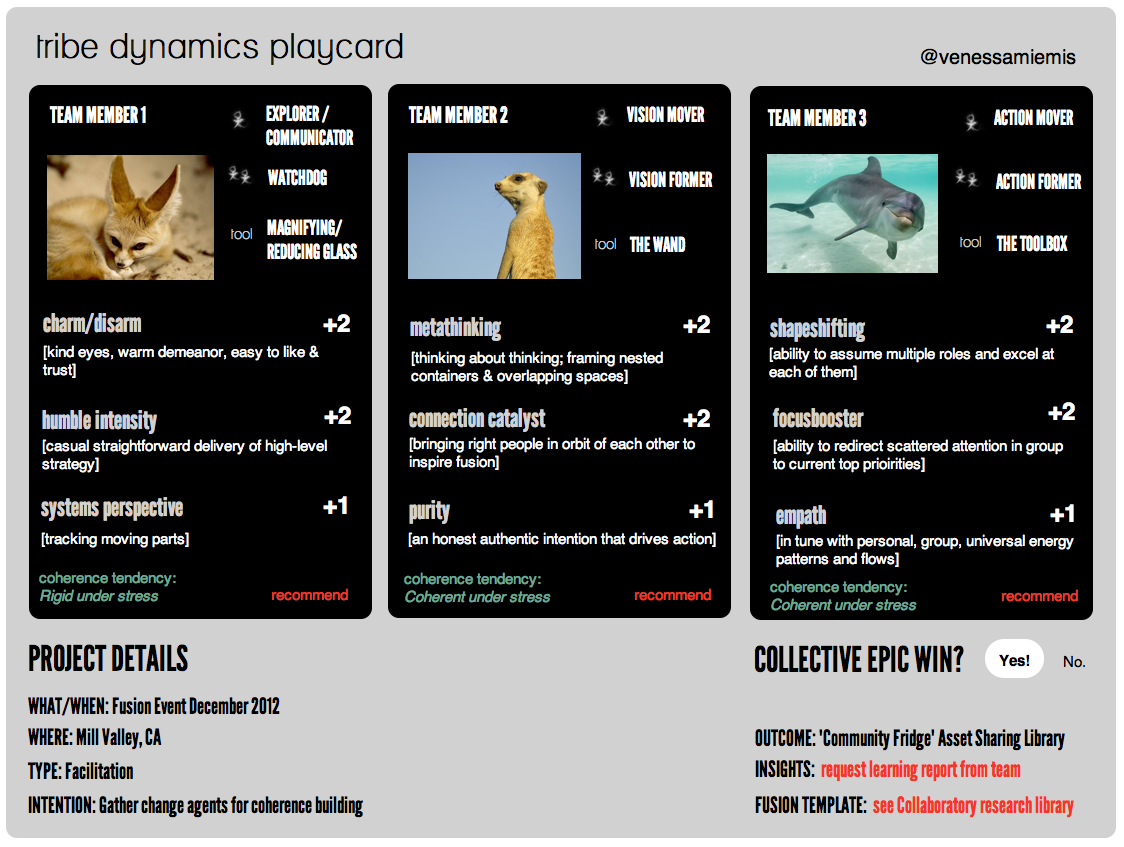
Tribe Dynamics: Appreciating Your Team’s Strengths to Build Coherence & Trust

Tags

coherence ::

1. the quality or state of cohering: as

a : a systematic or logical connection or consistency
b : integration of diverse elements, relationships, or values
2. the property of being coherent <a plan that lacks coherence>

How can we best surface our gifts and strengths?

How can we engage in meaningful work that motivates us through the elements of autonomy, mastery and purpose?

How do we amplify the strengths of our peers and cocreators?

How do we appreciate those strengths and align with them in order to build dynamic, high-performance, and highly coherent work teams?

As I’m participating in projects more and more with people across disciplines and boundaries, we’re experimenting with new ways to ask and answer these questions.

In December I ran a Fusion event in California with David Hodgson, Kirstin Ohm, and Adam Scislowicz. When the even was done, David suggested an exercise for us to show our gratitude and appreciate for the things we noticed as the inherent talents of the others.

We distributed 5 points per person in any combination to rank the person’s “superpowers” (performance, attitude, awareness, etc). We logged these responses into a google spreadsheet with the following columns:

[person giving] / [personal receiving] / [experience points] / [gifts acknowledged] / [assessment]

Then we hopped on a google hangout and shared our thoughts with each other and gave specific examples about when we saw each person’s gifts shine.

A few great things came of this process.

For one, it was fun. I’d never been challenged before to identify people’s natural gifts in this way — usually it’s just the opposite – you’re asked to examine the “failures” and figure out “what went wrong.” There were things that didn’t go as planned during the event, but starting our session with appreciation for each others’ efforts created a safe environment for being open and honest. We were then able to honestly discuss the things that played out suboptimally, and then described scenarios for how we could handle that type of situation more effectively in the future.

Secondly, it helped me to better understand our ‘tribe dynamics’ – how our personalities and styles can actually amplify the overall performance of the team, if acknowledged and understood coherently.

And lastly, it taught me more about myself. I’m finding it very interesting to learn that the way I see myself, or the things I think I bring to the table, are not always the things that others acknowledge or appreciate in me. Some of the acknowledgements i was given in this exercise were “story weaving,” “emergent facilitation,” and “completion,” all of which I would probably rate myself as a novice or apprentice. And yet these were the hidden gems that they could see were waiting to be polished up and brought forth.

I plan to continue participating in this type of process, not just on co-facilitated events or projects, but on a regular basis as I’m interacting with the people in my learning community. Participating in these feedback loops and productive discussions accelerates all of our learning. We get clarity on who we really are and where we excel, receive continuous feedback from trusted peers and mentors, and generally get a better understanding of ourselves, each other, and the dynamics between them.

In the larger context of the creative economy that we’re bootstrapping, these kinds of practices seem to be part of the foundational structure that will build trust and cultivate the kind of culture that is favorable for the kinds of change we want to see in the world.

further exploring:

The Gabriel Institute – role-based assessments / organizational dynamics / technology of teaming

Drive – Daniel Pink


9 Personal Capacities of Authentic Leaders

Tags

I came across the book The Lotus: a practice guide for authentic leadership toward sustainability on blurb.com yesterday.

Research by Baan, Long and Pearlman shows that successful sustainability leaders embody these nine personal capacities:

1. Being Present

Being Present means being fully aware and awake in the present moment – physically, mentally, emotionally and spiritually. This includes connecting to otheres, the environment around you and current reality.

2. Suspension & Letting Go

Suspension and Letting Go is the ability to actively experience and observe a thought, assumption, judgment, habitual pattern, emotion or sensation like fear, confusion, conflict or desire, and then refraining from immediately reacting or responding to the situation.

3. Intention Aligned with Higher Purpose

Intention Aligned with Higher Purpose is the alignment of one’s authentic nature with one’s internal resonance with manifested actions in the world. This alignment trickles down to all facets of life including one’s personal, professional and spiritual dimensions. “Where your deepest personal passion and the world’s greatest needs align, there is opportunity” (Peter Senge).

4. Whole System Awareness

Whole System Awareness is the capacity to quickly switch between different perspectives, scales and worldviews to see the big picture, interconnections within the system, and being able to scale down to small details. Whole System Awareness is not just cognitive – you ‘sense’ the system. It is the understanding that everything is interconnected within a system.

5. Compassion

Compassion is having unconditional acceptance and kindness toward all the dimensions of oneself and others, regardless of circumstance. Compassion involves the ability to reflect upon oneself and others without judgment, but with recognition and trust that others are doing the best they can in any given situation.

6. Whole Self-Awareness

Whole Self-Awareness is the continual, lifelong process of paying attention to knowing one’s self; it involves consciously and intentionally observing various dimensions of the self (including the physical, mental, shadow, emotional and spiritual realms). It is the capacity to observe how one is thinking, relating, feeling, sensing, and judging. Whole Self-Awareness includes perceptions beyond the rational mind, such as intuition.

7. Personal Power

Personal Power is the ability to use energy and drive to manifest wise actions in the world for the greater good, while being aware of one’s influences on a situation.

8. Dealing with Dualities & Paradox

Dealing with Dualities and Paradoxes is the capacity to sit with ambiguity in a facilitation session, manage polarities, and hold multiple perspectives.

9. Sense of Humor

A Sense of Humor, or ‘light-heartedness’, is the universal experience of simultaneous amusement, laughter and joy culminating from an experience, thought or sensation.

—-

originally found: Facilitating Transformational Change toward Sustainability

main site: The Lotus: Authentic Leadership for a Just, Resilient and Thriving World

Summary: The Postmodern Condition: A Report on Knowledge

Tags

.
.
this is a book review/summary of Jean-François Lyotard’s 1979 book The Postmodern Condition: A Report on Knowledge
.
.
How do we define ‘knowledge’ in a postindustrial society equipped with new media, instantaneous communication technologies and universal access to information? Who controls its transmission? How can scientific knowledge be legitimated?
.
These are the questions Lyotard asks in The Postmodern Condition. He believes that the method of legitimation traditionally used by science, a philosophical discourse that references a metanarrative, becomes obsolete in a postmodern society. Instead, he explores whether paralogy may be the new path to legitimation.
.
.
I. The Field: Knowledge in Computerized Societies
.

The nature of knowledge itself is shifting from being an end in itself to a commodity meant to be repackaged and redistributed. In order to be valuable, learning must be able to be reformatted into these packets of information in computer language, so that they can be sent through that channel of communication. Today, we increasingly hear the words “knowledge economy” and “information society” to describe the era we are entering. As was always the case, knowledge is power. Now, in an increasingly complex world, those with the ability to sort through the vast amounts of information and repackage it to give it meaning will be the winners. Technologies continue to solve problems that were formerly the source of power struggles between nations (i.e. the need for cheap labor is diminished by the mechanization of industry, the need for raw materials is reduced by advances in alternative energy solutions), and so control of information is most likely to become the 21st century’s definition of power.

.

2. The Problem: Legitimation

.

The definition of knowledge is determined by intertwining forces of power, authority, and government. Leotard draws a parallel between the process of legitimation in politics and of those in science: both require an authority figure or “legislator” to determine whether a statement is acceptable to enter the round of discourse for consideration. In an increasingly transparent society, this leads to new questions:

Who is authorizing the authority figure? Who is watching the watchers?
.

3. The Method: Language Games
.
The manner in which communication unfolds is like a dance. Or a battlefield. Those patterns that define our social interactions are identified here as language games, and put us in constantly changing positions and roles based on the type of discourse.
.

4. The Nature of the Social Bond: The Modern Alternative

.

Lyotard says that to understand the nature of knowledge in modern times, one must be able to understand how the society operates. In this case, postmodern society it is either a whole, or split in two. Is it an optimistic model that views society as a cohesive, unified whole, or a model based in dissonance, where the needs of the people and functions of the system are incompatible? Either way, society is a machine, and knowledge is a cog in the system that keeps it running.

.

5. The Nature of the Social Bond: The Postmodern Perspective

.

The social bond is itself a language game, each of us nodes on a communication net, intercepting and resending messages throughout the system. These messages affect the nodes in the language game, causing “moves,” “displacements,” and “countermoves,” all which potentially enhance and enrich the system by creating innovation and novelty. This method of communication differs greatly from the modern institutional approach at language games, which limit the kinds of ‘moves’ able to be made by creating rigid boundaries and rules.
.

.
6. The Pragmatics of Narrative Knowledge
.
Science is not the same as knowledge. Whereas science is made up of denotative statements, and must be observable, repeatable, and verifiable by experts, knowledge casts a wider net, being composed of a competence that encompasses concepts of truth, justice, efficiency, and beauty. Knowledge is not limited to a specific class of statements; it is characterized by a fluidity and flexibility that can identify the relationships across subjects in order to make “good” utterances. Narratives then decide the criteria of the competence of knowledge – in traditional knowledge this would be “know-how,” “knowing how to speak,” and “knowing how to hear.” A narrator attains legitimation simply by being the narrator; the information is transmitted to the listener, who then attains the knowledge, and through meter and repetition pass of the criteria of competence and the acceptable rules of a culture.
.

7. The Pragmatics of Scientific Knowledge

.

Scientific knowledge is characterized by the ability to provide proof supporting a statement, and ability to refute opposing statements. The combination of these two conditions do not prove a statement ‘true,’ but rather as being likely to be true based on our understanding of reality. The competence needed in the formulation of scientific knowledge does not require a social bond; it is one-sided, only requiring a sender’s competence, and is composed only of the language game of the denotative utterance.

In postmodern society, we have two types of knowledge: narrative and scientific. Neither can be judged as right or true or better in comparison to the other, because their criterion of competence is difference.

.

8. The Narrative Function and the Legitimation of Knowledge

.

Narrative knowledge is looked at disdainfully by advocates of scientific knowledge because it doesn’t put legitimation as its foremost priority when forming statements. Ironically, scientific knowledge must resort to narratives in order to legitimate itself, as arguments and proofs are merely dialectics. The new function of narrative knowledge is characterized by both denotative utterances concerning truth, and prescriptive utterances concerning justice. “The people” decide that what is needed to determine the legitimacy of truth or justice is simply their debate and consensus.

.

9. Narratives of the Legitimation of Knowledge

.

The two predominant versions of the narrative of legitimation. The first is “humanity as the hero of liberty.” Humanity becomes the validator of knowledge: laws that are created are just because the citizens who create them desire them to be just, and so it follows that they must be just. Knowledge is valuable insofar as it serves to meet the goals of the collective. The second positions science as a path to morality, ethical action, and spirituality. Legitimation then becomes the subject of the philosophical, of the spirit.
.

.
10. Delegitimation
.
In the postindustrial society, the grand narrative is dead. A process of deligitimation was inherent in terms of positive science, as its version of ‘knowledge’ was legitimated by itself  “by citing its own statements in a second-level discourse,” and is therefore not true knowledge at all. Instead, science can be seen as a speculative game that is defined by a certain set of rules. As the rules are being bent, fields of science are converging, and areas of inquiry are applicable to a greater range of disciplines. No one can master all the languages, and in the absence of a metalanguage,legitimation leaves the realm of being based on performativity and is accepted to be based on the social bond, consensus and communications.
.

11. Research and Its Legitimation through Performativity

.

New methods of argumentation and establishing proof are changing the pragmatics of research. It is accepted that there are a variety of methods to arguing truth, not just a universal metalanguage. New moves, new rules, and new games are all pathways of progress in scientific knowledge. Proof is increasingly established through technology, because the technical apparatus can make observations more efficiently than human senses. The problem is that technology costs money, and so truth can most often only be established by the wealthy. This interweaving of efficiency and wealth has meant that research is typically conducted not to establish truth, but to turn a profit and gain power. If those with wealth are running the game, they continue establishing proof by funding more research, which then increases efficiency or ‘performance improvement,’ which allows more ‘proof’ to be produced, which as an end in itself becomes a type of legitimation. So in the postmodern world, power is the knowledge of how to increase the efficiency of the system, which is accomplished by having, creating, and reformatting the most information and data.

.

12. Education and Its Legitimation through Performativity

.

What defines learning and education when knowledge becomes the equivalent of performativity of the social system? Education ceases to end with young people at the university level – instead members of society will need to continually absorb new information in order to be able to function in an ever-evolving system. The role of professor as transmitter of learning may decrease, as computer-based learning opportunities increase. When information becomes universally accessible and ubiquitous, learning becomes a matter of knowing how to harvest the information out of a vast pool of data, how to ‘create’ knowledge by reassembling available information in meaningful ways.
.

.
13. Postmodern Science as the Search for Instabilities
.
Lyotard says that postmodern scientific knowledge cannot be based on performativity, because efficiency must be calculated based on a stable system. Nature and society are not stable systems, it is impossible to define all the variables of those systems, and so they can never be perfectly controlled. Their success and progress are based on inconsistencies and innovations, or “new moves.” As is demonstrated by tyrannical governments or authorities, control does not increase performativity, but rather stifles the system. So knowledge in the postmodern world is about change, adapting to it, and generating new ideas, not on an established rigid scientific method.
.

14. Legitimation by Paralogy

.

Postmodern thought accepts that there cannot be a fixed, static paradigm for legitimation in a system that is fluid, organic, and constantly in flux in its process of growth. It is more apparent now that at any other previous point in history that we are living in a world of accelerating technological change, and flexibility of the players to create new moves and rules will be crucial to society’s functioning. Permanence has always been an illusion, and aligning our interactions and interpretations of society and knowledge more with the notion of transience and ephemerality will only service in our favor.

—-

update: lynne desilva johnson: “it can be a useful exercise to remove philosophical texts from their heritage and create new ownership of concepts and language, reapplying these concepts heuristically out of context to new and different times and places. While the author wishes some accuracy in terms of the general translation of this model, she is less concerned with the original application/ontological trappings and as such the following essay should read as her extrapolated contemporary reading of this theorist as applies to this time and place”

(from the archives; 19 march 2009; media studies graduate paper)

imagery from the Imaginary Foundation
[Image]: Decision Tree for Vision Manifestion

Tags

I just got back from a great trip to Burlington, VT, where I touched base with Amy Kirschner of the Vermont Sustainable Exchange. She and cocreator Kyra Pinchiera have been working on creating an inquiry process to assist people in making ideas happen.

Many of us have grand visions of the future, but to be able to tranform those into a “minimum viable product” – something tangible and actionable – can be a bit of an art.

She showed me her sketches for taking idea to action, and i made them into a little graphic. Enjoy!

Reflection: The Concept of Enlightenment

Tags

musings on Adorno & Horkheimer’s Dialectic of Enlightenment.

When I review these passages, my mind speaks back – “the machine is using us”.

The goal of the enlightenment was to free our minds, by favoring ‘rationality’ over myth and mysticism. Nature became something that was to be controlled by us, quantified, compartmentalized, labeled, manipulated.

But, this new scientific way of looking at things changed the way we THINK… or perhaps limited our ability to think at all. Instead of looking for greater ‘Truth’ or deeper meaning in things, identifying the essence of a thing, giving it ‘value’, it becomes a mere definition. The framework of thoughts are based in a soul-deadening logic and mechanicality. Everything that can be named and described and explained away can be somehow controlled, and there’s a power in that, but at the same time, something sacred is lost.

The belief in positivism seems as irrational to me as mythology must have been for those that started the enlightenment movement. To place utmost value in what the senses can perceive, and call it Truth, is ridiculous. I think we’re finally coming around full circle, not to a return to mysticism, but at least allowing ourselves to say that there’s more to life than meets the eye. In some ways, science itself has pointed out its fallibility. The more we dive into quantum mechanics, the more incongruities and incompatibilities we find with what we think we know and what is. Perhaps there really is an unknowable universal. Is it really such a horrible thing to have a sense of awe of the world around us??

We become like slaves in invisible chains, our minds shaped into the pattern of a machine: efficient, mechanical, repetitive, causal, our thoughts on the conveyor belt of an assembly line – there are no alternative paths for them to take.

This machine-like way of thinking is tied directly to the division of labor – the mechanized process of thinking is merely a function of material production and the “all-encompassing economic apparatus”. By abandoning the cumbersomeness of formulating actual thoughts in favor of following a predetermined reified path, the greater machine/system of society can operate smoothly. At the same time, the smooth operation leads to a distillation of society, a loss of culture.

By treating nature as something outside of oneself, something that needs to be manipulated and controlled verse something with which to be in harmony, humans become isolated and estranged. Both the lowly worker and the ones in charge are victims – the dominated are resigned sheep, and the dominators are equally immobilized by their distance from the experience, the self imposed detachment and repression of novelty in favor of utility in order to ‘better’ perform their role of power.

(from the archives; friday february 6, 2009; media studies graduate paper)

Launching: Heartsong Project: Who I Am, My Passion, My Vision & Intentions

Tags

As we’re building out human-centered next-gen profiles for the Collaboratory, we wanted an intimate and creative way for people to get to know each other.

Enter: the Heartsong Project.

(thanks lauren higgins for bringing up the term “heartsong” on our brainstorm call.)

The idea is pretty simple and straightforward:

Record a 1-3 minute video of you describing your heartsong.

What’s a Heartsong?

This is your personal “tune.”

Who are you?

What passion drives your actions?

What makes your heart sing?

Everyone has beautiful visions inside of themselves, and as we bring those to the surface and share them with each other, the likelihood of them becoming real amplifies.

Let’s manifest!

The above is a sample I made this morning. It took me a few hours total. I’m on an iMac. I recorded in photobooth and edited in iMovie.

I also purchased the domain “heartsongproject.cc”

I’d like this to be the 2nd project of Open Foresight.

(Open Foresight is a series of models and methodologies we’re developing for co-creative visions of the future. It combines techniques from futures studies together with design and media production. The first prototype was the Future of Facebook video series. The Heartsong Project is about developing personal foresight – understanding your own deep desires and aims and clarifying them. This is the first step to developing plans of action towards achieving them.)

I don’t have the bandwidth to develop out the website at the moment, but would be happy to do a wireframe or mockup with ideas for anyone who would like to run with it. (we can co-create it in the Collaboratory!)

We’re already creating our Heartsongs and uploading them to youtube.

All content we create for Open Foresight projects is being licensed Creative Commons Attribution-ShareAlike 3.0 (cc by-SA 3.0), meaning we’re making it available to be reused, remixed, and built upon by others.

Can’t wait to hear your heartsongs!!!

Developing Next-Gen Profiles: Collaboratory Mockup

Tags

I’ve been having a lot of fun the past few weeks fleshing out our next-gen profiles for the Collaboratory.

One of the things I think is critical for any sufficiently advanced social network is a way for us to actually express who we are as human beings – emotion, passion, intent, inherent gifts, and the like.

The problem with Facebook and LinkedIn is they predefine the scope of what it means to be human.

Either you’re this or that. This religious affiliation, this political view, this relationship status, this sex, and so forth.

And that’s all fine for those who find comfort in the rigidity of those labels.

But for those who wish to be untethered from that way of thinking, so that we can expand ourselves into expressing fuller human capacity, it’s a bit constraining.

So we’re working on allowing people to show who they are and what they’re about from a deeper, more meaningful level.

To that end, I’ve been playing with the new hive to do mockups (disclaimer – the new hive is for generally for you to “express yourself,” not do wireframes, so it’s no Illustrator – but for a dead simple tool that a child could start using within minutes, it’s perfect.). The above image is just v1 of what I’ve come up with, but I think I’m leaning towards everyone being able to make their profile however they want. We’ll provide a few fields (tribe dynamics, superpowers, strengths, projects, etc), and everyone makes it visually look however they want.

Profiles & Self-Discovery

I’ve spent a lot of time over the years experimenting with various self assessments (8 Tools for Self-Analysis), and thinking about how these assist in the process of self-discovery, clarity, and personal development. We want to provide as many options as we can to engage in this way. We’ve partnered with The Gabriel Institute to provide Role assessments (which we’re calling “tribe dynamics”). Also looking to partner with Gallup for the Strengthsfinder2.0.

Profiles & The Future of Work

And beyond the feel-good reasons of self-discovery, this is about the future of work and value creation too.

As we transition to a society and world of work where people are actually doing things that resonate with their core deeply, I think we need to go through a process of surfacing what we actually care about to help us discern what we’d like to be doing. For many people (at least that I’ve encountered), those deeper desires have been so suppressed over time that the individual isn’t even aware of the connection anymore. <desires for autonomy, mastery, and purpose, as Dan Pink would say>

Learning how to align around projects and opportunities based on our core resonance and values feels a lot more meaningful than chasing the biggest paycheck.

Profiles & Mutual Improvement

And beyond self-discovery and value creation, it comes down to the tie that binds – culture and community.

We’re fostering a community of continuous learning and mutual improvement, and revealing ourselves to each other in this way helps us know how we might assist each other to learn something new (contextual and relevant, or serendipitous) or develop in some meaningful way (help overcome cognitive biases, help heal emotional wounds).

We’re real people. We have these issues, and we’re not embarrassed to acknowledge them, address them, and grow beyond them. It’s’ a step in the direction of cultivating our latent superpowers so that our work teams operate at a level of joy and efficiency that can’t be purchased with any amount of ‘corporate training programs’ or HR ju-ju.

Profiles Part 2

The second part of the user profiles will go more deeply into specific passion projects that are being worked on, whether that’s software development to change the world, or a resilience project to support the local or regional economy.

We’re working on the database that’ll make these projects all searchable so collaborative and co-creative opportunities easily bubble to the surface.

Stay tuned, we’ll be posting updates as they develop!


Intentcasting an Epic Vision: How to Bootstrap Creative Economy 3.0

Tags

Q: How do the Amish raise a barn without money?

A: Community, and the social capital that weaves it together.

In my husband’s Latvian community, they have a concept similar to barnraising called “talka,” which describes collective volunteer work for the good of society and environment.

Several times a year we come together at our camp in the Catskill Mountains, and everybody chips in to maintain the property – clearing branches, building bridges, fixing roofs, painting, and whatever else needs to get done. No one gets paid for it (unless you count food, beer, and bonfires as payment), yet everyone helps.

Why?

Because we’re invested in ourselves and each other and are stakeholders in our community and believe that preserving and cultivating our culture matters.

So. How does that ethic translate to online community, and can we show that we have one?


**Let’s intentcast to bootstrap Creative Economy 3.0** Continue reading