• about
  • projects
    • Beach Loft Interior Design
    • Contact Conference
    • Emerging Leader Labs
    • Junto
    • Open Foresight
    • The Future of Money
      • future of money, cont.
    • The Future of Facebook

emergent by design

Category Archives: Uncategorized

Program or Be Programmed: 10 Commands for a Digital Age

06 Sunday Feb 2011

Posted by Venessa Miemis in Uncategorized

≈ 16 Comments

Tags

books


Thanks to digital technologies and networked activity, we’re living through a global transition that is redefining how culture and commerce operate. We’re presented with the opportunity to be active participants in this process, steering ourselves into new modes of civilization, verse being just passive spectators.  But if we don’t understand the biases of the tools and mediums we’re using, we’ll risk being slaves instead of masters.

This is not the first time this has happened, but it may be the most significant one so far. Every media revolution has given the people a sneak peek of the control panel of civilization, and a chance to view the world through a new lens. When humans developed language, we were able to pass on knowledge and experiences, and allow for progress. We could both listen and speak.

When we developed alphabets and literacy, we were able to create laws and accountability, and a new kind of authority. Of course, it was the elites that knew how to read these symbols – the masses could just gather in the town square and listen.

With the invention of the printing press, a society of readers developed. But the elites still controlled the means of production, the access to the presses themselves. We’ve seen the same patterns with broadcast radio and television. We don’t create, we watch and consume. Continue reading →

Has the Online Privacy Backlash Begun?

25 Tuesday Jan 2011

Posted by Venessa Miemis in Uncategorized

≈ 18 Comments

Tags

technology + society

Though some may like to believe that the age of privacy is dead, recent developments in Do Not Track browser options would suggest otherwise.

Microsoft recently announced a new feature for Internet Explorer 9, called Tracking Protection Lists, enabling consumers to limit the data third-party sites can collect about them. Yesterday, Mozilla announced they will incorporate a Do Not Track header into the upcoming Firefox 4.1, which would essentially notify each website the user visits that they want to opt-out of third party, advertising-based tracking. And Google just made a new Chrome extension available called Keep My Opt-Outs, which permanently opts your browser out of online ad personalization via cookies.

While these efforts are underway for our browsers, tools are also being developed for our social networks. WSJ just covered a new tool called uProtect.it, whose tagline is “Protection from Facebook on Facebook.” The free app encrypts your comments and posts, making them inaccessible to unwanted viewers, including Facebook itself.

This flurry of recent activity indicates a larger trend:

People may finally be ready to demand intuitive privacy settings, ownership of personal data, and opt-out rather than opt-in as a default.

While many would argue that openness and transparency are a good thing, it should be at an individual’s discretion to decide how public they want to be, and to have control over who gets to see what. In that positive vision of the future, we’re able to choose how we share and exchange information on a peer to peer level, and actually create value together, instead of having it extracted from us.
If that battle is lost, the web may continue to devolve into a playground for advertisers, embedded with increasingly fine-tuned mechanisms to exploit our preferences, behaviors, and social graph.

A Tool for Building Resilient Cities

08 Saturday Jan 2011

Posted by Venessa Miemis in Uncategorized

≈ 62 Comments

Tags

sustainability

Yesterday, this tweet by @thesuperfluid went through my stream:

(Superfluid is a site that enables people to collaborate and exchange favors using their virtual currency, Quids.)

Apparently they will be here in NYC on Monday, demo-ing thier product at the NY Tech Meetup, and wanted a cool idea they could bring to life in front of the crowd. So, I emailed them with my idea, something that’s been filed away in my mind as “The Resilient City Project.”

the one line description would be something like:

a tool that helps local communities share resources and reduce expenses using geolocation, interactive mapping, and visualization

To unpack that a bit, let’s start with the components of a resilient city.

I found a cool Community Resilience Toolkit that was put together for the San Francisco Bay Area, which breaks down aspects of resilience into these topic areas:

  • food
  • water
  • energy
  • transportation and housing
  • jobs and economy
  • civic preparedness and social services

Ok, so the idea is, how can we strengthen those things so that a community can weather tough economic times or uncertainty?

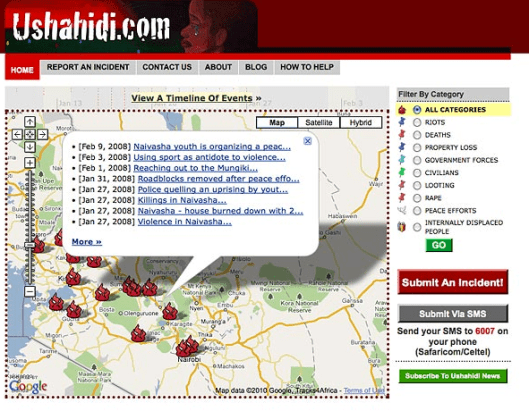
I was thinking something along the lines of Ushahidi meets sustainability. Ushahidi is an open source platform that was originally used to map incidents of violence and peace efforts in Kenya, and has since expanded to be a customizable tool for information collection, visualization, and interactive mapping. With just a mobile phone, you can upload info that gets transformed into a real-time visualization.

the original web mash-up

So, how could this be used to help people within a community display their resources/assets, needs, or initiatives towards resilience?

I live in Beacon, about 60 miles north of NYC, a small city of around 15,000 people. I’ve always thought it would be a perfect testbed for something like this. Basically you have a Google map, and everyone can ‘claim’ their property/residence, and make stuff visible so that it can be made more efficient/effective. (we care about the stuff we can measure). For instance:

Energy example –

How could we reduce the energy used citywide? Having dabbled in real estate here, I know that I can call Central Hudson (our utility provider) and find out the average monthly electric bill on any property. So the information is publicly available. What if we could map those numbers on every property, and have a dashboard that displays the overall energy usage in the city.

Then, what if we organized, say, a light-bulb exchange initiative, where we began getting the city switched over to energy star bulbs/CFLs. When a household/business converts, they get a “badge,” that can then be displayed on the site when you scroll over that property. (we could also make actual stickers that could be displayed in the window of storefronts and people’s homes showing they’ve gotten the energy badge…. i saw something like this in Boulder, Colorado several years ago.) The real-time city data would also reflect the change, showing some kinds of graphs or pie charts displaying the increase in efficiency.

Food example –

We had many local farms in the area and options for food co-ops. We also have a lot of people who have gardens and have excess produce in the summer that they’d be happy to swap for other goods. We have a lot of people who brew beer. We have people who would be happy to go in together to get a deal on buying a ¼ steer or some quantity of grass-fed beef from a farm, or dairy products, or whatever. What if people could make this information available, so they could more easily make arrangements to invest in local food?

Transportation & Housing example –

I’ve been inspired by all the “collaborative consumption” services I’ve seen spring up over the past few years. There’s car sharing (ZipCar), bike sharing (Bcycle), land rental for gardening (landshare), or room rental for travelers (Airbnb). How could we implement similar services, or use those existing services as plugins? (getting a car or bike sharing program going is clearly a large initiative, and trickier than just offering a plot of your backyard as common gardening ground, but you get the idea.)

Jobs and Economy example –

If economy is about the exchange of goods and services, what are the peer to peer services out there that could duplicated/implemented? For instance, there’s Freecycle for reuse of goods, Swap for trading, and Zilok for renting out any kind of thing you might have – electronics, tools, whatever. Can we hook into these services or make a simple local version? Google map + stuff that’s for offer + stuff that’s available. Same idea for exchanging services and collaborating on projects… using something like superfluid, perhaps?

We already have a great coworking space here in town, BEAHIVE, that’s been itching to be a catalyst to coordinate more real-world local initiatives and projects. It seems like we have a lot of the things necessary to be a prototype city for resilience building.

Where You Come In

Well, the guys at superfluid suggested I provide as much info & visuals as possible to reinforce the idea. And they want it within 24 hours. (eek!)

So…… what can we whip up?

If anyone has suggestions for a name for this, logo ideas, better description, etc, please pass em along. Any kind of video / graphical / text assets to communicate the vision also appreciated. My Illustrator skills are pretty amateur, but at the least I’ll take a screenshot of a google map and overlay an info bubble on top of it to convey some of the elements I’ve described above.

If this thing manifests, the intention is for it to be a free tool for any community us utilize, so I hope it’s intriguing! I’m eager to prototype it in Beacon.

Looking forward to your input, as always.

–

via @yodelheck

– list of mapping software

– Community Impact Through Mapping

via @Deborah909

– A community garden as a use case for interoperable capacity mapping and resource matching tools

2010 in review

03 Monday Jan 2011

Posted by Venessa Miemis in Uncategorized

≈ 2 Comments

Tags

community

wordpress delivered these stats to my inbox the other day… cool to see how the community blossomed this year!

–

The stats helper monkeys at WordPress.com mulled over how this blog did in 2010, and here’s a high level summary of its overall blog health:

Healthy blog!

The Blog-Health-o-Meter™ reads Wow.

Crunchy numbers

Featured image

The Louvre Museum has 8.5 million visitors per year. This blog was viewed about 170,000 times in 2010. If it were an exhibit at The Louvre Museum, it would take 7 days for that many people to see it.


In 2010, there were 69 new posts, growing the total archive of this blog to 98 posts. There were 208 pictures uploaded, taking up a total of 53mb. That’s about 4 pictures per week.

The busiest day of the year was February 2nd with 5,297 views. The most popular post that day was iPad: Overhyped Flop or a case of Great Design Thinking?.

Where did they come from?

The top referring sites in 2010 were twitter.com, stumbleupon.com, wordpress.com, facebook.com, and Google Reader.

Some visitors came searching, mostly for emergent by design, venessa miemis, collaboration, ipad flop, and design thinking.

Attractions in 2010

These are the posts and pages that got the most views in 2010.

1

iPad: Overhyped Flop or a case of Great Design Thinking? February 2010
153 comments

2

The Rise of Collaborative Consumption October 2010
83 comments and 86 Likes on WordPress.com

3

What is Design Thinking, Really? January 2010
98 comments and 3 Likes on WordPress.com

4

who’s the architect? March 2009
37 comments

5

36 Awesome Idea Hubs to Spark Creative Thinking, Innovation, & Inspiration November 2009
7 comments and 2 Likes on WordPress.com

Humanity’s Next God: You?

31 Friday Dec 2010

Posted by Venessa Miemis in Uncategorized

≈ 40 Comments

Tags

social evolution

In a recent article in The Economist, futurist Paul Saffo claims humanity’s overdue for a new god. He points out that throughout history, great new religions took shape during times characterized by uncertainty and social unrest, combined with an ability to spread compelling new ideas and world views virally.

And here we are today, he says, equipped with the Web as our communication channel, and a cultural climate bubbling with that same potential for something new to emerge. The article ends there, with only an image of worshippers gathered around an iPad to suggest where we might be placing our faith next.

It was just a prompt, but it’s made me wonder.. is this where we’re headed? Will the next “great” mythology be a story about how technology is going to save us? And can we do better?

If a new zeitgeist were to capture the minds of billions, what might it look like?

Externalizing our saviors, whether in personified gods or computerized devices, is a convenient way to bring us hope when we feel powerless or misdirected, but it can also relieve us of the burden of taking responsibility for our actions or inactions.

Perhaps it’s time to advance our collective story.

We continue to grow more connected, more informed, more intelligent, and more dangerous. Many are aware that the fictions being thrown around about how the world works are just that – fictions. Things are not working all that optimally, and that reality is only thinly veiled. We see the shift underway – with some trying to reveal “truth” by making information free, allowing open communication across borders, and giving people the tools to decide for themselves what’s what and how they want to live and participate. Opposing that effort, as has always been the case, are the ones terrified to lose control.

But how much longer can we continue this charade? It’s clear that our environments and economies are interwoven. We impact each other more and more every day, and our commonalities become apparent just as quickly as our differences. We must be nearing a tipping point.

Can we find a common ground? Can we put the games aside and be honest about things, perhaps agree upon some baseline for sustainability and thrivability on the planet? Can we wake up to our own potential to change the way things are and shape the way they can become?

Or or ideologies too entrenched? Are those in power too enchanted by their own stories to even attempt a reality that could be better for us all?

And while we watch those bigger forces biding time and maintaining illusions, we are given the option to become the change agents – to influence, inspire, and lead ourselves into a brighter future.

Will we act?

Or just pray?

Infographic: New Lenses of Wealth

27 Monday Dec 2010

Posted by Venessa Miemis in Uncategorized

≈ 10 Comments

Tags

projects

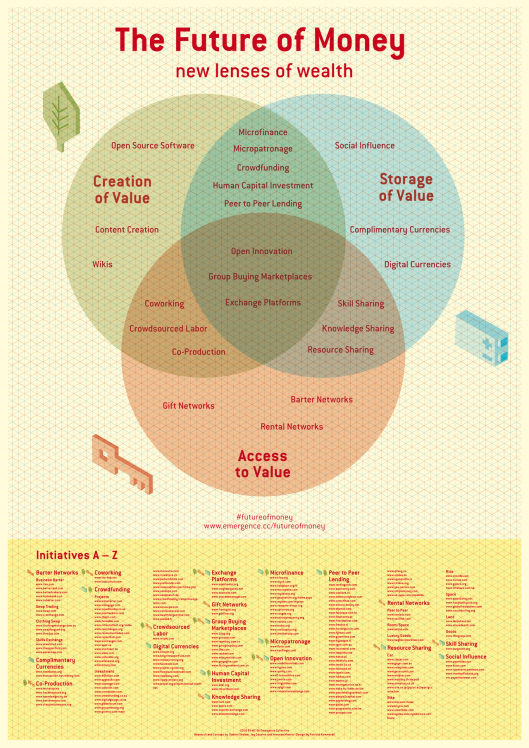
The infographic summarizing our research for The Future of Money project is now complete! Thanks to Patrizia Kommerell for the design work, and Gabriel Shalom & Jay Cousins for concept work. You can check out Pati’s post and download the infographic in A1 or A4 size PDF over at emergence.cc.

Crowdfunding 101: 5 Questions to Consider

23 Thursday Dec 2010

Posted by Venessa Miemis in Uncategorized

≈ 8 Comments

Tags

money + currency

Now that the Future of Money project has come to a close, I wanted to do a brief wrap-up post/case study about the process and our crowdfunding efforts.

Though we’d never tried it before, we managed to receive almost $6,000 in donations in about 6 weeks, and went on to get some pretty impressive media coverage. So, here’s a few questions to consider when structuring a crowdfunding campaign, and a few reflections about what I’ll do differently the next time around. Continue reading →

3 Tools for Futures Thinking & Foresight Development

08 Wednesday Dec 2010

Posted by Venessa Miemis in Uncategorized

≈ 32 Comments

Tags

futures

(followup to When Futures Thinking Meets Design Thinking post)

The last post outlined a general framework for “futures thinking.” Here, we look at three techniques for honing your ability to see beyond the horizon.

1. Trend Analysis

In order to develop the capacity for imagining alternative futures and create design solutions accordingly, it is useful to be aware of the current driving forces and megatrends underway. The “STEEP” categories [Social, Technological, Environmental, Economic, Political] give us the mental framework for understanding the complex web of change around us, and can also be further broken down into subcategories for refinement. For example, “Social” could be viewed at the more granular levels of culture, organization, and personal.

Once a trend is identified, both its causes and impacts can be considered. For instance, a rise in life expectancy might be caused by rising living standards, better medical treatments, and healthier environments. The corresponding impacts of this trend may be that a longer portion of a person’s life is spent in retirement, and so there will be an increasing demand in goods and services for the elderly and perhaps a bigger financial strain on families to care for aging parents or grandparents. What types of environments should be designed in order to accommodate these changes?

Another example is the increasing amount of “leisure time” people are now facing. Technological automation has made human involvement in many processes unnecessary, and global economic recession has left many unemployed. If these trends continue, what types of structures must be designed in order to redirect the wasted productivity and surplus mental power that is currently sitting idle? When thinking about the world at this scale, the “big picture” pops out and we can begin to think about design in terms of strategic preparation for our future.

2. Visioning

Clarifying a vision is one of the most powerful mechanisms for engaging a team, organization or community and getting them excited to push forward into new territory. A successfully designed product or service should intentionally impact the thoughts and behaviors of society and culture, and serve as an example of the mindset and values of its creators. So, what does this future humanity look like? Creating that clear vision is a precursor to planning, and a key to creating the conditions to mobilize a group of collaborators around a common goal.

There is a nice guideline in the book Futuring that breaks down this process of “Preferred Futuring” into these eight tasks:

1. Review the organization’s common history to create a shared appreciation.
2. Identify what’s working and what’s not. Brainstorm and list “prouds” and “sorries.”
3. Identify underlying values and beliefs, and discuss which ones to keep and which to abandon.
4. Identify relevant events, developments, and trends that may have an impact on moving to a preferred future.
5. Create a preferred future vision that is clear, detailed, and commonly understood. All participants, or at least a critical mass, should feel a sense of investment or ownership in the vision.
6. Translate future visions into action goals.
7. Plan for action: Build in specific planned steps with accountabilities identified.
8. Create a structure for implementing the plan, with midcourse corrections, celebrations, and publicizing of successes.

Ultimately, it’s not about creating MY vision, but about creating a SHARED vision. As responsible, forward thinking humans, we all want to create a better future. But what does it look like? Have we defined it? Have we described it? Who are we within it? What does interaction look like? If our idea gained mass adoption, what would that mean? What does that world look like?

If we can see it, we can build it.
3. Scenario Development

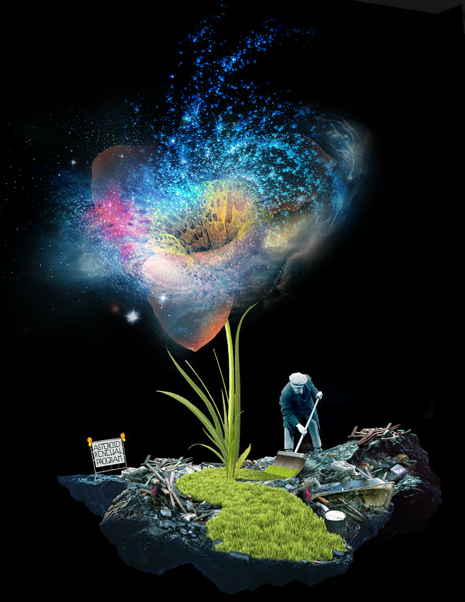
As an extension of visioning, scenario development is where the power of narrative comes in. Throughout human history, we are defined by the stories we tell each other and ourselves. We create meaning and understanding by the way we remember our stories, like personal cargo that we carry in our minds. Our surroundings, natural or designed, are artifacts and objects within those stories. When thinking about the future, whether it’s the future of society, the organization, or the self, developing a series of scenarios allows us to objectively deal with uncertainty and imagine plausible costs and benefits to various actions and their consequences. It is often suggested to create a minimum of three scenarios when considering future events or situations by identifying futures that are possible, probable, and preferable. Here’s a suggested five sample scenario from the Futuring book:

1. A Surprise-Free Scenario: Things will continue much as they are now. They won’t become substantially better or worse.
2. An Optimistic Scenario: Things will go considerably better than in the recent past.
3. A Pessimistic Scenario: Something will go considerably worse than in the past.
4. A Disaster Scenario: Things will go terribly wrong, and our situation will be far worse than anything we have previously experienced.
5. A Transformation Scenario: Something spectacularly marvelous happens – something we never dared to expect.

Once the stories has been written that describes what each of these scenarios looks like, the conversation can begin. What is the likelihood of each of these? What is the desirability? What are the correlating values of the people? And most importantly, what actions can be taken today to steer the ship and design towards or away from the various scenarios?

Two common methods for determining a potential course of action are forecasting and backcasting. While forecasting starts in the present and projects forward into the future, backcasting starts with a future goal or event and works it’s way back to the present. In this method, the sequence of events or steps that led to that goal are imagined and defined, so that a roadmap to that desirable future is created. In either case, the scenarios generated serve to illuminate pathways to action.

–

Further Reading:

Futuring: The Exploration of the Future

Foundations of Futures Studies

The Art of the Long View

Thinking About the Future: Guidelines for Strategic Foresight

The Universal Traveler: A Guide to Creativity, Problem Solving & the Process of Reaching Goals

–

imagery found at Imaginary Foundation

When Futures Thinking Meets Design Thinking

06 Monday Dec 2010

Posted by Venessa Miemis in Uncategorized

≈ 14 Comments

Tags

Design

(this post was originally featured on core77)


image by erica glasier


The business world has been quick to try and implement design thinking in hopes of stimulating sweeping organizational change and innovation, only to abandon it and return to old practices when it doesn’t “work.” Is design thinking nothing more than a poorly defined gimmick, or are people just missing the big picture?

Perhaps a part of the problem is that design thinking is more than just a set of tactics to be carried out, but rather a new ecology of mind. While grounded in business-minded rationality and operating within a defined set of constraints, it also contains an emotional/intuitive component that is often lost upon the more traditional thinkers. What this aspect requires is a capacity for switching between multiple perspectives and the ability to understand the world and our relationship to it, and within it, in a different way. Though there are many methods than can help develop this skill, I’d like to discuss an approach that may be unfamiliar to some: Futures Thinking. Continue reading →

Creative Entrepreneurship: Day 5 (the dark side)

04 Saturday Dec 2010

Posted by Venessa Miemis in Uncategorized

≈ 11 Comments

Tags

creativity

final day of creative entrepreneurship retreat; click for day 1, day 2, day 3, and day 4)

Continue reading →

← Older posts
Newer posts →

abundance anti-rivalrous authority biohacking books cognitive enhancement collaboration commerce communication community consciousness consciousness & evolution consciousness hacking creativity creativity + design culture currency decor Design digital literacy ello entheogens ethics evolution flow futures innovation interview microdosing money money + currency neurohacker collective neurohacking neuroscience neurotech nootropics personal development philosophy projects psychedelics psychotherapy reputation Resources response-ability scarcity self smart drugs social evolution social innovation Social Media social organization society sovereignty style sustainability technology technology + society Trends Video vision willpower women Work workshop

Archives

Blog Stats

  • 1,121,861 hits

Enter your email address to subscribe to this blog and receive notifications of new posts by email.

Join 1,180 other subscribers

Top Posts

  • 5 Key Issues Impacting the Future of Facebook
  • What is Design Thinking, Really?
  • Summary: The Postmodern Condition: A Report on Knowledge
  • 8 Tools for Self-Analysis: Mapping Your Strengths, Gifts & Roles
  • A Step-by-Step Guide to Tribal Leadership: Part 1: The Five Stages of Tribal Culture

Recent Posts

  • What it Means to Be A Neurohacker
  • Using Psychedelics to Increase Performance and Reprogram the Mind/Brain Interface
  • Why the World Needs Neurohacking Now
  • The Neurohacker’s Toolbox: Nootropics
  • What is Neurohacking?
  • when the mind hijacks my flow state
  • what mental slavery looks like: repressive & reactive patterns
  • Constructing the New Narrative
  • i am a consciousness with a society of personalities
  • on the forcing of willpower & the art of relaxation

@venessamiemis

Tweets by venessamiemis

Emergent by Design

Emergent by Design

Recent Comments

Venessa Miemis's avatarVenessa Miemis on Why the World Needs Neurohacki…
Monica Anderson's avatarMonica Anderson on Why the World Needs Neurohacki…
Venessa Miemis's avatarVenessa Miemis on The Neurohacker’s Toolbo…
bonnittaroy's avatarbonnittaroy on The Neurohacker’s Toolbo…
What is Neurohacking… on What is Neurohacking?
Creative Commons License
This work is licensed under a Creative Commons Attribution 3.0 Unported License.
  • RSS - Posts

Blog at WordPress.com.

  • Subscribe Subscribed
    • emergent by design
    • Join 1,180 other subscribers
    • Already have a WordPress.com account? Log in now.
    • emergent by design
    • Subscribe Subscribed
    • Sign up
    • Log in
    • Report this content
    • View site in Reader
    • Manage subscriptions
    • Collapse this bar
 

Loading Comments...