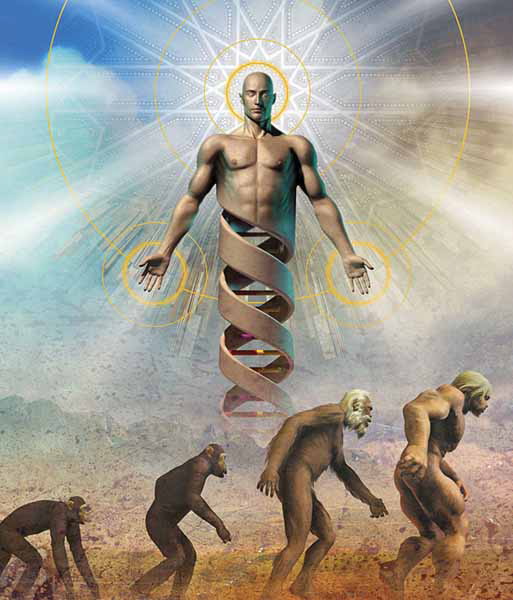
Metalogue: The Evolution of Mind, Consciousness, and the Web

Tags

(this is my final paper for cybernetics class and for graduate school. it is a theoretical metalogue between myself and gregory bateson. many of his phrases and passages are pulled directly from the book Steps To An Ecology of Mind)

vm: i want to understand the ecology of mind, how it works. I want to understand how technology is accelerating intentional evolution, and what the Web is becoming… a collective intelligence? a global mind? a path to destruction? How do you propose i begin?

gb: You certainly are full of questions.

vm: Yeah, it’s a curse. I’m insatiable.

gb: Perhaps, but an exploration of mind and self is a worthy endeavor. To begin, we might say that in creative art man must experience himself – his total self – as a cybernetic model.

vm: Please explain.

gb: We are complex, self-corrective systems. As a simplified example, take a steam engine. It is simply a circular train of causal events, regulating itself to maintain some type of status quo. It is the same principle for processes of civilization, or human behavior, human organization, or any biological system. We check for irregularities, and correct against internal disturbance… keeping the system in balance. Continue reading

Let’s Share A Mixtape

Tags

Hi!

Tonight I tweeted “i am compelled to make you a mixtape.”

i got a response from @Twilliamson15 suggesting we make this a community sharing event.

Sounds fantastic.

So here’s the deal:

Use your preferred music sharing service (I’ll be using Grooveshark) to make a playlist of music worth sharing.

What’s “worth” mean?

Whatever you think. Something that moves you, inspires you, saddens you, keeps you company during your workout, calms you, energizes you. Bring it.

Post the link to your playlist either in the comments section of this post, or on Twitter with hashtag #mixtape and I’ll pick it up.

We’ll take entries until next Wednesday November 24th, then compile our playlists for your listening pleasure here in time for Thanksgiving the 25th.

Looking forward to hear your favorites!

– v

check out @Twilliamson15 post – “PLN Mixchange”  http://thetechnorateteacher.wordpress.com/2010/11/17/pln-mixchange/


If Groupon Flipped Their Model, Could It Unleash the Power of Networks?

Tags

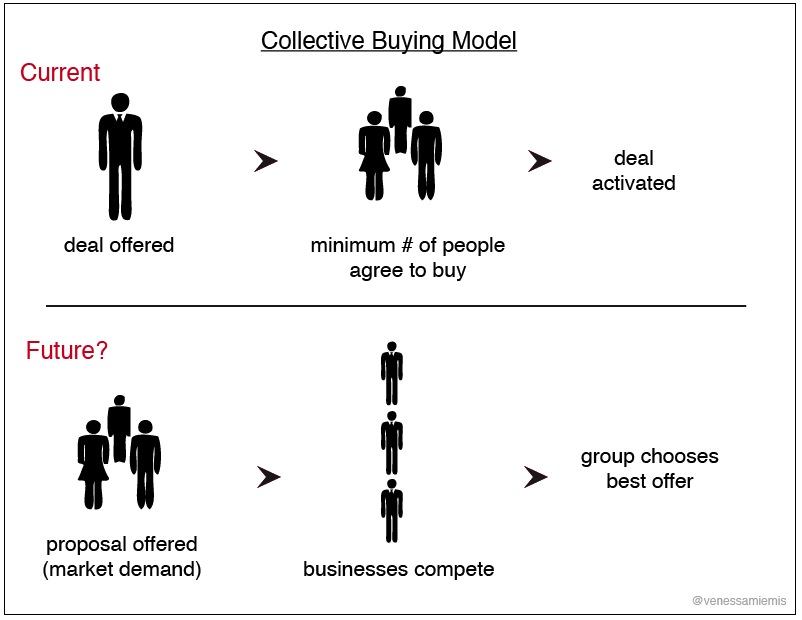
As I’ve been working on the supplemental infographic for the Future of Money project, I noticed that all of the interesting new sites and ideas for value exchange are essentially types of marketplaces. There are peer to peer marketplaces now for gifting, sharing, bartering, trading, renting, lending, and investing. Most are operating on the level of exchange between individuals, but very few at the group level. (spider sense tingling: opportunity?) Continue reading

Rant: Reflections from #Sibos & What I Want From A Bank

Tags

Ahhhhh! They're all Smiths!

After spending a month in Europe co-producing the Future of Money video in Berlin and then presenting it at Sibos in Amsterdam, I have finally returned home to New York to catch my breath and reflect on what just happened.

The week at Sibos was both enlightening and discouraging. Being surrounded by thousands of similarly outfitted bankers was surreal, and Matrix-like. The video we presented during Monday morning’s keynote was intended to plant a seed about what is going on, to provoke them, to inspire them. The feedback I received afterwards was mostly positive, but the message seems to have mostly gone over their heads.

The problem isn’t just that we are speaking different languages, but that we live in different worlds. Continue reading

Web Premiere of Future of Money video; Now where do we go from here?

Tags

, ,

What are young adults thinking about money and value? How can we create new systems of wealth generation and abundance? What does the future hold for banks and other financial institutions in the wake of massive peer to peer exchange?

“The Future of Money” begins a conversation on these topics and invites your participation (twitter hashtag #futureofmoney)
We did it! Thank you to everyone who has been a part of this process over the past few months!

I presented this video to a room full of bankers (200+, standing room only!) as part of my keynote on Monday, 25 October 2010, at the SIBOS Conference in Amsterdam. Though I don’t think most of them “got it,” the seed has been planted. And apparently someone found my talk compelling enough to quote me in an article on finextra.com! yay! (Sibos kicks off with call for innovation).

It will be interesting to see if we whetted their appetite enough that Swift or another organization might want to provide funding for us to take the project further. Perhaps we could roll out a whole video series that dives deeper into what is really going on with peer to peer exchange, the emergence of complimentary currencies, and the social movements that are fueling this (wealth generating commons, open innovation, coworking and open design spaces, sharing, cooperatives, collaboration, data transparency, social networks, mobility, etc).

In all, I’m so pleased with this experience and the energy and activity supporting it. We crowdfunded over $5,700 over on emergence.cc, and donations are still rolling in! Pretty amazing, and resonant with a comment Linus Olsson of Flattr makes in the video, describing the new way people are thinking about micropayments and the funding of an individual’s creative process –

It’s not a question that you pay for what you already got. You actually pay for what you will get… the things that can be made because you paid.

Please pass the video around, and let’s keep the conversation going. In just 2 days since we posted it online, it’s received over 4,000 views! Share, embed, spread! A Future of Money page has also been started on Facebook, and the #futureofmoney hashtag is alive and well on Twitter. 🙂

I’d love any feedback on the video from you, or any suggestions as to where we go from here. As you know, we will also be creating an infographic as the final part of this particular project, so stay on the lookout for its release in the next few weeks!

Below is the transcript of my talk – it’s quite brief because I only had 15 minutes total, and the video took up half that time. I’ve also listed all the people who appear in the video, along with links to their initiatives/projects.

Thanks again to all!

——————–

“I’m going to talk to you about the changes that are taking place in the way my generation is redefining money and value and wealth. To help convey this message, I spent the past three weeks co-producing a video with a creative studio in Berlin, especially for this event. Just using webcams and Skype, we interviewed people from around the world – from Thailand, Sweden, Germany, the UK, the US, Mexico – all of whom are involved with initiatives that enable new forms of peer to peer value exchange. So, without further explanation, here is the world premiere of The Future of Money.

(video played)

I hope you found that both though provoking and entertaining. There was a lot of information there, so if I had to distill it down into one main concept, one takeaway, it’s this:

There is a class of young, intelligent, creative people who are disillusioned with the debt-based monetary system, and are busy building the infrastructures for a commons-based economy, which is emerging, right now, in parallel to what currently exists. The foundation of this economy is built on trust… and transparency…. and the ability of distributed networks to self organize. And using the Web as a grounds for experimentation, we’re learning more effective ways to link unmet needs with unused resources, innovate, generate wealth, and build resilient communities.

This is the prototype of the future. This is where the opportunities are.

I hope that during the Innotribe sessions the remainder of the week, we can explore ways to create bridges between these two worlds and ways of thinking, and co-evolve the next global economy.”

__________

Future of Money Interviewees:

Featuring (in order of appearance):
Edward Harran, Attention Philanthropist
Caroline Woolard, Our Goods
Alan Rosenblith, Director, The Money Fix
Hans Schoenburg, Founder, GiftFlow
Ashni Mohnot, Founder, Enzi
Linus Olsson, Founder, Flattr
Jerry Michalski, Founder, Relationship Economy Expedition
Georg Zoche, Founder, Transnational Republic
Fernanda Ibarra, Advocate, Metacurrency Project
Jessica Harris, One Blue Dot Share Networks
Michel Bauwens, Founder, P2P Foundation
Douglas Rushkoff, Author, Program or be Programmed
Documenting the Open Innovation Process

Tags

How can the open innovation process be made more transparent? How can information be more shareable and useable for others? How easy can we make it to modify, reshape, and build upon experimental frameworks and prototypes?

We’ve been asking ourselves these questions as we create the videoblogs documenting the Future of Money project. The episode above shows us reflecting a bit about the interviews we conducted, answering a few questions that were posed on Twitter, and enjoying the free time we were able to squeeze in here and there.

We plan to get into more specifics in upcoming episodes, but would love your feedback in the meantime. How could this collaborative storytelling project be improved? What parts of the process do you want to know more about? Let us know!

Investing in the Process, Not Just the Product

Tags

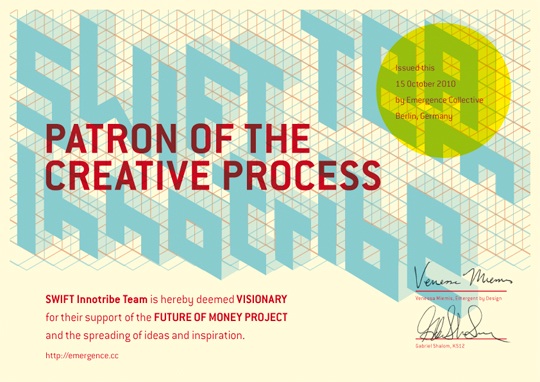
Now that the whirlwind week of interviews for the Future of Money project has come to a close, we’ve been able to turn our focus to the layout and design of the personalized Open Innovation Certificate. (We’re creating these for everyone who donates $100 or more.) Thanks to the work of Patrizia Kommerell, our graphic designer, we think we’ve gotten a pretty spiffy result.

As we discussed what the text should read, it felt important to use language that went deeper than just a buzzword like “open innovation,” and instead try to convey something with thicker meaning. As you can see from the image above, we chose to title it “Patron of the Creative Process.”

This notion came to mind as I’ve thought about the way this whole project is being crowdfunded, and the realization that you’re investing in the process as much as the product. When we initially talked about fundraising, we considered using Kickstarter. With that service, you specify a fundraising goal and a timeframe to raise the money, and people pledge their potential donations. If the fundraising goal is met, the donations are processed. If it’s not, no donations are accepted. While this model works well, the constraints don’t quite fit with what we’re doing. We chose to take a leap of faith, and made a commitment to create this video regardless of if we make a dime or not. We’re just doing it.

Amazingly, despite this fact, we’ve already received almost $4,000.

Of course, that’s led me to ask myself – Why?

When it comes down to it, we want to participate in the process of creation.

It feels good to be part of something bigger than ourselves! Though I took the initiative to start this project, I’m only a small part of it in the scheme of things. The momentum is building because others have gotten involved – amplifying the messages on twitter, commenting on our blogs, connecting us to interesting people to interview, and contributing through donations. Though there will be value in the final product, I feel that the wealth is being generated now as the people who care about this topic come together, exchange information and ideas, and build relationships.

And secondly, the process itself is the innovation. The fact that I’m sitting in a studio right now in Berlin writing this, after having conducted a week of interviews with people on multiple continents via webcam over Skype, to be pulled together in less than two weeks into a video that will be presented at a financial conference in Amsterdam – is all pretty incredible. We’re doing our best to videoblog, update, and document everything we’re up to, in hopes that others will build upon this prototype.

That said, thanks for investing in our process, our talents, and our potential to inspire.

We’ll keep planting seeds and spreading memes! 😉

you can follow the future of money project at emergence.cc

Update: Second Round of Interviewees for Future of Money Project

Tags

Thanks to your support we reached over $3800 in contributions this week! We’re very excited about the possibility of reaching our first fundraising goal of $5000. In the meantime we’ve been too busy conducting video interviews to videoblog ourselves. Rest assured more videoblog updates will be on their way in the coming days. Here’s the list of our second round of interviewees:

Edward Harran is an attention philanthropist and former Palomar5 resident. He helps people spread, seed and share awesomeness. He’s currently experimenting with a micropatronage investment model to enable him to continue exploring a digitally (k)nomadic lifestyle.

Jessica Harris is the founder of Time Interchange New York and Co-Founder of One Blue Dot Share Networks, a platform where users can use their online social networks to to share skills, resources and goods and create their own complimentary currency.

Zaq Mosher is an abundance advocate and member of the MotiveSpace Coalition in Portland, a nonprofit community group researching models for sustainable property development.

Linus Olsson is the co-founder of Flattr, the world’s first social micro-payment system. He is also a web designer, photographer, coder, and a media producer with a dislike for copyright.

Stan Stalnaker is the founder and creative director of Hub Culture Ltd., a social network that merges online and physical world environments which uses Ven, a digital social currency priced in real time against a basket of currencies, commodities and carbon futures.

Caroline Woolard is co-founder of OurGoods, a barter network for cultural producers to exchange skills, space, labor and art objects. OurGoods manifests itself in Trade School, a non-traditional learning environment where students barter for instruction.

Georg Zoche is a lightweight aircraft diesel engine design engineer. Since 1996 he has explored the topic of “Global Governance”, resulting in a grassroots movement to establish a system of democratic representation within globalisation: The United Transnational Republics. Today, the “First Transnational Republic” has about 5000 citizens from over 100 nations.

The Rise of Collaborative Consumption

Tags

A few weeks ago, I got a copy of Rachel Botsman’s new book, What’s Mine is Yours: The Rise of Collaborative Consumption.

The general theme of the book is that we’re shifting away from a society of hyper-consumption and equating personal self-worth with amount of material good accumulated, and instead to a world where our ability to access and exchange resources, develop a reputation, and build community and social capital takes precedence in how we choose to express who we are and what we choose to define us.

The authors give hundreds of examples of how people are finding new ways to share and exchange value – what they call “collaborative consumption” – using social lending platforms (Zopa, LendingClub, Prosper), open barter networks (ITEX, Bartercard), peer-to-peer coworking and currencies (Hub Culture), reuse networks (Freecycle), car sharing (ZipCar, GoGet), bike sharing (BIXI), swap trading (SwapTree), and peer to peer rentals for plots of land (Landshare, a room for the night (Airbnb), or any other item you could imagine (Zilok).

The list goes on, and the book is packed with some pretty interesting statistics (for instance, did you know that bike sharing is the fastest-growing form of transportation in the world, or that peer-to-peer social lending is set to grow to $5 billion by 2013?). All the examples are broken down in three main categories of collaborative consumption: product service systems, redistribution markets, and collaborative lifestyles – which highlights that there are numerous ways that consumption is being redefined. Continue reading

Interview Themes: Sneak Peek

Tags

October has come quickly, and I will be leaving for Berlin tomorrow to begin production for the Future of Money project together with Gabriel, Patrizia and Jay! The creation of the video will be an evolving process – the narrative and flow will unfold as we conduct interviews and brainstorm visions of the future. We’d like to share some of the themes that have manifested over the course of our research, so you can get an idea of the direction we’re heading and stay up to date on our process. Specific questions will be tailored for each interviewee, but here’s a brief sampling of some overarching themes we plan to cover:

  • new forms of peer to peer value exchange
  • radical transparency and the networked self
  • digital nomadism and the challenge of an aging agile generation
  • balance between personal empowerment and collective good
  • hyper-efficient resource management and allocation
  • rising value of virtual goods and currencies
  • contemporary definitions of wealth

Have anything to add? Please post any themes or questions you’d like to see addressed in the film in the comments section below or on Twitter using the hashtag #futureofmoney.

To learn more about the project, or contribute to the cause, click here!

Thanks to everyone for your donations – we’ve raised almost $2,000 to date!