• about
  • projects
    • Beach Loft Interior Design
    • Contact Conference
    • Emerging Leader Labs
    • Junto
    • Open Foresight
    • The Future of Money
      • future of money, cont.
    • The Future of Facebook

emergent by design

Monthly Archives: December 2010

Humanity’s Next God: You?

31 Friday Dec 2010

Posted by Venessa Miemis in Uncategorized

≈ 40 Comments

Tags

social evolution

In a recent article in The Economist, futurist Paul Saffo claims humanity’s overdue for a new god. He points out that throughout history, great new religions took shape during times characterized by uncertainty and social unrest, combined with an ability to spread compelling new ideas and world views virally.

And here we are today, he says, equipped with the Web as our communication channel, and a cultural climate bubbling with that same potential for something new to emerge. The article ends there, with only an image of worshippers gathered around an iPad to suggest where we might be placing our faith next.

It was just a prompt, but it’s made me wonder.. is this where we’re headed? Will the next “great” mythology be a story about how technology is going to save us? And can we do better?

If a new zeitgeist were to capture the minds of billions, what might it look like?

Externalizing our saviors, whether in personified gods or computerized devices, is a convenient way to bring us hope when we feel powerless or misdirected, but it can also relieve us of the burden of taking responsibility for our actions or inactions.

Perhaps it’s time to advance our collective story.

We continue to grow more connected, more informed, more intelligent, and more dangerous. Many are aware that the fictions being thrown around about how the world works are just that – fictions. Things are not working all that optimally, and that reality is only thinly veiled. We see the shift underway – with some trying to reveal “truth” by making information free, allowing open communication across borders, and giving people the tools to decide for themselves what’s what and how they want to live and participate. Opposing that effort, as has always been the case, are the ones terrified to lose control.

But how much longer can we continue this charade? It’s clear that our environments and economies are interwoven. We impact each other more and more every day, and our commonalities become apparent just as quickly as our differences. We must be nearing a tipping point.

Can we find a common ground? Can we put the games aside and be honest about things, perhaps agree upon some baseline for sustainability and thrivability on the planet? Can we wake up to our own potential to change the way things are and shape the way they can become?

Or or ideologies too entrenched? Are those in power too enchanted by their own stories to even attempt a reality that could be better for us all?

And while we watch those bigger forces biding time and maintaining illusions, we are given the option to become the change agents – to influence, inspire, and lead ourselves into a brighter future.

Will we act?

Or just pray?

Infographic: New Lenses of Wealth

27 Monday Dec 2010

Posted by Venessa Miemis in Uncategorized

≈ 10 Comments

Tags

projects

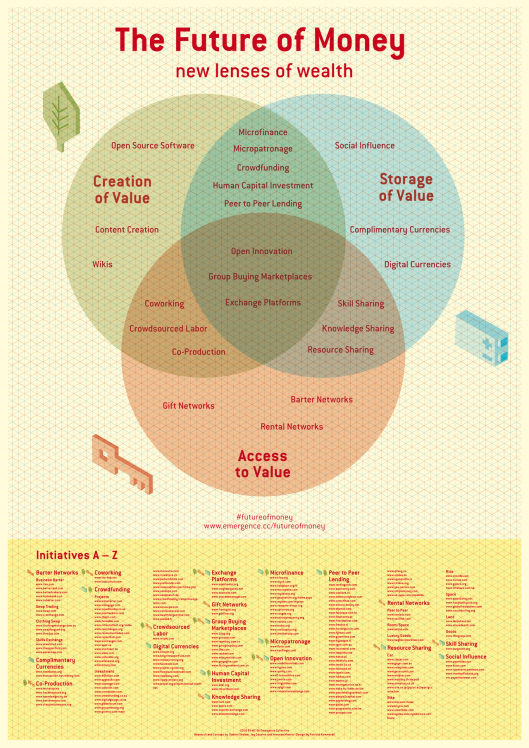
The infographic summarizing our research for The Future of Money project is now complete! Thanks to Patrizia Kommerell for the design work, and Gabriel Shalom & Jay Cousins for concept work. You can check out Pati’s post and download the infographic in A1 or A4 size PDF over at emergence.cc.

Crowdfunding 101: 5 Questions to Consider

23 Thursday Dec 2010

Posted by Venessa Miemis in Uncategorized

≈ 8 Comments

Tags

money + currency

Now that the Future of Money project has come to a close, I wanted to do a brief wrap-up post/case study about the process and our crowdfunding efforts.

Though we’d never tried it before, we managed to receive almost $6,000 in donations in about 6 weeks, and went on to get some pretty impressive media coverage. So, here’s a few questions to consider when structuring a crowdfunding campaign, and a few reflections about what I’ll do differently the next time around. Continue reading →

3 Tools for Futures Thinking & Foresight Development

08 Wednesday Dec 2010

Posted by Venessa Miemis in Uncategorized

≈ 32 Comments

Tags

futures

(followup to When Futures Thinking Meets Design Thinking post)
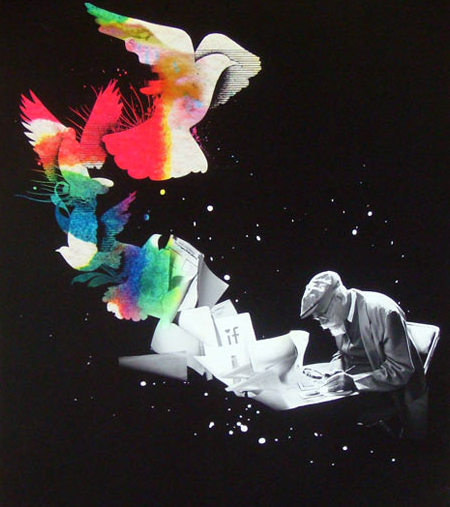
The last post outlined a general framework for “futures thinking.” Here, we look at three techniques for honing your ability to see beyond the horizon.

1. Trend Analysis

In order to develop the capacity for imagining alternative futures and create design solutions accordingly, it is useful to be aware of the current driving forces and megatrends underway. The “STEEP” categories [Social, Technological, Environmental, Economic, Political] give us the mental framework for understanding the complex web of change around us, and can also be further broken down into subcategories for refinement. For example, “Social” could be viewed at the more granular levels of culture, organization, and personal.

Once a trend is identified, both its causes and impacts can be considered. For instance, a rise in life expectancy might be caused by rising living standards, better medical treatments, and healthier environments. The corresponding impacts of this trend may be that a longer portion of a person’s life is spent in retirement, and so there will be an increasing demand in goods and services for the elderly and perhaps a bigger financial strain on families to care for aging parents or grandparents. What types of environments should be designed in order to accommodate these changes?

Another example is the increasing amount of “leisure time” people are now facing. Technological automation has made human involvement in many processes unnecessary, and global economic recession has left many unemployed. If these trends continue, what types of structures must be designed in order to redirect the wasted productivity and surplus mental power that is currently sitting idle? When thinking about the world at this scale, the “big picture” pops out and we can begin to think about design in terms of strategic preparation for our future.

2. Visioning

Clarifying a vision is one of the most powerful mechanisms for engaging a team, organization or community and getting them excited to push forward into new territory. A successfully designed product or service should intentionally impact the thoughts and behaviors of society and culture, and serve as an example of the mindset and values of its creators. So, what does this future humanity look like? Creating that clear vision is a precursor to planning, and a key to creating the conditions to mobilize a group of collaborators around a common goal.

There is a nice guideline in the book Futuring that breaks down this process of “Preferred Futuring” into these eight tasks:

1. Review the organization’s common history to create a shared appreciation.
2. Identify what’s working and what’s not. Brainstorm and list “prouds” and “sorries.”
3. Identify underlying values and beliefs, and discuss which ones to keep and which to abandon.
4. Identify relevant events, developments, and trends that may have an impact on moving to a preferred future.
5. Create a preferred future vision that is clear, detailed, and commonly understood. All participants, or at least a critical mass, should feel a sense of investment or ownership in the vision.
6. Translate future visions into action goals.
7. Plan for action: Build in specific planned steps with accountabilities identified.
8. Create a structure for implementing the plan, with midcourse corrections, celebrations, and publicizing of successes.

Ultimately, it’s not about creating MY vision, but about creating a SHARED vision. As responsible, forward thinking humans, we all want to create a better future. But what does it look like? Have we defined it? Have we described it? Who are we within it? What does interaction look like? If our idea gained mass adoption, what would that mean? What does that world look like?

If we can see it, we can build it.
3. Scenario Development

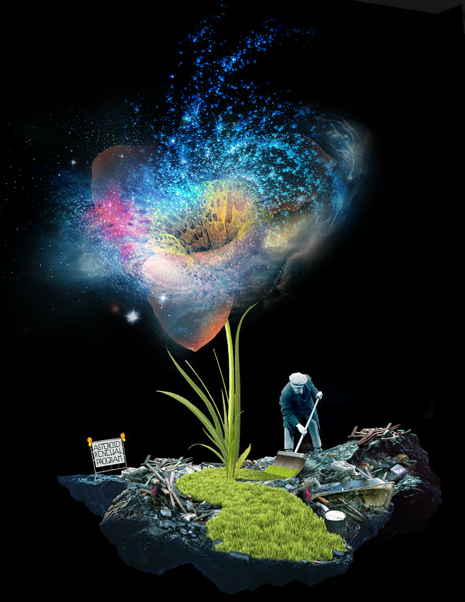
As an extension of visioning, scenario development is where the power of narrative comes in. Throughout human history, we are defined by the stories we tell each other and ourselves. We create meaning and understanding by the way we remember our stories, like personal cargo that we carry in our minds. Our surroundings, natural or designed, are artifacts and objects within those stories. When thinking about the future, whether it’s the future of society, the organization, or the self, developing a series of scenarios allows us to objectively deal with uncertainty and imagine plausible costs and benefits to various actions and their consequences. It is often suggested to create a minimum of three scenarios when considering future events or situations by identifying futures that are possible, probable, and preferable. Here’s a suggested five sample scenario from the Futuring book:

1. A Surprise-Free Scenario: Things will continue much as they are now. They won’t become substantially better or worse.
2. An Optimistic Scenario: Things will go considerably better than in the recent past.
3. A Pessimistic Scenario: Something will go considerably worse than in the past.
4. A Disaster Scenario: Things will go terribly wrong, and our situation will be far worse than anything we have previously experienced.
5. A Transformation Scenario: Something spectacularly marvelous happens – something we never dared to expect.

Once the stories has been written that describes what each of these scenarios looks like, the conversation can begin. What is the likelihood of each of these? What is the desirability? What are the correlating values of the people? And most importantly, what actions can be taken today to steer the ship and design towards or away from the various scenarios?

Two common methods for determining a potential course of action are forecasting and backcasting. While forecasting starts in the present and projects forward into the future, backcasting starts with a future goal or event and works it’s way back to the present. In this method, the sequence of events or steps that led to that goal are imagined and defined, so that a roadmap to that desirable future is created. In either case, the scenarios generated serve to illuminate pathways to action.

–

Further Reading:

Futuring: The Exploration of the Future

Foundations of Futures Studies

The Art of the Long View

Thinking About the Future: Guidelines for Strategic Foresight

The Universal Traveler: A Guide to Creativity, Problem Solving & the Process of Reaching Goals

–

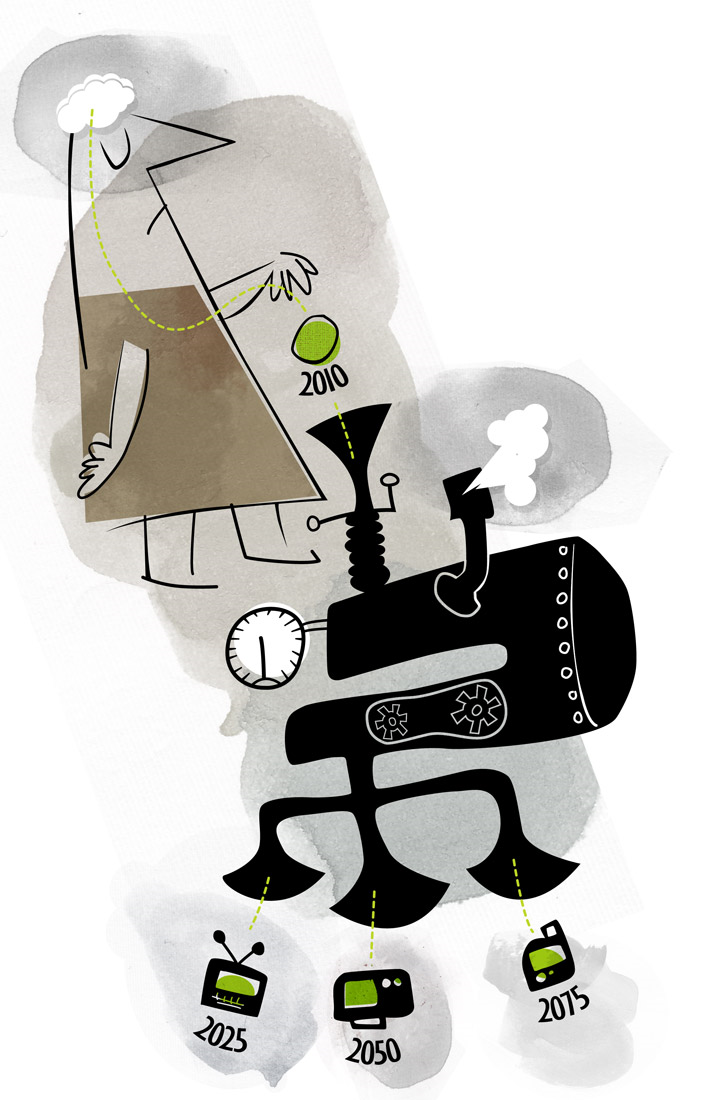
imagery found at Imaginary Foundation

When Futures Thinking Meets Design Thinking

06 Monday Dec 2010

Posted by Venessa Miemis in Uncategorized

≈ 14 Comments

Tags

Design

(this post was originally featured on core77)


image by erica glasier


The business world has been quick to try and implement design thinking in hopes of stimulating sweeping organizational change and innovation, only to abandon it and return to old practices when it doesn’t “work.” Is design thinking nothing more than a poorly defined gimmick, or are people just missing the big picture?

Perhaps a part of the problem is that design thinking is more than just a set of tactics to be carried out, but rather a new ecology of mind. While grounded in business-minded rationality and operating within a defined set of constraints, it also contains an emotional/intuitive component that is often lost upon the more traditional thinkers. What this aspect requires is a capacity for switching between multiple perspectives and the ability to understand the world and our relationship to it, and within it, in a different way. Though there are many methods than can help develop this skill, I’d like to discuss an approach that may be unfamiliar to some: Futures Thinking. Continue reading →

Creative Entrepreneurship: Day 5 (the dark side)

04 Saturday Dec 2010

Posted by Venessa Miemis in Uncategorized

≈ 11 Comments

Tags

creativity

final day of creative entrepreneurship retreat; click for day 1, day 2, day 3, and day 4)

Continue reading →

Creative Entrepreneurship: Day 4 (Opportunity Exploration)

03 Friday Dec 2010

Posted by Venessa Miemis in Uncategorized

≈ 4 Comments

Tags

Design

(documenting creative entrepreneurship retreat. so far: day 1, day 2, day 3)

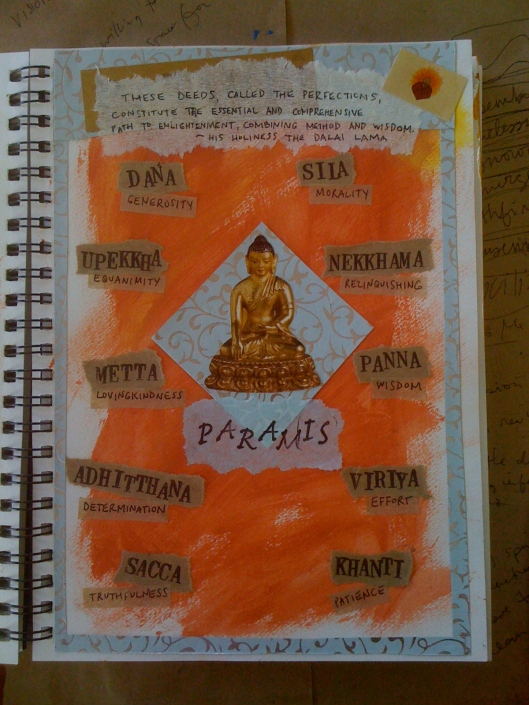
Day 4 was great. (well, they’ve all been great). But there is definitely a lot going on subconsciously during this whole process, and it’s been amazing to see what ends up on the journal pages while we think we’re just playing. Been having some good ‘a ha’ moments. Continue reading →

Creative Entrepreneurship: Day 3

02 Thursday Dec 2010

Posted by Venessa Miemis in Uncategorized

≈ 3 Comments

Tags

workshop

(documenting creative entrepreneurship retreat; click to view day 1 & day 2)

Today will be a double post day, since I didn’t get a chance to post last night. Yesterday was surprisingly calm and peaceful after Tuesday’s day of anxiety. It gave me a bit of a personal insight when I realized I waste a lot of energy being apprehensive about things that are not nearly as stressful in actuality as I build them up to be in my head. Anyway, I ended up spending yesterday mostly preparing pages in the journal for what comes next. Continue reading →

Creative Entrepreneurship: Day 2

01 Wednesday Dec 2010

Posted by Venessa Miemis in Uncategorized

≈ 18 Comments

Tags

creativity

(documenting creative entrepreneurship retreat. day 1 here.)

Day 2 is coming to a close, and it’s surprisingly been a day characterized by feelings of anxiety and being overwhelmed. Yesterday felt like creative playtime… but now I’m feeling like I need to get down to business and “do” something. Even though what I’m doing is the thing I’m supposed to be doing. Guh.

Comments are being kept brief from sheer mental exhaustion, but the work is all documented here via imagery. Continue reading →

abundance anti-rivalrous authority biohacking books cognitive enhancement collaboration commerce communication community consciousness consciousness & evolution consciousness hacking creativity creativity + design culture currency decor Design digital literacy ello entheogens ethics evolution flow futures innovation interview microdosing money money + currency neurohacker collective neurohacking neuroscience neurotech nootropics personal development philosophy projects psychedelics psychotherapy reputation Resources response-ability scarcity self smart drugs social evolution social innovation Social Media social organization society sovereignty style sustainability technology technology + society Trends Video vision willpower women Work workshop

Archives

Blog Stats

  • 1,122,514 hits

Enter your email address to subscribe to this blog and receive notifications of new posts by email.

Join 1,180 other subscribers

Top Posts

  • 13 Trend Maps & Visualizations of the Future
  • What it Means to Be A Neurohacker
  • Guidelines for Engaging in Generative Dialogue (a.k.a. The Conversation)
  • What is Design Thinking, Really?
  • A Step-by-Step Guide to Tribal Leadership: Part 1: The Five Stages of Tribal Culture

Recent Posts

  • What it Means to Be A Neurohacker
  • Using Psychedelics to Increase Performance and Reprogram the Mind/Brain Interface
  • Why the World Needs Neurohacking Now
  • The Neurohacker’s Toolbox: Nootropics
  • What is Neurohacking?
  • when the mind hijacks my flow state
  • what mental slavery looks like: repressive & reactive patterns
  • Constructing the New Narrative
  • i am a consciousness with a society of personalities
  • on the forcing of willpower & the art of relaxation

@venessamiemis

Tweets by venessamiemis

Emergent by Design

Emergent by Design

Recent Comments

Venessa Miemis's avatarVenessa Miemis on Why the World Needs Neurohacki…
Monica Anderson's avatarMonica Anderson on Why the World Needs Neurohacki…
Venessa Miemis's avatarVenessa Miemis on The Neurohacker’s Toolbo…
bonnittaroy's avatarbonnittaroy on The Neurohacker’s Toolbo…
What is Neurohacking… on What is Neurohacking?
Creative Commons License
This work is licensed under a Creative Commons Attribution 3.0 Unported License.
  • RSS - Posts

Blog at WordPress.com.

  • Subscribe Subscribed
    • emergent by design
    • Join 1,180 other subscribers
    • Already have a WordPress.com account? Log in now.
    • emergent by design
    • Subscribe Subscribed
    • Sign up
    • Log in
    • Report this content
    • View site in Reader
    • Manage subscriptions
    • Collapse this bar
 

Loading Comments...