(followup to When Futures Thinking Meets Design Thinking post)
The last post outlined a general framework for “futures thinking.” Here, we look at three techniques for honing your ability to see beyond the horizon.
1. Trend Analysis
In order to develop the capacity for imagining alternative futures and create design solutions accordingly, it is useful to be aware of the current driving forces and megatrends underway. The “STEEP” categories [Social, Technological, Environmental, Economic, Political] give us the mental framework for understanding the complex web of change around us, and can also be further broken down into subcategories for refinement. For example, “Social” could be viewed at the more granular levels of culture, organization, and personal.
Once a trend is identified, both its causes and impacts can be considered. For instance, a rise in life expectancy might be caused by rising living standards, better medical treatments, and healthier environments. The corresponding impacts of this trend may be that a longer portion of a person’s life is spent in retirement, and so there will be an increasing demand in goods and services for the elderly and perhaps a bigger financial strain on families to care for aging parents or grandparents. What types of environments should be designed in order to accommodate these changes?
Another example is the increasing amount of “leisure time” people are now facing. Technological automation has made human involvement in many processes unnecessary, and global economic recession has left many unemployed. If these trends continue, what types of structures must be designed in order to redirect the wasted productivity and surplus mental power that is currently sitting idle? When thinking about the world at this scale, the “big picture” pops out and we can begin to think about design in terms of strategic preparation for our future.
2. Visioning
Clarifying a vision is one of the most powerful mechanisms for engaging a team, organization or community and getting them excited to push forward into new territory. A successfully designed product or service should intentionally impact the thoughts and behaviors of society and culture, and serve as an example of the mindset and values of its creators. So, what does this future humanity look like? Creating that clear vision is a precursor to planning, and a key to creating the conditions to mobilize a group of collaborators around a common goal.
There is a nice guideline in the book Futuring that breaks down this process of “Preferred Futuring” into these eight tasks:
1. Review the organization’s common history to create a shared appreciation.
2. Identify what’s working and what’s not. Brainstorm and list “prouds” and “sorries.”
3. Identify underlying values and beliefs, and discuss which ones to keep and which to abandon.
4. Identify relevant events, developments, and trends that may have an impact on moving to a preferred future.
5. Create a preferred future vision that is clear, detailed, and commonly understood. All participants, or at least a critical mass, should feel a sense of investment or ownership in the vision.
6. Translate future visions into action goals.
7. Plan for action: Build in specific planned steps with accountabilities identified.
8. Create a structure for implementing the plan, with midcourse corrections, celebrations, and publicizing of successes.
Ultimately, it’s not about creating MY vision, but about creating a SHARED vision. As responsible, forward thinking humans, we all want to create a better future. But what does it look like? Have we defined it? Have we described it? Who are we within it? What does interaction look like? If our idea gained mass adoption, what would that mean? What does that world look like?
If we can see it, we can build it.
3. Scenario Development
As an extension of visioning, scenario development is where the power of narrative comes in. Throughout human history, we are defined by the stories we tell each other and ourselves. We create meaning and understanding by the way we remember our stories, like personal cargo that we carry in our minds. Our surroundings, natural or designed, are artifacts and objects within those stories. When thinking about the future, whether it’s the future of society, the organization, or the self, developing a series of scenarios allows us to objectively deal with uncertainty and imagine plausible costs and benefits to various actions and their consequences. It is often suggested to create a minimum of three scenarios when considering future events or situations by identifying futures that are possible, probable, and preferable. Here’s a suggested five sample scenario from the Futuring book:
1. A Surprise-Free Scenario: Things will continue much as they are now. They won’t become substantially better or worse.
2. An Optimistic Scenario: Things will go considerably better than in the recent past.
3. A Pessimistic Scenario: Something will go considerably worse than in the past.
4. A Disaster Scenario: Things will go terribly wrong, and our situation will be far worse than anything we have previously experienced.
5. A Transformation Scenario: Something spectacularly marvelous happens – something we never dared to expect.
Once the stories has been written that describes what each of these scenarios looks like, the conversation can begin. What is the likelihood of each of these? What is the desirability? What are the correlating values of the people? And most importantly, what actions can be taken today to steer the ship and design towards or away from the various scenarios?
Two common methods for determining a potential course of action are forecasting and backcasting. While forecasting starts in the present and projects forward into the future, backcasting starts with a future goal or event and works it’s way back to the present. In this method, the sequence of events or steps that led to that goal are imagined and defined, so that a roadmap to that desirable future is created. In either case, the scenarios generated serve to illuminate pathways to action.
–
Further Reading:
Futuring: The Exploration of the Future
Foundations of Futures Studies
The Art of the Long View
Thinking About the Future: Guidelines for Strategic Foresight
The Universal Traveler: A Guide to Creativity, Problem Solving & the Process of Reaching Goals
–
imagery found at Imaginary Foundation

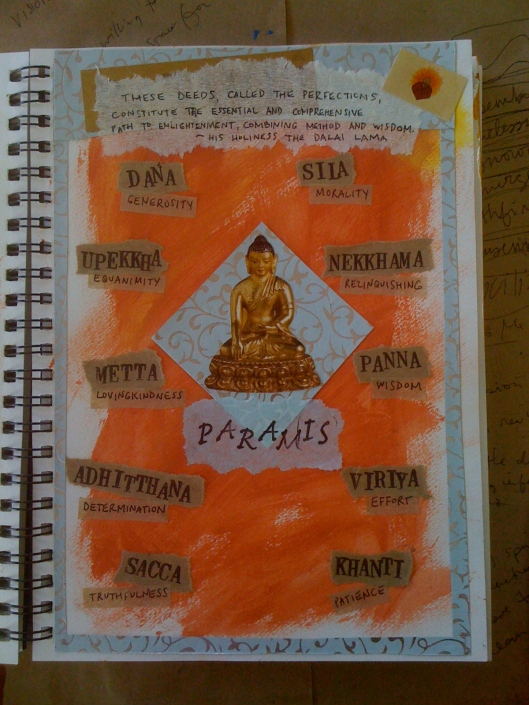

 Today kicks off day one of a creative entrepreneurship retreat I’m attending in Puerto Vallarta, Mexico. The fundamental question to be answered here is “What is the unique gift you can leverage that has a value in the marketplace people will pay for?” Great question, and the process of seeking the answers is even better. Instead of a dry, run of the mill business development course, this program uses visual journaling to help tap into the subconscious and embrace the creativity that so often lies dormant.
 emergent by design